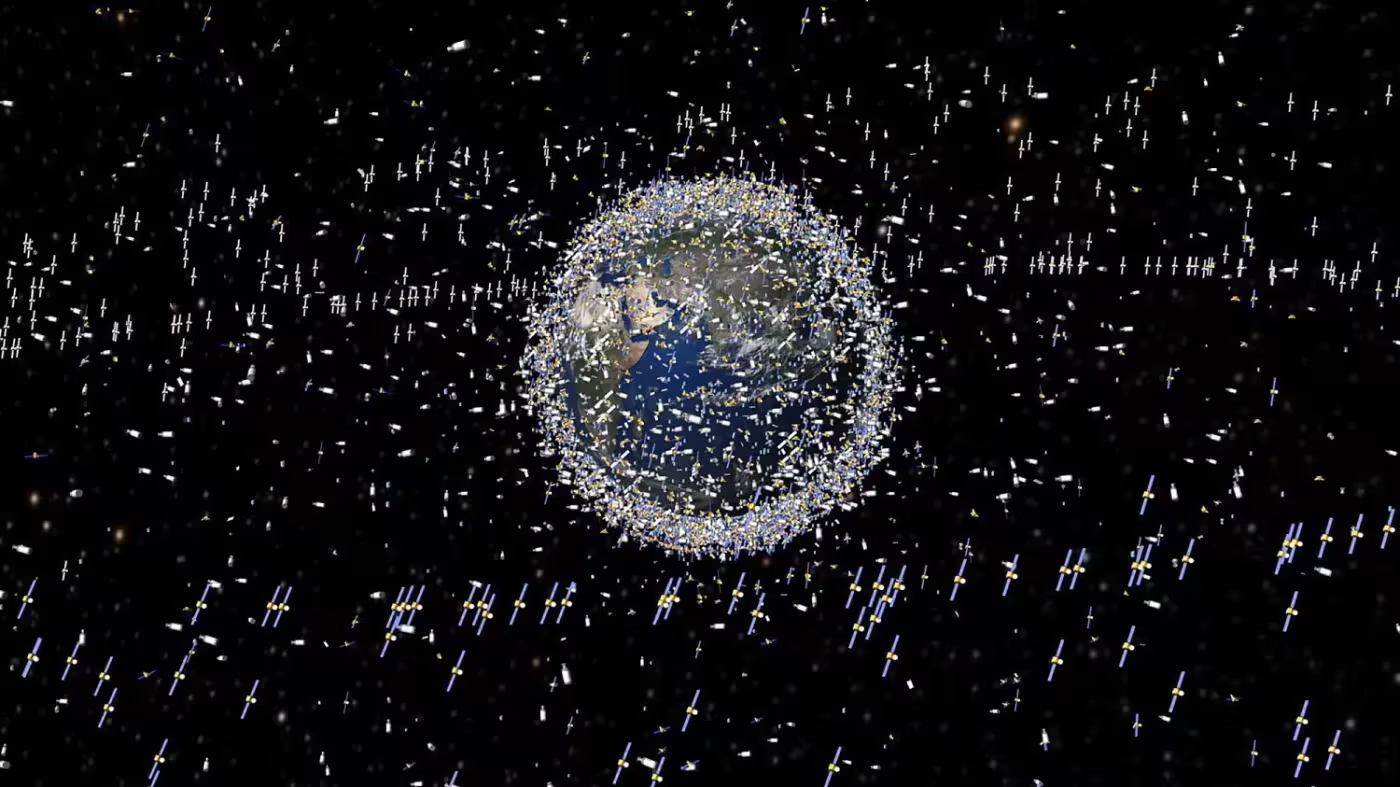
The mass deployment of satellites is brightening the night sky and complicating astronomers’ efforts to study distant galaxies, intensifying debates over who actually controls access to space. The sharp rise in launches, according to Nasa scientists, will degrade the quality of images captured by major orbital observatories, including the Hubble telescope. Their findings stress that the absence of coordinated international rules threatens essential astrophysical measurements both from Earth and from orbit. Emerging satellite constellations reflect light that distorts telescope images.
“All types of telescopes are recording a troubling increase in satellite streaks,” said Nasa researcher Alejandro Serrano Borlaff, one of the authors of the paper published in Nature on Wednesday. He added that “[our] projection should be viewed as a worst-case scenario and a cautionary warning for the scientific community.”
The number of satellites in orbit is soaring as governments and companies—including Elon Musk’s Starlink—build their own constellations to meet rising demand for wireless connectivity. The trend is fuelled by cheaper manufacturing and the growing value of the data collected by satellites.
Scientists assessed the consequences of the rapid expansion in satellite numbers, which are expected to rise sharply from today’s roughly 15 000. According to calculations by the European Space Agency, by 2030 there could be around 100 000 satellites in orbit. Nasa researchers note that by the late 2030s the total could exceed 500 000 if all applications filed with the US Federal Communications Commission result in actual launches.
The researchers modelled the impact of satellites on four space telescopes operating or planned for low Earth orbits between 400 and 800 km: Nasa’s Hubble and SPHEREx, the European Space Agency’s proposed ARRAKIHS, and China’s Xuntian. Their calculations show that with 560,000 satellites, about 39.6 percent of Hubble’s images would be compromised, while the share for the other three telescopes would exceed 96 percent. With 100,000 satellites, nearly 20 percent of Hubble’s images and more than 80 percent of those from the other instruments would be affected.
Jeff Grubb, senior physics lecturer at King’s College London, said the findings echo earlier studies indicating that the expansion of satellite constellations amounts to “blatant vandalism of cutting-edge astronomical research.” Noelia Noel, senior lecturer in astrophysics at the University of Surrey, called the results “alarming” and noted that they touch all domains—from galaxies and stars to dark matter. She stressed that “satellite streaks are not just unsightly lines.” According to Noel, who leads an experiment to reduce satellite light pollution using non-reflective coatings, “they add noise, scattered light and saturation that can completely drown out the faint signals that matter most to us.”
The problem of light pollution is closely tied to the broader question of how state and commercial activities in space should be regulated. Scientists acknowledge the possibility of placing satellites in orbits below those used by telescopes, though they admit such a strategy could release substances that damage Earth’s ozone layer.
Yet any potential solution comes with its own costs, noted David Clements, associate professor of astrophysics at Imperial College London. Options include imposing a light-pollution levy on satellite operators or relying less on space-based internet in favour of wired terrestrial networks.
In his words, “we need to treat low Earth orbit as a commons for all humankind that requires genuine oversight and effective regulation, rather than a resource to be strip-mined for short-term corporate or nationalistic gain.”
As Robert Massey, deputy executive director of the UK’s Royal Astronomical Society, noted, scientists and several governments are already pushing for the UN to take up the issue of light pollution. “Governments and especially international organisations are being outpaced by the rate at which satellites are being launched,” he said. “If we want to preserve astronomy and prevent broader environmental harm, that needs to change.”