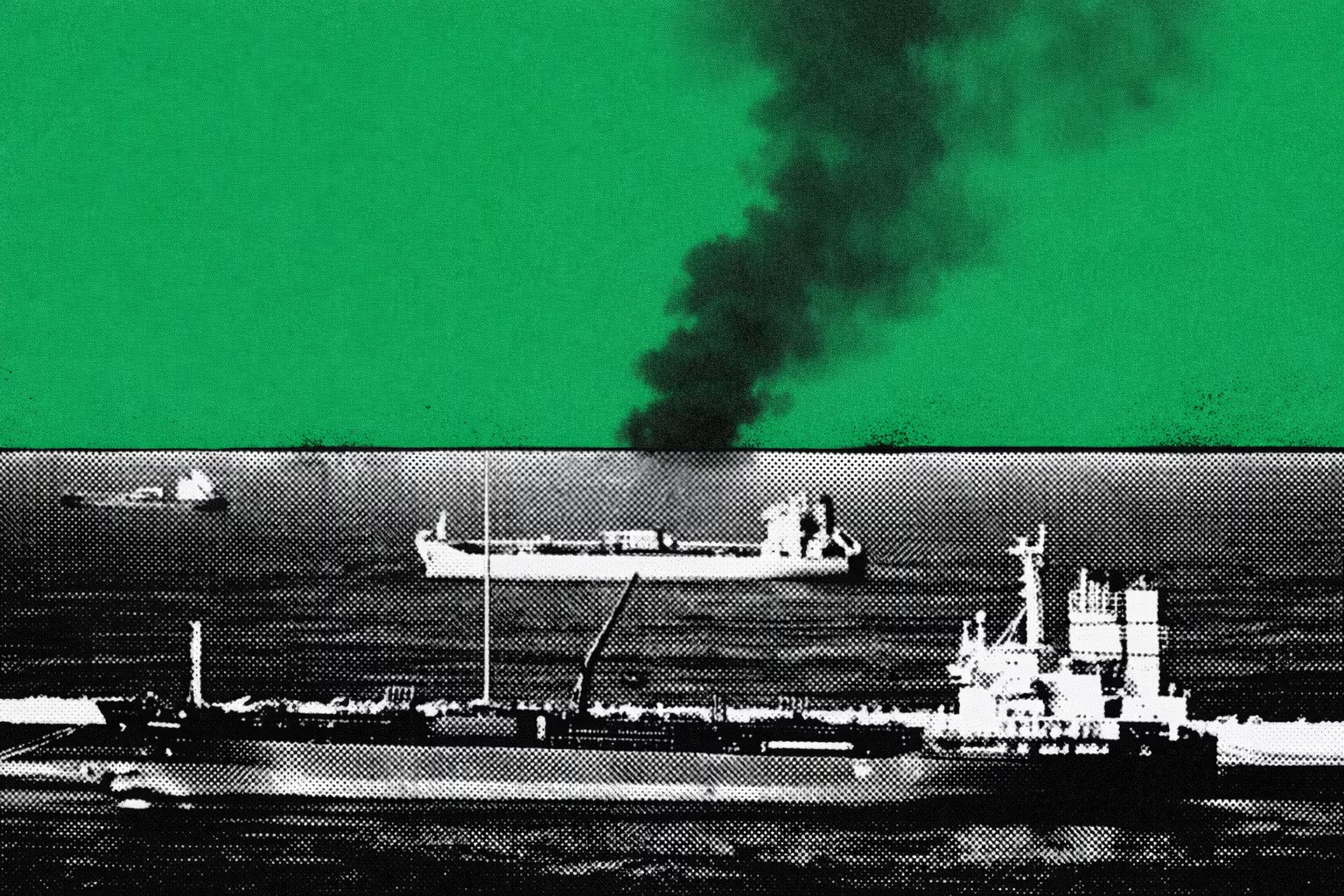
The rise in stock markets this week and the fall in oil prices amid a visible easing of tensions between the United States and Iran may have created the impression that the energy shock that rattled the global economy is quickly receding—along with the risk of recession.
Yet beneath that surface calm, a very different picture is taking shape. Disrupted supply chains and damaged infrastructure are deepening anxiety among those who produce, transport, and directly depend on energy. "People closest to the industry are far more concerned about these disruptions and understand how long it will take to return to normal—if that happens at all," said Jerry Morton, co-chair of the oil and gas practice at the law firm Baker Botts. "The farther you are from the actual process of producing oil, the less you seem to care about the physical realities and the problems they create."
Even investors seeking to capitalize on market optimism privately acknowledge that it masks deep structural risks capable of triggering a painful correction in the foreseeable future. "We know supply chains are breaking down in Asia and even in Europe," said Ritesh Jain, founder of the investment firm Pinetree Macro. "We understand that a correction is inevitable. But everyone prefers to live for today. People tell themselves: 'These problems will be solved. And if they are not—then we will sell.'"
"You have to dance while the music is playing and hope to be near the exit when it stops," he added. "That is exactly the position I am in myself, despite speaking with people who understand that something is bound to break."
The widening gap between market signals and conditions in the real economy is becoming an increasingly important force in global dynamics. While investors and the algorithms they rely on respond to headlines and hints of diplomatic progress, analysts warn that more troubling signs of what may unfold in the coming weeks and months are being ignored. Against that backdrop, several key economic institutions, including the International Energy Agency and officials at the International Monetary Fund, are warning that complacency is misplaced.
Europe could face a shortage of jet fuel within six weeks. Fertilizer prices have risen so sharply that they may continue to sustain higher food prices next year. There is a shortage of key components needed not only to make masks and toys, but every kind of plastic—which means any product packaged in plastic could become more expensive. Factories in countries such as Vietnam and Bangladesh, on which American corporations rely, are facing such a sharp increase in energy costs that they risk halting production altogether.
"Some countries may be richer than others," Fatih Birol, executive director of the International Energy Agency, told the Associated Press on Thursday. "Some may have more energy than others, but no country—not a single one—is protected from this crisis."
Stock market behavior, however, scarcely reflects that assessment. A number of analysts see parallels with the way markets reacted during the coronavirus pandemic. After a sharp fall, prices quickly rebounded, overlooking the long-term damage to supply chains and the inflationary risks created by their disruption. Then came a reckoning: as inventories were depleted, energy reserves drawn down, and state support scaled back, the consequences emerged in the form of painful financial shocks that spread across the world.
"People are fooling themselves if they think all of this will be resolved very quickly," said Emma Ashford, a senior fellow at the Stimson Center and author of Oil, the State, and War: The Foreign Policies of Petro-States. "It will not. At some point, reality will assert itself."
Participants in the oil industry are watching with bewilderment how lightly traders and investors are treating a global disruption that cannot be resolved in the near term—regardless of whatever diplomatic movement may occur in the coming days. Iran's announcement that shipping through the Strait of Hormuz would partially resume—a narrow passage through which about 20% of the world's oil and gas supplies pass—is seen by them as a limited step, not the breakthrough implied by falling futures. Tehran has made clear that ship passage will be selective and confined to certain routes, even as the strait itself remains mined.
"If you had told me three weeks ago that the futures price of oil would fall below $100, I would have called it a lie," said Neil Crosby, head of oil-market analytics at Sparta. "After Russia's invasion of Ukraine, prices reached $130 even though the supply risks were minimal. Now 20% of the world's oil is under threat, and futures are barely reacting. It is madness."
In his view, that erratic behavior is explained by the "fog of war": traders understand neither America's objectives nor its willingness to continue the conflict, and instead assume that President Donald Trump is looking for a way out. That uncertainty is forcing the firm's clients to act cautiously and cut their positions in the oil market. It is also reflected in the unprecedented gap between the price of oil for immediate delivery—in some regions it is above $140 a barrel—and the cost of deliveries several months out, which fell below $90 on Friday.
"At any moment during the day, Trump can post something on X, and the algorithms react to it immediately," Crosby said. "That makes the situation far more complicated."
Analysts say this sets off a chain reaction: falling futures prices trigger algorithms that push investors toward buying stocks, since cheaper energy theoretically boosts corporate profits. The risk is that all of this is unfolding against the backdrop of a vast unresolved energy crisis whose economic consequences have yet to fully appear. The further market prices drift from underlying reality, the greater the likelihood of a painful correction.
"There is a disconnect between what the markets look like and what is happening in the world," said Tibor Besedes, an economics professor at the Georgia Institute of Technology. "Markets are treating this as a temporary shock, whereas people in the oil industry are talking about long-term consequences. It is not as simple as turning on a tap and getting the oil flowing again. I do not understand why, every time there is news of a possible ceasefire, the markets respond this way. It is as though investors do not grasp that the war is still going on."
Energy infrastructure in key regions has already been damaged—in some cases severely. The main supply routes remain under threat, and the logistics of transporting oil and gas have been disrupted in ways that cannot be quickly repaired.
"You can move faster on a bicycle than a tanker can sail," Morton said. "It will take weeks, and possibly months, before tanker traffic returns to normal."
Restoring damaged facilities could take even longer. Industry figures know that production capacity in the Gulf states has suffered significant damage, though its full extent has yet to be assessed. Repairs will begin only after hostilities have fully ceased.
History, Morton said, has already provided similar examples. In 1990, Iraq set Kuwait's oil fields ablaze. After their liberation, many believed that "everything would quickly return to normal," but in practice the recovery took years.
Energy infrastructure, according to Amir Handjani, a board member at the Quincy Institute for Responsible Statecraft, resembles a coronary artery in the global economy. As long as it functions, few think about it—but when it falters, the consequences become systemic.
"We are already seeing extensive damage to energy infrastructure in the Gulf states," said Handjani, who is also a partner at the consulting firm KARV. "Markets assume they can lean on reserves while everything is being repaired. But what if hostilities resume and Iran launches new strikes on that infrastructure? Then we could be talking about a supply disruption severe enough to hit the entire world economy."