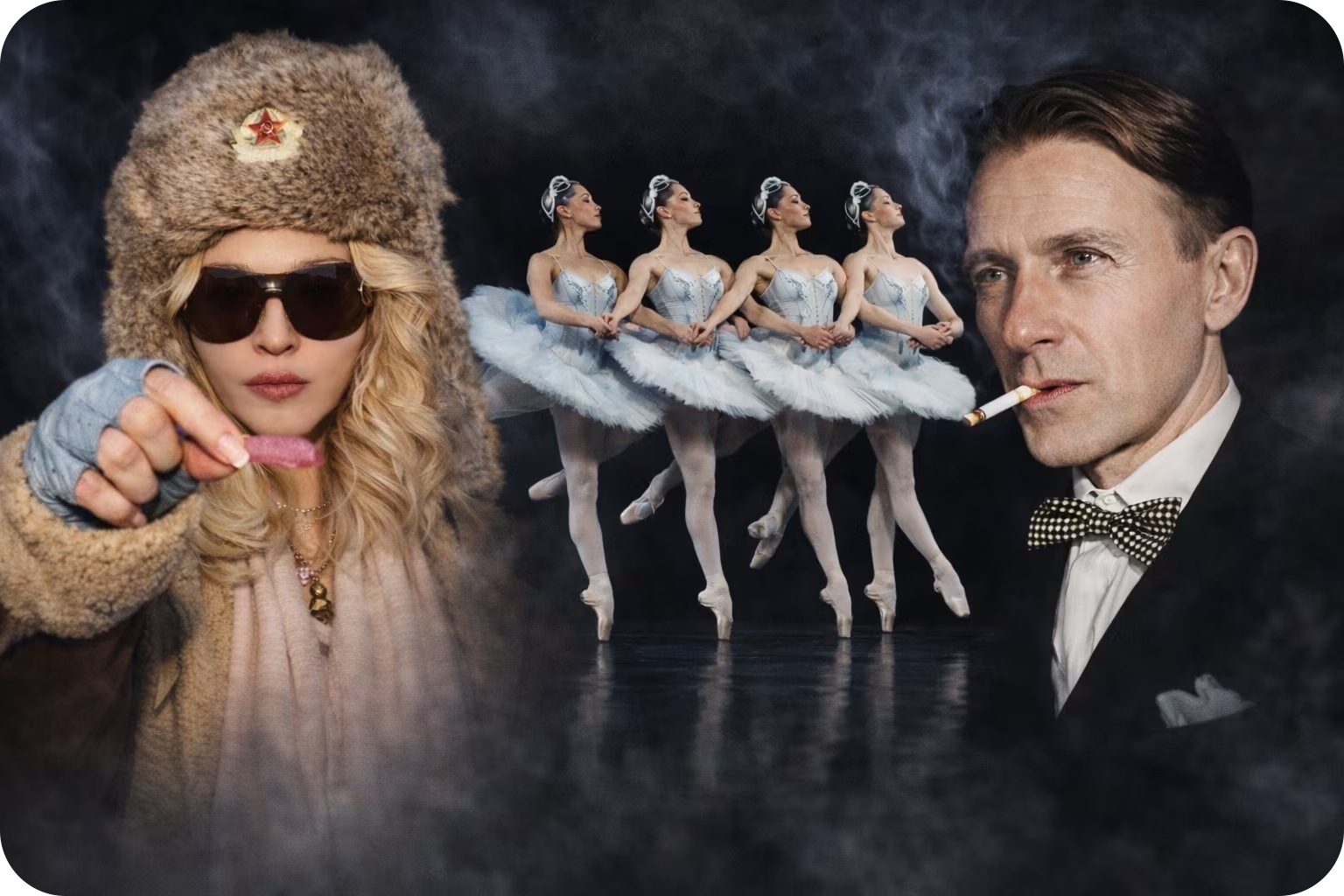
Journalist Owen Matthews, in an article for the British Spectator, calls Ukraine’s attempts at a total rejection of figures from Russian culture—from Tchaikovsky to Bulgakov—“barbarism.” He argues that, following Russia’s invasion, music, literature, and language began to be scrubbed from Ukraine’s public space, treated as the property of the Kremlin. This logic, the author says, is not only mistaken but dangerous: culture and language belong neither to states nor to regimes.
Criticism of Ukraine’s policy of “canceling” Russian culture is appearing ever more frequently in Western media—and each time it provokes a sharp reaction inside the country.
The Kyiv City Council’s decision to dismantle a monument to Mikhail Bulgakov in Kyiv sparked a heated public debate. Some critics saw it as a rejection of one of the city’s most famous writers, closely associated with Kyiv, and as a symbolic concession to Russia. Within this line of reasoning runs the argument that such figures should not be unconditionally “gifted” to Moscow. Others were angered by something else: amid war, regular shelling, and a severe energy crisis, the city authorities, they argue, are spending attention and resources on dismantling monuments rather than on more urgent tasks.
Supporters and initiators of the demolition, for their part, insisted that Bulgakov was allegedly a Ukrainophobe and that his works discredited the Ukrainian national movement. Yet this debate itself largely diverts attention from the reasons why Bulgakov’s name ended up on Ukraine’s list of undesirables.
Notably, similar logic is being applied beyond the country’s borders. Owen Matthews describes how the drive to “cancel” Russian culture in Ukraine stems from the assumption that classical music, literature, and the Russian language itself belong to the Kremlin. According to him, after Russia’s invasion “all forms of Russian culture—including music and literature—were excluded from the repertoires of Ukrainian theaters and concert halls and scrubbed from curricula and from the bookshelves of schools and universities.” He also recalls cases in which two soloists of the National Opera of Ukraine were threatened with dismissal for touring with Tchaikovsky’s Swan Lake.
Matthews calls this approach a mirror image of Putin’s own logic. In his view, the idea that culture and language can be “nationalized” and declared the property of a regime is equally barbaric in any guise. “Neither ‘Shchedryk’ nor Swan Lake belongs to any nation, let alone to any leader—they belong to all civilized people of the world,” he writes.
He is particularly critical of the claim that Russian speakers are not full-fledged Ukrainians, calling it a “deeply Putinist view of the world.” Such logic, Matthews stresses, effectively excludes hundreds of thousands of Russian-speaking people who fought and died for Ukraine’s freedom in the face of Russian aggression and dangerously fractures society.
First and foremost, the assertion that Bulgakov was a Ukrainophobe is not supported by sources. There is no evidence that he demeaned Ukrainians as a people—it is important not to conflate the author’s position with the lines and views expressed by characters in his works. Nor did he deny the existence of a distinct Ukrainian nation. In this sense, the contrast with the figure of Igor Sikorsky is telling—a native of Kyiv after whom an airport, a street, and one of the country’s largest technical universities are named. Already living in exile in the United States in the 1930s, Sikorsky said: “My lineage is of purely Ukrainian origin, from a village in the Kyiv province, where my great-grandfather and great-great-grandfather were priests. However, we consider ourselves Russian by origin, from a certain part of Russia, viewing the Ukrainian people as an integrated part of Russia in the same way that Texas or Louisiana are an integrated part of the United States.” Nevertheless, Sikorsky’s memory in Kyiv is not being revised.
As for Bulgakov’s works written and published during the Soviet period, even where they contain criticism of the UNR, its severity clearly falls short of the portrayals found, for example, in Oleksandr Dovzhenko’s 1939 film “Shchors.” Yet Dovzhenko’s name has not become the target of campaigns to erase him from the public space.
At the same time, the decision to cancel Bulgakov fits into a broader and long-running logic of humanitarian processes in Ukraine. As far back as some twenty years ago, during the first “Maidan,” expectations were widespread among Russia’s liberal opposition that Ukraine would become a kind of “other Russia”—a country close to the Russian Federation in language, culture, and mentality, yet European and democratic. It was assumed that such an example could also influence Russian society, nudging it toward protest against Putin.
There were grounds for these hopes. The “Maidan” was in many ways anchored in what was then a predominantly Russian-speaking Kyiv, in business circles and an emerging middle class that was also largely Russian-speaking. The doctrine of an “other Russia,” distilled into the formula “we respect the Russian language and culture, honor Pushkin, but build democracy and move toward Europe,” seemed feasible. Yet it failed to secure lasting support within Ukrainian society.
Within the “Orange” camp, a nationalist position on humanitarian policy gradually took hold and came to dominate. Its essence lay in the belief that Ukrainian identity could be preserved only through strict Ukrainization—linguistic, cultural, media, historical, and religious. The alternative, it was argued, was inevitable Russification under the pressure of Russia’s powerful cultural and informational influence. From this followed a radical conclusion: everything Russian was perceived as a threat, the memory of a shared past was to be dismantled, and in its place a new history, a new culture, and effectively a new Ukrainian nation were to be constructed through a deep “reprogramming” of society.
Ideas of this kind, initially shaped within the Ukrainian diaspora, long lacked broad support inside the country. Nationalists therefore opted for a strategic compromise, fusing their concept with the popular theme of European integration. Thus emerged the thesis that the path to Europe inevitably means a path away from Moscow, and that moving away from Moscow entails rejecting not only Putin, but also the Russian language, the memory of a shared history, and a cultural canon that includes Pushkin and other symbols.
Naturally, at the time this concept was articulated far more softly and cautiously in public than it is today. More neutral and tolerant language was used, but in substance it was about the very same thing. Within this logic, the hostile force was seen as not only Putin, but also Russian liberals. Indeed, they were viewed as particularly dangerous, since were they to come to power it would become far more difficult to advance the thesis that the path to Europe necessarily requires a break with Moscow and with everything Russian.
Viktor Yushchenko accepted this concept and actively supported it. Other leaders of the Orange camp, many of whom were themselves Russian-speaking, chose not to challenge it, fearing accusations of “betrayal” and of “working for Moscow.” At the same time, the question of who ultimately played into the Kremlin’s hands remains open.
In effect, this very line became one of the factors behind the split in Ukrainian society. It reinforced pro-Russian sentiments in Russian-speaking regions and set in motion processes that played a significant role in the events of 2014—processes the Kremlin then exploited. It is enough to recall how the repeal of the Kivalov—Kolesnichenko language law, carried out by the Rada immediately after the Maidan’s victory, helped to destabilize the situation. From the standpoint of elementary logic, this was far from a priority issue at the time, but within the nationalist framework it was considered fundamental.
One can argue that the Kremlin would have carried out the annexation of Crimea and other steps regardless, but it is hard to deny that repealing the language law made those objectives easier to achieve. This is also borne out by the fact that after events began in Crimea and the Donbas, Ukrainian authorities—at the insistence of the West—suspended the decision to repeal the Kivalov—Kolesnichenko law.
As soon as the situation stabilized somewhat, the language issue returned almost immediately. A series of Ukrainization laws followed, culminating in the 2019 law that amounted to de facto total Ukrainization. Society, however, continued to accept this course without much enthusiasm and showed little hurry to be “reprogrammed.” This was clearly reflected in the presidential election, where Poroshenko, running under the slogan “Army, Language, Faith,” suffered a crushing defeat to Zelensky, who emphasized that it does not matter which language one speaks. For nationalists, this was a heavy blow, although the new president—contrary to the expectations of many voters—ultimately did not reverse the course on Ukrainization.
After the start of Russia’s full-scale invasion, proponents of radical Ukrainization felt a renewed surge and saw in the moment a unique opportunity to settle the issue once and for all. A new, decisive argument was added to the old ones—“the Russian language is the language of the enemy.” Despite the fact that hundreds of thousands of Russian-speaking soldiers are defending Ukraine, the authorities chose not to engage this claim, and the pace of Ukrainization accelerated sharply.
In recent months, however, as already noted, anxiety has been growing among supporters of this course. The reason is negotiations over ending the war, within which the issue of restoring rights to the Russian language is also being discussed. This is a demand from Russia that, judging by a number of signals, is also supported by the United States. In the 20-point peace plan published by Zelensky, point 13 states that “Ukraine will apply EU rules on religious tolerance and the protection of minority languages.”
The wording is vague, yet even this provoked a sharp reaction from Viatrovych, who said that in this way “Russia is trying to restore its influence over those lands it failed to take by force.” Along the same lines, a large-scale media campaign is already unfolding against any rollback of Ukrainization.
And yet, one would think there should be little cause for alarm. If the thesis of a “language of the enemy,” as its proponents claim, has indeed taken deep root in society, then no changes in the law would lead to a return of the mass use of the Russian language.
But this is precisely what they fear—because they understand that in reality things are otherwise.
A recent episode involving Madonna is also telling. After she posted a photo on social media wearing an ushanka with a Soviet cockade, she almost immediately faced a wave of aggressive comments. Ukrainian activists and bots demanded apologies and explanations, effectively attempting to dictate to a global pop star what she is allowed to wear and what she is not. The impulse is a familiar one: the same logic has long been applied to opera singers, musicians, and performers who have not lived in Russia for years, do not support the Kremlin, and work in international theaters, yet whose personal accounts and the pages of the theaters themselves are regularly targeted by humiliating and accusatory comments. At the core of this approach lies the notion that cultural symbols, biographies, and even visual gestures are subject to political control, and that the right to interpretation belongs to a narrow circle of self-appointed censors. As a result, Ukraine’s humanitarian stance begins to look not like a defense against aggression, but like an attempt to export its own internal cultural war to the outside world.
With the outbreak of the war, paradoxically, opposite processes were set in motion as well. Constant pressure to switch to Ukrainian, demands not to listen to Russian-language music, and remarks along the lines of “chomu ne derzhavnoiu” triggered not acceptance but rejection among many Russian-speaking Ukrainians. Before the war, most of them viewed Ukrainization calmly, since it was barely felt in everyday life. After finishing their education, a citizen of Ukraine could almost entirely avoid using Ukrainian while still working, earning a living, and running a business. Once demands emerged to switch to Ukrainian precisely in daily life, however, the situation changed—ignoring Ukrainization became impossible.
Yes, some Russian-speaking residents of the country did switch to Ukrainian, seeing it as a “patriotic act,” especially in spheres connected to public activity. For many others, however, the pressure came to look like an unacceptable intrusion into private life, one that moreover stands in direct contradiction to the European values for which, according to official rhetoric, the state is waging war against Russia. These sentiments have not disappeared and continue to surface regularly.
Supporters of Ukrainization see this and fear that if rights to the Russian language are restored, it will quickly regain its position, and the entire constructed framework will begin to unravel.
In reality, however, the Russian language is not going anywhere in Ukraine. It could disappear only in one scenario—if the country were to completely cut itself off from the global internet and shut down all social networks. In all other cases, Ukrainians, from childhood and from the moment a first smartphone appears in their hands, will be immersed in Russian-language content created by more than 150 million people worldwide, content that will objectively always be many times more abundant than Ukrainian-language material.
For this reason, Ukrainization will not lead Ukrainians to read or consume less content in Russian—the closeness of the languages and constant contact with the Russian-speaking environment, both in real life and online, make this inevitable. It will only reduce the production of Russian-language content within Ukraine, automatically giving Russians an advantage as competition on the global market weakens. This once again brings the discussion back to the question of who is, in fact, “working for Moscow.”
One way or another, the language question in postwar Ukraine will inevitably resurface—regardless of whether it is codified in the terms of a peace agreement. And this will happen irrespective of Russia’s position. All the more so because equating “Russian-speaking” with “pro-Russian” is plainly incorrect. By the same logic, no one thinks of labeling predominantly English-speaking Irish people a “nation of Britophiles.”
Returning to Bulgakov.
If the current dominant framework persists in Ukraine, he will, of course, be subject to a ban. The White Guard is saturated with the Russian-cultural vibe of early twentieth-century Kyiv. And within this logic, no trace of that vibe should remain—it is declared hostile and slated for complete eradication, as if it had never existed. Thus, while Dovzhenko can still be fitted into this scheme with caveats, even if only fragmentarily, this is impossible with Bulgakov.
And it is not only about him. Russian-language writers of Odesa fall under the same question. Over time, questions may also arise around Gogol—so far he is being left untouched, but that may well prove to be only a matter of time.
If, however, a different concept of the state prevails—one capable of encompassing all of Ukraine, with all periods of its history and the full diversity of its citizens, regardless of the language they speak—then Bulgakov will cease to be labeled a “Ukrainophobe” and will return to the circle of famous Kyivites it is customary to take pride in.
And the fact that Bulgakov criticized Petliura, in itself, changes little. Many criticized him—Hrushevsky and Vynnychenko alike. One of the key military commanders of the UNR, Petro Bolbochan, is unlikely to have had warm words either, when he was led to execution on the orders of a military field court controlled by Petliura. Yet this does not prevent the 3rd National Guard Brigade “Spartan,” which today is fighting at the front, from bearing Bolbochan’s name.