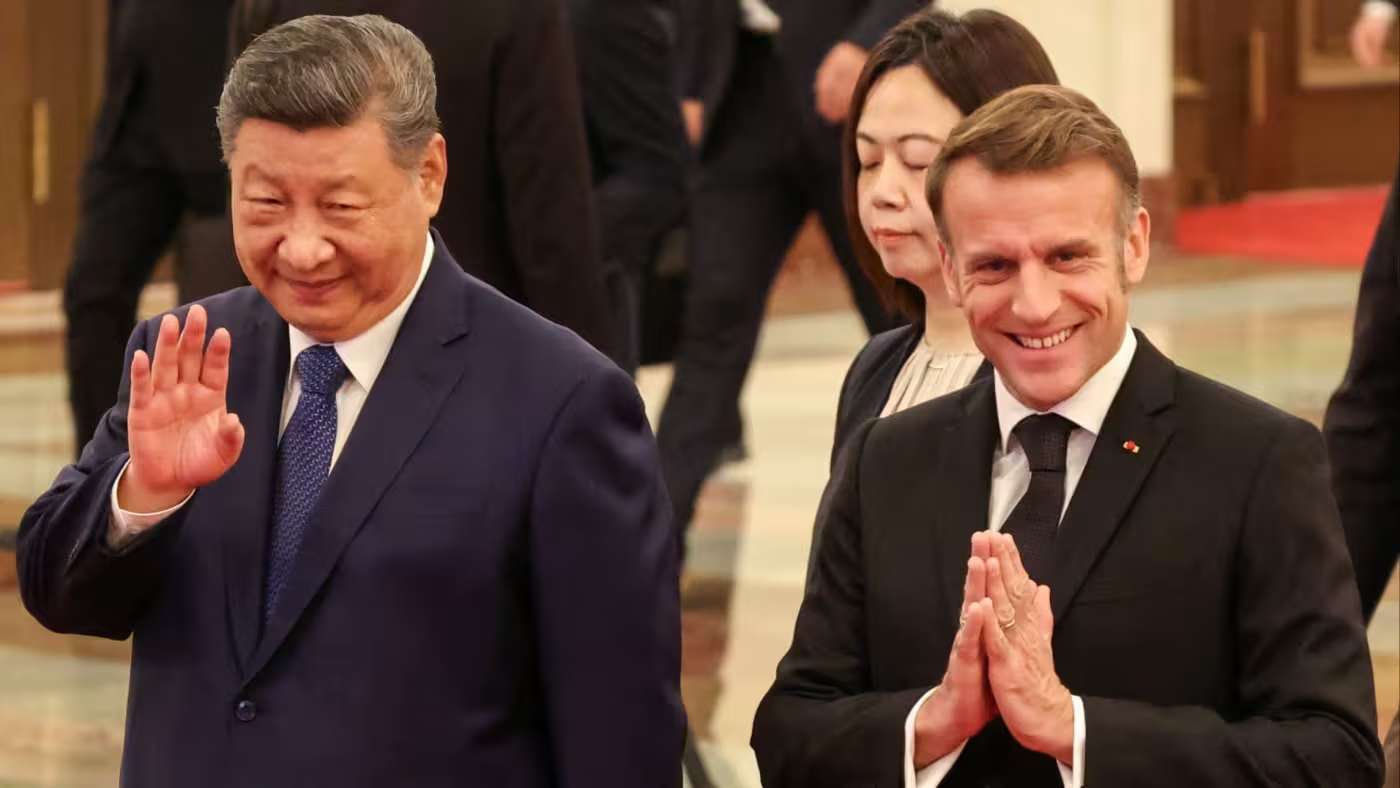
On Thursday, December 4, in Beijing, French President Emmanuel Macron held talks with China’s President Xi Jinping—their meeting coming at a moment of escalating trade tensions between China and Europe. During the discussion, Macron warned of the risk of the “disintegration of the international order” and stressed that the resilience of the global system hinges on whether Paris and Beijing can find common ground.
The visit coincided with a series of contentious economic issues—from China’s anti-dumping investigations into European goods to an expected French court ruling on the Shein case—against the backdrop of mounting EU pressure on Beijing to rebalance trade flows.
Speaking in Beijing against the backdrop of intensifying trade frictions between China and Europe, French President Emmanuel Macron warned of the risk of a “disintegration of the international order.” After talks with the Chinese leader, he said the world was facing the potential unraveling of a system that had underpinned global stability for decades, and that in such circumstances dialogue between Paris and Beijing was “more essential than ever.” He noted that the two sides share ample areas of convergence, that “differences sometimes arise,” but that their ability to navigate them will determine the effectiveness of the multilateral diplomacy both claim to uphold.
Addressing Macron before the start of their bilateral talks, Xi urged the two countries to “hold high the banner of multilateralism” and to prevent external forces from intruding into their relationship. His remarks, delivered in the Great Hall of the People, were a veiled response to accusations that Europe’s China policy is shaped under the influence of the hard-line approach pursued by Donald Trump’s administration. “China is ready to work with France on the basis of the fundamental interests of our peoples and the long-term interests of the international community, removing any obstacles,” Xi said.
Macron’s trip to China marks his fourth since taking office in 2017 and comes ahead of France’s presidency of the G7 in 2026, where global economic imbalances are set to dominate the agenda. Tensions between Beijing and Europe have been rising over widening trade gaps, investment flows, and China’s export-driven growth model. Macron said it was “time for a new phase” in economic relations and urged Beijing to increase investment in Europe by 2030, warning that the current imbalance “is beginning to become unsustainable.” He cautioned that staying the course could trigger a crisis and that a trade war would be “the worst way to resolve it.”
European governments are also concerned about China’s export controls on rare earth elements, a sector it dominates and whose output is critical for industries ranging from automotive manufacturing to defense. Later on Thursday, Xi announced that the two sides had agreed to expand cooperation in aviation, nuclear energy, biopharmaceuticals, and artificial intelligence, as well as in areas such as panda conservation and “global governance.” He said China’s forthcoming five-year plan, to be formally unveiled in March, would create opportunities for French industry despite Beijing’s emphasis on industrial self-reliance. “We support Chinese companies that have the capacity and desire to invest in France,” Xi told business representatives, without offering specific commitments.
Xi again underscored that China maintains its position of supporting peace in Ukraine, though he made no mention of European demands that a ceasefire be a precondition for any negotiations. Paris has been trying to persuade Beijing to act as a mediator in the Russia-Ukraine conflict, but these efforts have so far yielded little.
The talks took place as France awaited a court ruling on the government’s proposal to impose a three-month ban on the operations of China-founded ecommerce retailer Shein, after illegal products were found on its platform.
China, for its part, has launched anti-dumping investigations into European goods. The probe into cognac exports is largely nearing completion, but others—chiefly those concerning EU dairy products—remain under way. Industry representatives say decisions on possible additional tariffs could be announced in the coming weeks.