The United States has imposed visa restrictions on five European politicians and civil society figures involved in drafting and promoting European regulation of digital platforms, including the Digital Services Act (DSA). Those sanctioned include former EU commissioner Thierry Breton, as well as activists from Germany and the United Kingdom working to combat disinformation and online hate. Washington framed the move as a response to “extraterritorial censorship” and as a defense of free speech and the interests of American technology companies. In response, French President Emmanuel Macron and EU leaders accused the United States of intimidation and interference, arguing that the EU’s digital rules are the product of a democratic process and an integral part of European sovereignty.
French President Emmanuel Macron and the leadership of the European Union accused Washington of “coercion and intimidation” after the United States imposed visa restrictions on five prominent European figures who played a central role in advancing legislation to regulate American technology corporations.
On Tuesday, December 23, visa bans were imposed on former EU commissioner Thierry Breton, one of the architects of the Digital Services Act (DSA), as well as four activists working to counter disinformation—two in Germany and two in the United Kingdom.
Those targeted include Imran Ahmed, the UK-based head of the US-based Center for Countering Digital Hate; Anna-Lena von Hodenberg and Josephine Ballon of the German non-profit HateAid; and Claire Melford, a co-founder of the Global Disinformation Index.
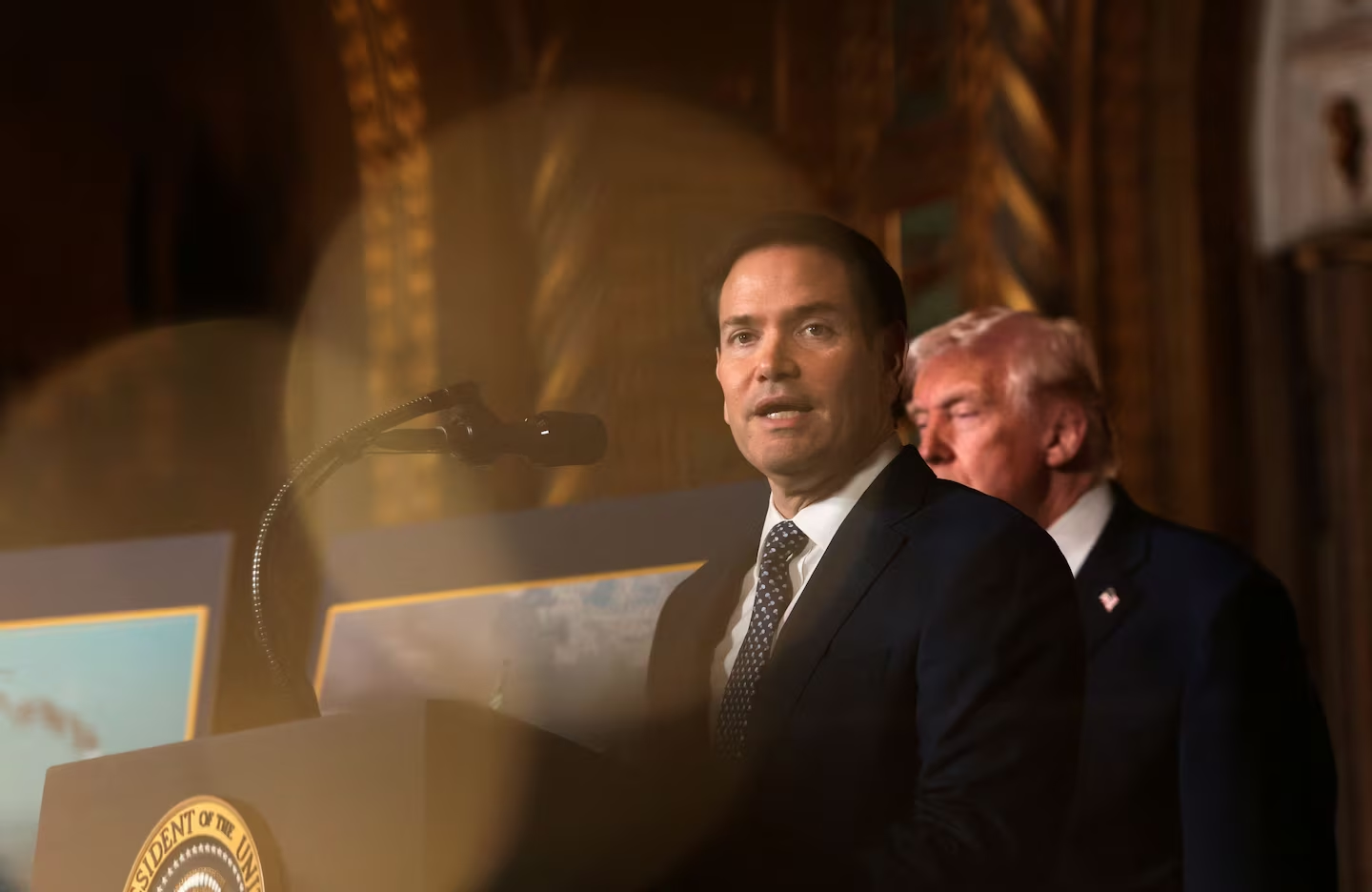
US Secretary of State Marco Rubio, commenting on the decision, wrote on X: “For too long, European ideologues have led organized efforts to coerce American platforms into punishing American views they dislike. The Trump administration will no longer tolerate these egregious acts of extraterritorial censorship.”
In Washington, the DSA is viewed as a form of censorship, while European leaders insist the new rules are necessary to curb hate speech and illegal content. Yet the dispute risks becoming part of a broader and already entrenched cultural and political conflict between Donald Trump’s administration and Europe. Artificial intelligence and digital technologies were long seen as a potential arena of confrontation, as their role in shaping the distribution of power continues to grow.
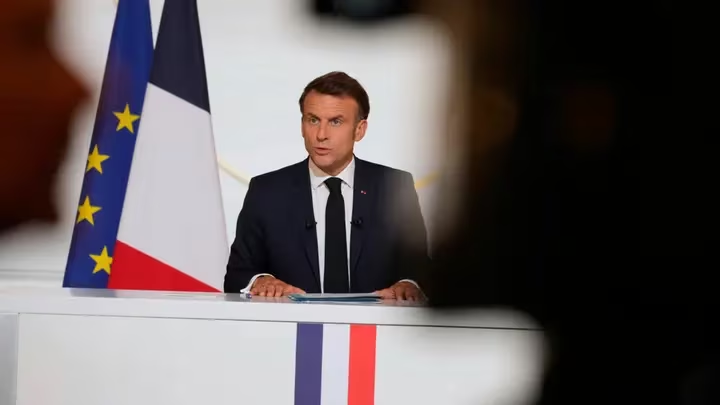
Macron responded to the visa bans in unusually stark terms. “These measures are acts of intimidation and coercion aimed at undermining Europe’s digital sovereignty,” he wrote on X. According to Macron, the EU’s digital regulation was adopted through a “democratic and sovereign process” by the European Parliament and the Council of the EU, applies exclusively within the bloc, is not directed against third countries, and is intended to ensure that what is illegal offline remains illegal online. “The rules governing the European Union’s digital space must not be determined outside Europe,” the French president подчеркнул.
The United States Imposes Visa Sanctions on European Regulators and Activists, Accusing Them of Censorship
The European Union Calls the Measures Interference and Defends Its Right to Regulate the Digital Space Independently
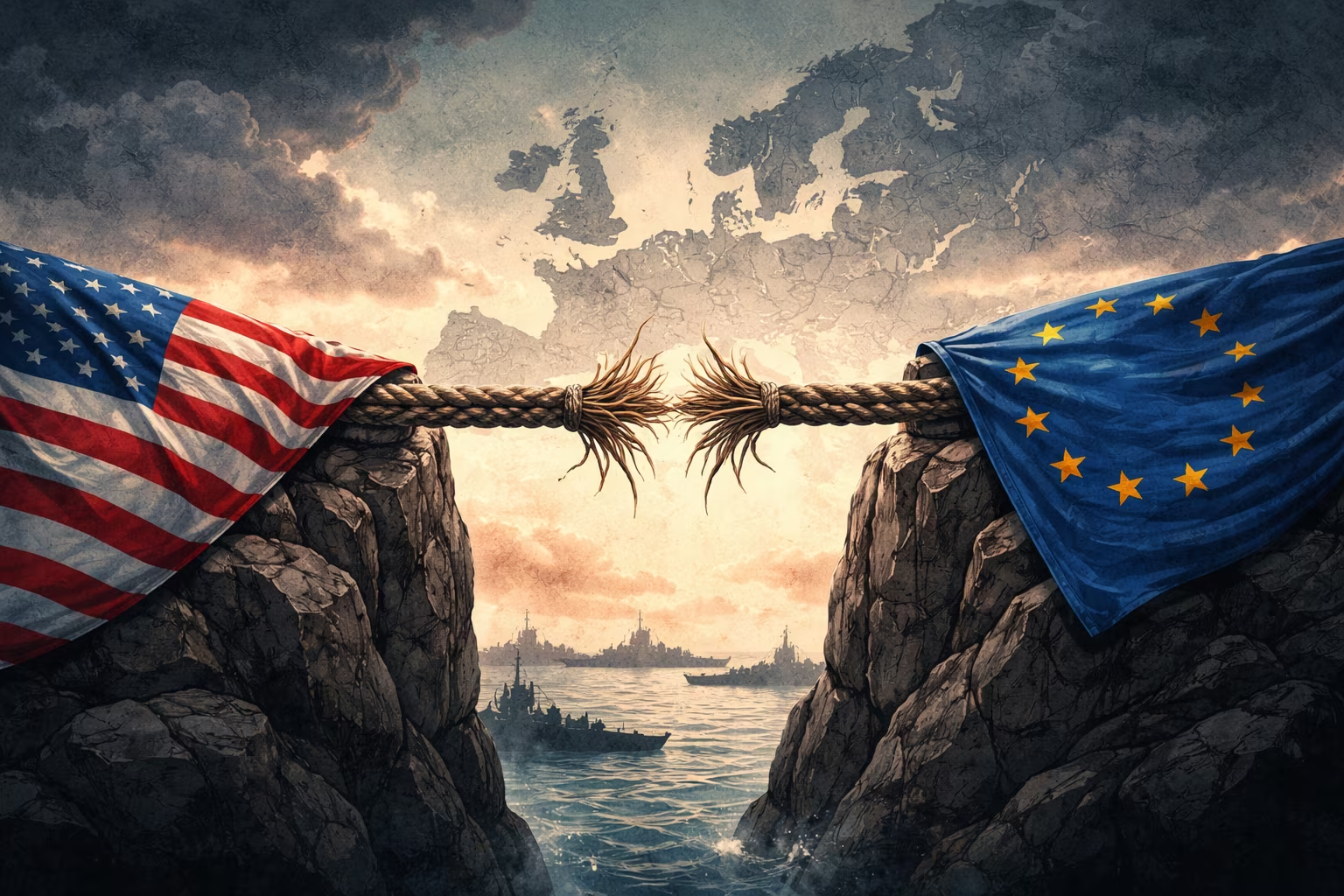
Trump’s First Year Revealed a Mismatch Between the Long-Term Interests of the United States and Europe
The EU Maintains Its Alliance With Washington Without a Strategy in Case It Is Lost
French Foreign Minister Jean-Noel Barrot said that “the peoples of Europe are free and sovereign and cannot allow others to impose the rules by which their digital space should function.”
Breton himself, who served as EU commissioner for the internal market from 2019 to 2024 and previously headed France’s finance ministry, responded with irony: “Is McCarthyite witch-hunting making a comeback?” He noted that the DSA was approved by 90% of the European Parliament—a democratically elected body—and by all 27 EU member states. “To our American friends: censorship is not where you are looking for it,” he said.
A European Commission spokesperson said that, if necessary, Brussels would “respond swiftly and decisively” to protect its regulatory autonomy from unjustified measures.
EU officials insist that the aim of the DSA is to make the online environment safer, including by strengthening the accountability of technology giants for the dissemination of illegal content, such as hate speech and material related to the sexual abuse of children.
Washington takes the opposite view, arguing that the European Union is imposing “excessive” restrictions on freedom of expression under the guise of combating hate, disinformation, and misinformation, and that the DSA is unfairly targeted at American technology companies and US citizens.
Previously, the European Union fined Elon Musk’s X platform €120 million (£104 million) for violations of content moderation rules.
Breton was succeeded as EU commissioner for the internal market by another French politician—Stephane Sejourne, who serves as an executive vice-president of the Commission. He voiced support for his predecessor, saying: “No sanctions will silence the sovereignty of Europe’s peoples. Full solidarity with him and with all Europeans affected by this.”
Describing the bans, US Deputy Secretary of State for Public Diplomacy Sarah Rogers referred to Breton as the DSA’s “chief ideologue.”
Germany’s justice ministry said it supports the two German activists, calling the visa restrictions unacceptable, and stressed that HateAid provides assistance to people affected by illegal hate speech in the digital sphere.
“Anyone who describes this as censorship is misrepresenting our constitutional system,” the statement said. “The rules by which we want to live in the digital space of Germany and Europe are not determined in Washington.”
Dennis Radtke, a member of the European Parliament from Germany’s governing CDU party, said: “Trump supporters in Europe portray this as a fight for free speech. Where exactly has an opinion been suppressed? Where is this fight for free speech when it comes to China and Russia? This is all about business and the confrontation with the rule of law.”
Raphael Glucksmann, a French socialist MEP, said in a message to Rubio: “For far too long, Europe has been weak in enforcing its own laws and defending its own interests. You chose to cosy up to tyrants and confront democracies. The time has come to stand up straight. Kneel as much as you want before Putin—now the free world is us.”
“We are not a colony of the United States. We are Europeans and must defend our laws, our principles, and our interests. This scandalous step against Thierry Breton is a tribute to his fight for our sovereignty. We will continue it together. To the end,” he added.
The current dispute is the latest manifestation of tensions between the United States and Europe. In August, Washington imposed sanctions on French judge Nicolas Yann Guyot of the International Criminal Court in response to the pursuit of Israeli leaders and an earlier decision to open investigations involving US officials.
Michel Duclos, a former senior French diplomat and senior fellow for geopolitics and diplomacy at the Institut Montaigne think tank, sharply criticised the developments, recalling the recent visit of Russian negotiator Kirill Dmitriev to Miami to discuss the war in Ukraine. “Dmitriev is celebrating in Miami, while Breton is denied entry to the United States: for Washington, Europe is becoming the new Russia. It recalls the 1920s—when America favoured a former enemy [Germany] at the expense of its previous allies—but in an even harsher form,” he said.
Mika Beuster, head of the German Journalists’ Association, expressed solidarity with the Berlin-based organisation HateAid. “This is censorship in its purest form—something we had previously encountered only in autocratic regimes,” he said.