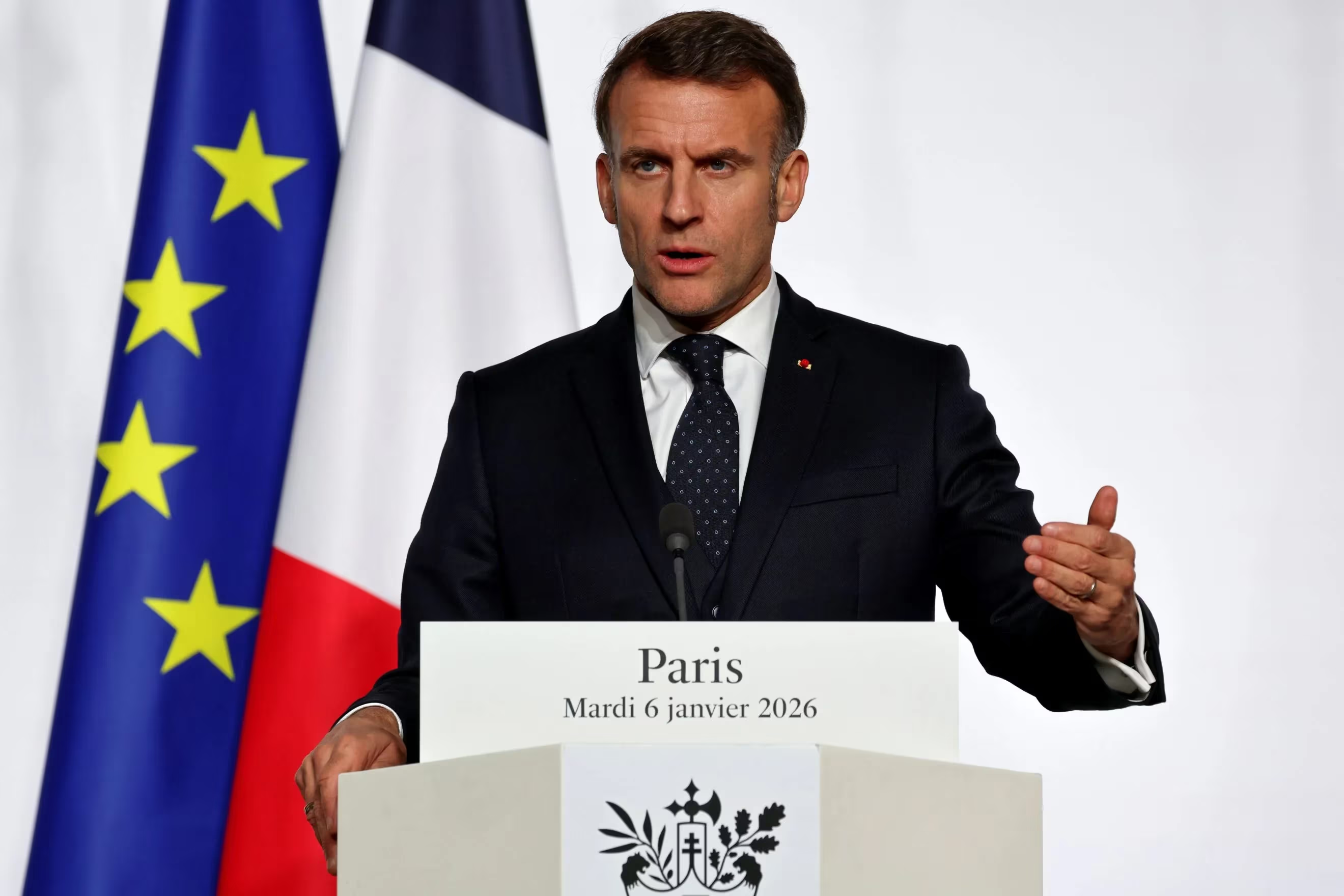
French President Emmanuel Macron criticized the Donald Trump administration, accusing it of retreating from the rules-based global order following the overthrow of Venezuelan President Nicolas Maduro and the renewed threats to annex Greenland. According to Macron, the United States, while remaining an established global power, is gradually distancing itself from some of its allies and abandoning international norms it had previously championed. He made the remarks during his annual address on foreign policy.
In his speech, the French president sketched a world in which major powers seek to act predatively and carve the planet into spheres of influence. In this logic, Macron noted, the United States is asserting dominance over the Western Hemisphere under the so-called Donro Doctrine. At the same time, he made clear that he views Washington’s diplomatic efforts aimed at ending the war in Ukraine positively.
“We are evolving in a world of great powers, where there is a real temptation to redraw the world,” he said. Events of recent months-and at times of recent days-only reinforce this conclusion, he added.
Earlier, Macron faced criticism over his muted response to Maduro’s removal from power. In one statement, he wrote that Venezuela “could only welcome” his departure, without specifying whether the manner of the change in power violated international law.
In a speech on Thursday, January 8, the French president directly accused the United States of breaking rules in trade and “across a number of security-related areas.” “Every day people ask whether Greenland will be invaded or whether Canada will face the threat of becoming the 51st US state,” he said.
Macron did not mention Venezuela explicitly, but the situation in Caracas and around Greenland remains one of the central issues for Paris. France is involved in shaping a pan-European response to Trump’s threats directed at the self-governing Danish territory.
In the French president’s view, Europe should respond by refusing to accept what he called “new colonialism” and by stepping up investment in its own strategic autonomy.
For many years, Macron has argued for reducing Europe’s dependence on the United States and China, but his latest appeal risks sounding unconvincing to partners concerned about his weakened standing at home. He enters the final full calendar year of his presidency with a fragmented parliament and low approval ratings.
Further straining his leadership are protests by French farmers in Paris against a potential European Union trade agreement with the Mercosur countries. The deal is deeply unpopular in France, yet Paris is widely expected to be unable to block it ahead of a key EU vote on Friday.
In his speech, Macron stressed that Europe must protect its borders through trade agreements that include tougher safeguard and mirror provisions. “When you impose rules on your own producers and then open markets to those who do not abide by those rules, you will not secure broad support from your producers,” he said. “Common sense suggests that they should be listened to,” Macron added.