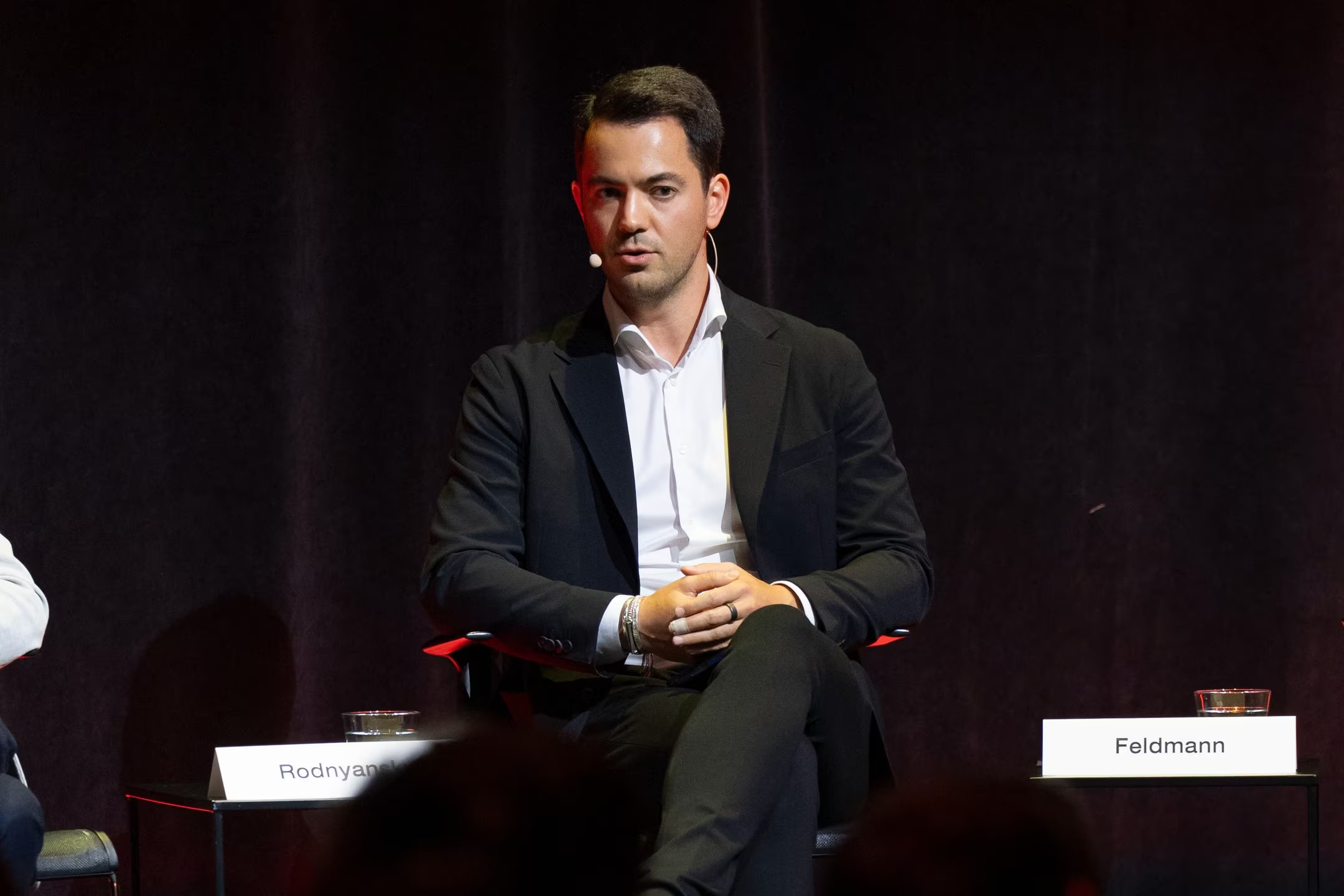
Alexander Rodnyansky—an economist, professor at the University of Cambridge, and co-founder of the finformant analysis platform—served for five years as an economic adviser to Volodymyr Zelensky. After leaving office, he told Meduza that he had long sought to resign of his own accord and had been urged to stay. In his column for The Economist, Rodnyansky frames the corruption scandal surrounding Energoatom as a symptom of a broader problem—the personalization of power and the erosion of institutions that now determine whether Ukraine’s leadership remains part of the solution or becomes part of the problem.
In his column for The Economist, the economist and former adviser to the president of Ukraine, Alexander Rodnyansky, writes that today’s agenda has been crowded with reports of an American-Russian “peace plan” that could amount to a managed capitulation for Ukraine. That alone is dangerous enough. No less troubling, however, is the condition of the authority that would be expected to sign such a document. Over the past two weeks, Ukrainians have been absorbing grim details of a major corruption scandal. Yet the Energoatom affair—a kickback scheme of roughly $100m at the state nuclear power operator—is not merely another episode of wartime plunder. It has become a test: can Ukraine’s leadership reform the system it has built, or has that system already become one of the Kremlin’s most valuable assets.
The broad outline of the case is now familiar to many. After a 15-month investigation, Ukraine’s anti-corruption agencies said that intermediaries allegedly skimmed 10–15% from Energoatom contracts, including those intended to protect substations from Russian missiles. Investigators say the money was routed through a network linked to Timur Mindich, a long-time business partner of Kvartal 95—the media production company of President Volodymyr Zelensky—who, by a curious coincidence, left the country shortly before searches began. Two ministers were dismissed. Energoatom’s supervisory board was dissolved in its entirety. Sanctions were imposed on Mr Mindich and an associate. On paper, it all resembles a functioning system: detectives investigate, prosecutors bring charges, ministers step aside; Brussels says it has received confirmation that the course is the right one. Look more closely, however, and a different picture emerges.
Such a blow would be painful at any time, but now it takes on a destructive quality. Contrary to repeated forecasts of an imminent collapse, Russia’s economy has managed to adapt to the war. The Kremlin is allocating 7–8% of GDP to defence, covering these costs through higher taxes, the redistribution of oil revenues, and an unspoken social compact of “guns instead of butter”. Independent analysts now assess Russia’s remaining fiscal runway not in months, but in years. Ukraine, by contrast, spends nearly a third of its GDP on its armed forces and can pay pensions and provide basic public services only thanks to external assistance. Against this backdrop, a mobilisation crisis has also been quietly unfolding: since the start of the full-scale invasion, prosecutors have opened more than 300,000 cases related to unauthorised absence from units and desertion.
It is into this already precarious reality that the Energoatom scandal has burst. For European voters, it looks like a textbook case of corruption—and Russian propaganda scarcely needs to invent anything. The immediate danger, however, is not that Europe will suddenly turn its back on Ukraine. A different scenario is far more likely: support becomes slower, more parsimonious, and hedged with additional conditions at precisely the moment when Kyiv desperately needs a predictable, multi-year framework of assistance to stabilise the front and the economy.
Volodymyr Zelensky’s own reaction captures the full ambiguity of the moment. In a recent video address, he reminded Ukrainians of their dignity and warned that the country stands before one of the most difficult choices in its history—between accepting one version or another of an American-Russian peace proposal and risking isolation with an even harsher winter ahead. At the same time, he urged the political class to “stop throwing mud”. It sounded less like the stance of a head of state confronting a systemic failure than like a new episode of Servant of the People—the satirical television series in which Zelensky starred before entering politics: a leader appealing directly to society over the heads of a discredited establishment that he himself had created and protected.
Behind this lies a broader governing philosophy. Since 2019, the presidential team has systematically personalised power. The cabinet has been treated not as an independent centre of policymaking, but rather as an administrative extension of the presidential office. Loyalty has trumped competence. Institutional roles have been devalued; boards and commissions have been filled with friends and “practitioners” for whom the measure of success was not preventing scandals, but surviving them.
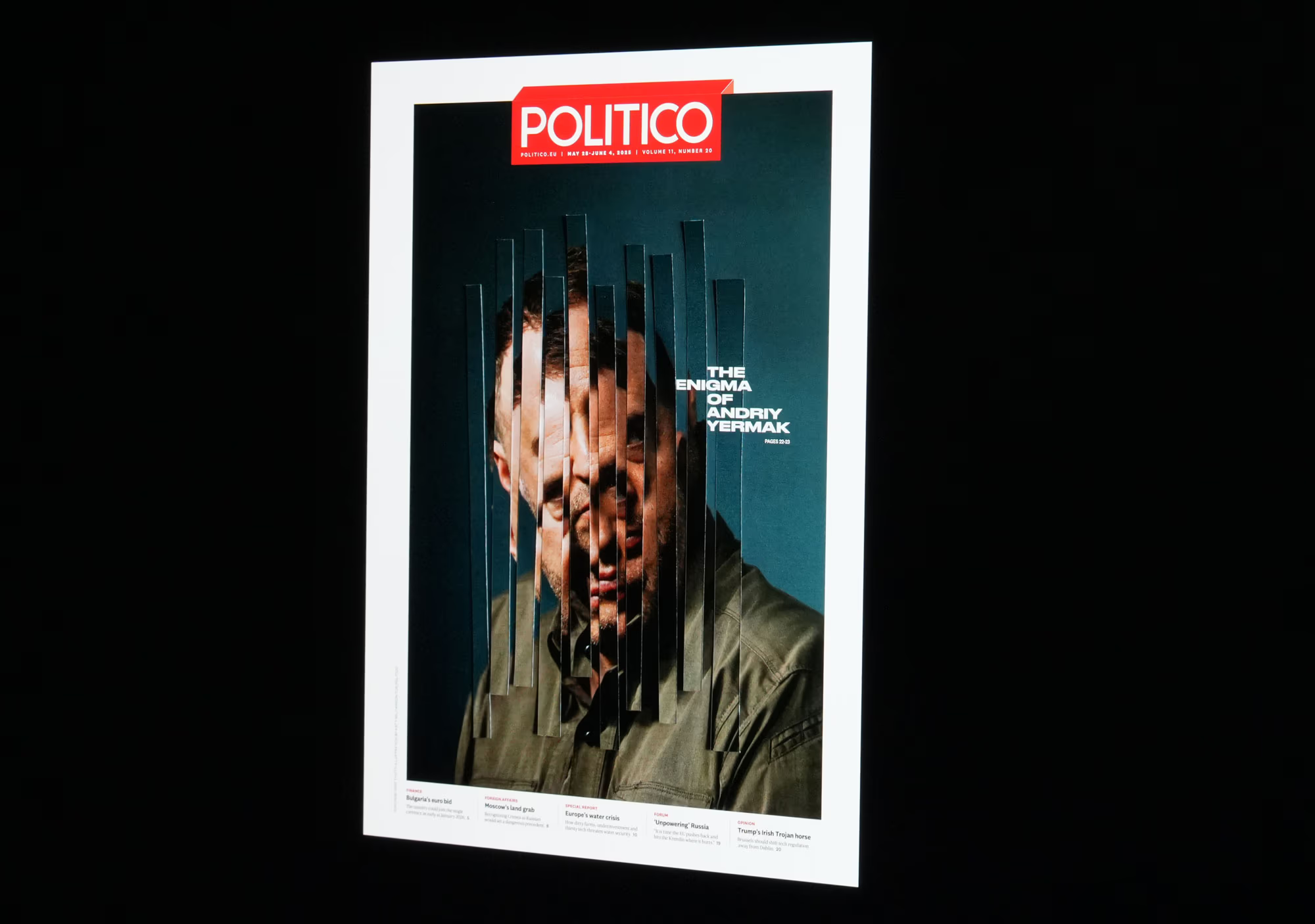
The Institution of Personal Loyalty
A Politico article explains how Andriy Yermak became Zelenskyy’s indispensable envoy—and the center of power in Ukrainian politics
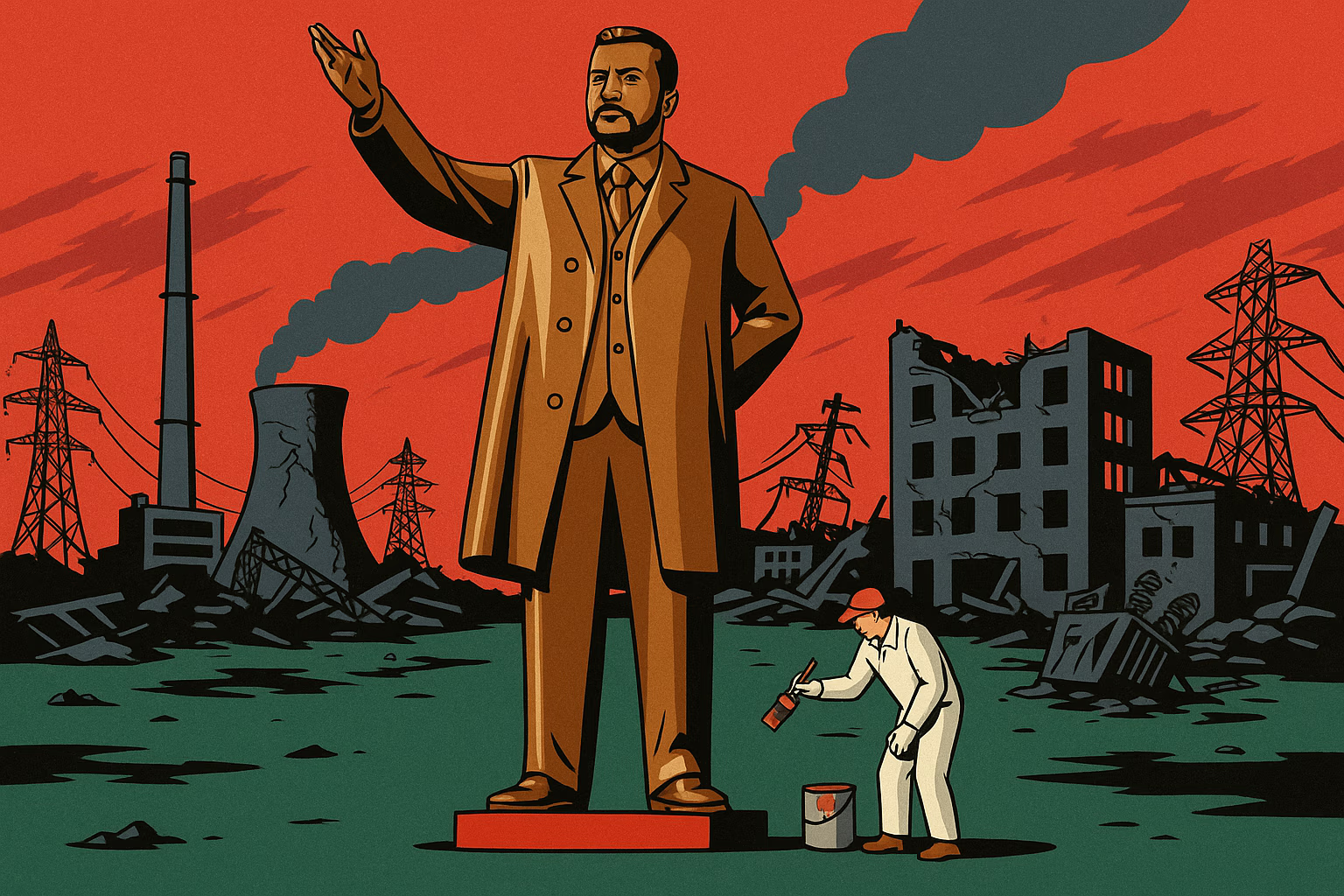
The Corruption Schemes That Never Stopped
How the “Mindich Tapes” Scandal Deepens Public Disillusionment in Wartime Ukraine
Recalling his own experience in government, Alexander Rodnyansky writes: “In all my years in office, I was never mistaken for a ‘practitioner’. I was a theorist.” The implication was clear: he was deemed unfit to take part in Ukraine’s transformation. Rodnyansky recalls how one of the president’s close associates once told him that the real test for an economic “practitioner” was not macroeconomics at all, but the ability to survive prison if fate sent you there. In that sense, he and his circle enjoyed an advantage. The author concedes that his Princeton PhD in economics had skipped that part of the curriculum.
What happens next could prove decisive in the medium term. Corruption scandals will almost certainly continue to unfold—with new recordings, new names, and new resignations. The president will deny the accusations, sacrifice a few expendable figures, appeal to national dignity, and accuse critics of undermining unity. Prime Minister Yuliia Svyrydenko will remain in her post just long enough to lead a “clean-up”, even though she oversaw the formation of the nuclear company’s supervisory board while serving as economy minister. In effect, the president has tasked her with investigating her own institutional design, betting that no one will notice. Ms Svyrydenko, who took office in July, has so far been barely mentioned—largely because almost no one knows her. This invisibility is not a side effect, but a core feature of the appointment: a prime minister colourless enough not to compete with the president, and invisible enough to absorb responsibility without attracting attention.
Volodymyr Zelensky is unlikely to change course voluntarily. He will continue to shift blame downward and sideways, insisting that any talk of political change plays into Russia’s hands. Is another scenario possible? Only if the scandal, combined with a burdensome peace plan, forces him into a choice—either to personally accept deeply unpopular terms, or to step aside.
For Ukraine’s partners, the taboo is no longer the question of how deep corruption runs, but a sharper one: whether the current leadership remains part of the solution or has already become part of the problem. Ukrainian soldiers are still buying time at the front. Whether that time is used to reset a compromised system or merely to prolong the life of an overextended political series will determine not only the quality of any future peace, but also who will ultimately be signing it.