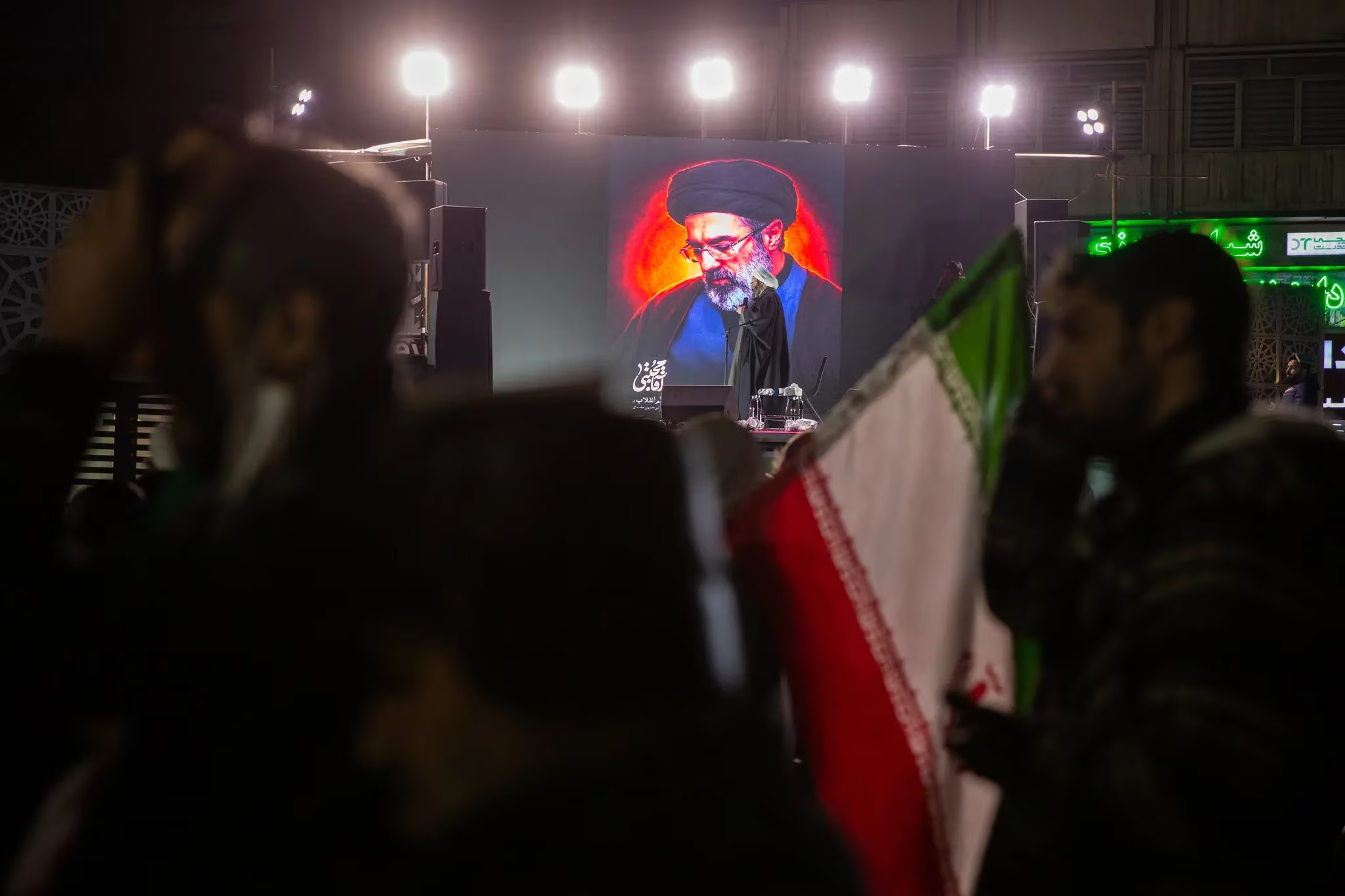
Iran’s military establishment and the regime’s hard-line political factions welcomed the appointment of Mojtaba Khamenei—the son of the recently killed Supreme Leader, Ayatollah Ali Khamenei—as his successor. In these circles, his elevation was framed as the rise of a figure drawn from their own ranks.
The Islamic Revolutionary Guard Corps issued a statement endorsing the new leader. In it, Mojtaba Khamenei was described as “a new dawn and a new phase for the revolution and the rule of the Islamic Republic.” The 56-year-old cleric had long been seen as the candidate closest to the security establishment. His ties to the IRGC are believed to be especially strong—during the final years of the Iran-Iraq war he served within its ranks.
Ali Larijani, one of the key figures in Iran’s national security establishment, said the decision demonstrated the failure of the country’s adversaries. He thanked the Assembly of Experts—the body of 88 senior Shiite clerics responsible for selecting the supreme leader—for continuing its work despite the war.
“Despite the enemies’ tactics, who hoped that killing Imam Khamenei would bring the country to a dead end, Mojtaba Khamenei was elected through a legal process,” Larijani said in a statement to state media.
He also stressed that the new supreme leader must serve as a symbol of unity and urged political factions to set aside internal rivalries and rally around him.
Yet it soon became clear that divisions within the country had not disappeared.
Iran’s state television quickly replaced mourning coverage of the war and religious ceremonies with upbeat revolutionary songs. The broadcast was filled with statements from supporters of the new leader and footage of celebrating crowds in city squares across different parts of the country. State media, tightly controlled by the conservative faction of the ruling establishment, showed neither critics nor any signs of dissent.
At the same time, in Tehran, residents said opponents of the regime reacted differently. From windows and rooftops across the capital came chants of “Death to Mojtaba.”
Several Iranians opposed to the government, who had hoped the war might lead to its collapse, said in private messages that the new leader was likely to rule harshly and intensify confrontation with the United States and Israel. “This is a sign that everything will become much worse,” said Alireza, an engineer in Tehran who asked that his surname not be published for fear of reprisals.
Shortly afterward, Iran’s armed forces issued a statement declaring their loyalty to the new leader. The announcement was reported by the semi-official Fars news agency, which is affiliated with the Islamic Revolutionary Guard Corps.
The military vowed to “demonstrate even greater strength, determination and devotion to defending the achievements of the Islamic Revolution and will resist and stand firm under the command of their leader until the last breath and the last drop of blood.”