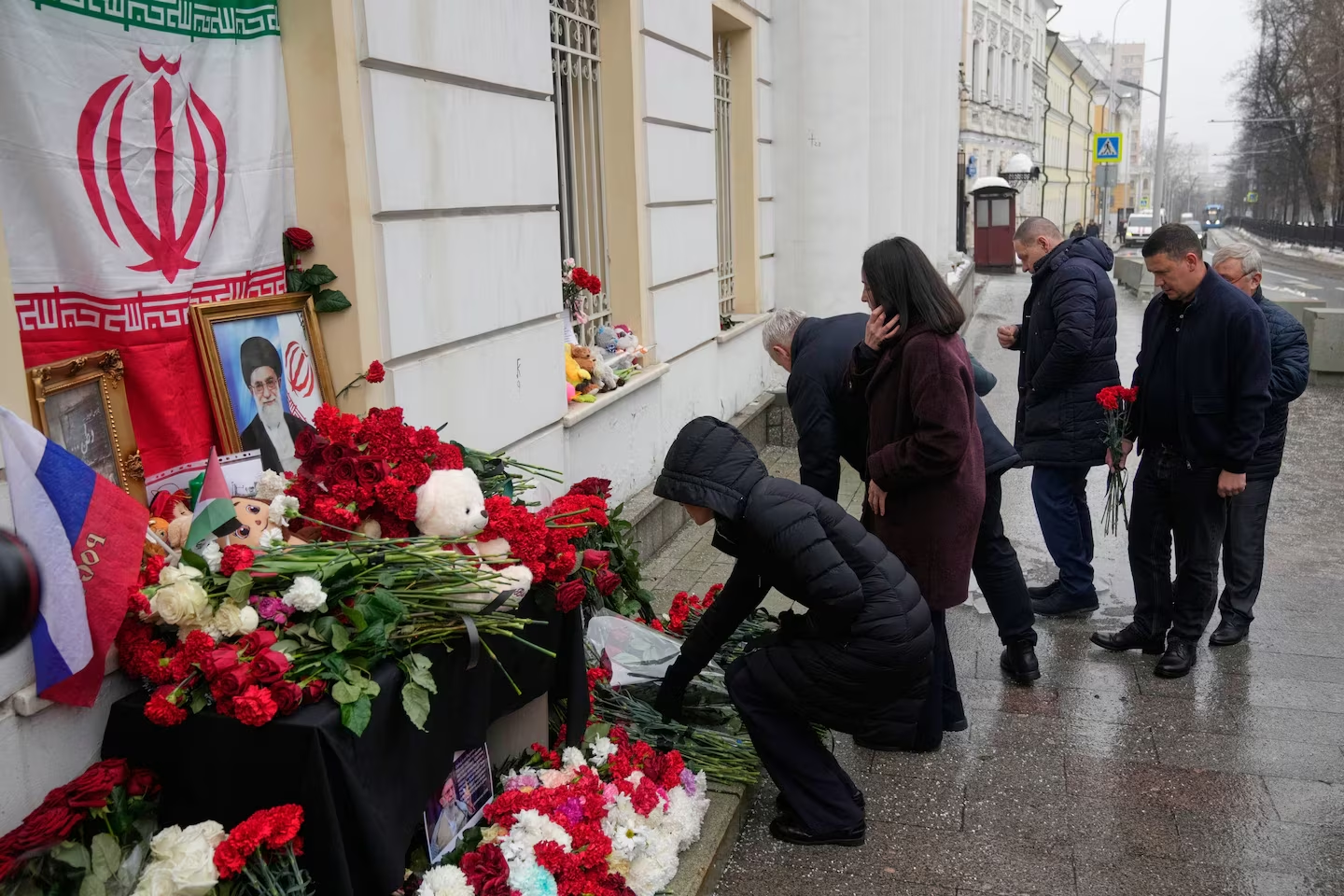
The assassination of Iran’s supreme leader Ayatollah Ali Khamenei dealt Moscow another blow to Vladimir Putin’s network of anti-Western partners and simultaneously underscored how sharply Russia’s influence on the global stage has diminished—from the Middle East to Latin America.
Yet alongside the frustration over Moscow’s inability to counter the global reach of U.S. President Donald Trump’s policies, the Kremlin is also weighing potential advantages. Russia’s leadership hopes that drawing the United States into a protracted campaign in the Middle East could ultimately play to Moscow’s advantage—above all in the war against Ukraine, which remains Putin’s foremost priority.
Over roughly the past 15 months, Russia has largely watched from the sidelines as three leaders friendly to Moscow were removed from power—in Syria, Venezuela, and now Iran, with the latter two cases occurring directly as a result of U.S. military action.
“It is clear that Russia and China were unable to do anything,” said a Russian academic close to senior Moscow diplomats, speaking on condition of anonymity in order to candidly assess the government’s position. “This could affect Moscow’s standing in its relations with other partners.”
Russian officials have also voiced growing concern over Trump’s proposals for a “friendly takeover” of Cuba through economic pressure, yet here as well Moscow appears to have little real capacity to push back.
Still, the Kremlin is also weighing potential advantages in the situation. If Washington’s attention remains fixed for a prolonged period on Iran and the Middle East, the U.S. administration may have fewer resources left for Ukraine, while pressure on European allies to fill the gap could intensify. Weapons—above all air-defense systems—may be redirected to the Middle East rather than reaching Kyiv, which Russia continues to strike almost every night.
Particularly favorable for Moscow has been the sharp rise in oil prices following the attacks on Iran and Tehran’s retaliatory strikes, including attacks on oil-refining facilities in Persian Gulf countries. The price surge comes at a moment when Russia’s military budget is under significant strain.
Kirill Dmitriev, the Kremlin’s special economic envoy, predicted that prices could exceed $100 per barrel. Already seeking to capitalize on rising energy prices, Putin on Wednesday threatened to redirect Russian gas supplies away from Europe toward other markets.
A blockade of the Strait of Hormuz—a critical artery of global oil trade—would not affect Russian shipments to China and India. Analysts, however, warn that only a prolonged and substantial surge in prices, or sustained disruptions to oil supplies from Persian Gulf countries, would provide Russia’s military campaign in Ukraine with meaningful financial relief.
“It is obvious that Russia has an interest in a prolonged war that would lead to the closure of the Strait of Hormuz,” said a European official, also speaking on condition of anonymity.
The full-scale invasion of Ukraine, now entering its fifth year, has drained a significant share of Moscow’s resources and attention. That has pushed countries once within Russia’s orbit—most notably former Soviet republics in the Caucasus and Central Asia—to seek new alliances. Some have increasingly turned toward Turkey, China, the United States, or the European Union.
One of the clearest signs of Russia’s constrained capabilities has been the reaction of state television commentators and pro-war bloggers. They watched the campaign against Iran from last summer onward—and the swift capture of Venezuelan President Nicolás Maduro in January—with a mixture of unease and reluctant admiration.
“They are looking at this extremely effective campaign, and Russian commentators are almost asking themselves—why can’t we, Russia, operate like that?” noted foreign-policy expert Hanna Notte in an analysis for the Kennan Institute. “There is even an element of envy in their reaction.”
In Kyiv and across European capitals, Khamenei’s death was quickly framed as further proof of Russia’s limited capabilities and Moscow’s inability to protect its allies.
“Putin has lost three of his closest friends in just over a year. He also failed to help any of them,” Ukraine’s foreign minister Andrii Sybiha wrote on X. “Russia is not a reliable ally even for those who rely on it heavily. … As Russia remains bogged down in its senseless war against Ukraine … its influence around the world is rapidly shrinking.”
András Rácz, a senior fellow at the Center for Security and Defense at the German Council on Foreign Relations, said Russian military thinking is focused on “one big war”—the war against Ukraine—to which all other allies and foreign-policy considerations are subordinated.
“Everything else is merely collateral damage,” Rácz said.
Russia’s relationship with Iran was strengthened during the Syrian civil war. At the time, Moscow backed President Bashar al-Assad with air power, while Iran provided military support through a network of proxy militias. Assad, who lost power last year, now lives in Russia.
After Russia’s full-scale invasion of Ukraine in 2022, cooperation between Moscow and Tehran grew even closer—as both countries sought to overcome the severe economic restrictions imposed by the West. Iran assisted Moscow by providing Shahed drone technology—one of the key weapons used against Ukraine.
Even so, the partnership has always had its limits. A twenty-year strategic partnership agreement signed last year between the two countries does not include a mutual-defense clause that would obligate either side to come to the other’s aid in the event of military aggression.
According to a person familiar with closed-door negotiations between Russia and the United States, during discussions over the past year the Kremlin signaled to Washington that it would not obstruct potential American efforts to topple the current Iranian regime.
Khamenei’s killing may also have served as an unsettling reminder for Putin himself of his own potential vulnerability. The Russian leader had previously expressed outrage over footage of the killing of Libyan dictator Muammar Gaddafi during the 2011 civil war and was reportedly shaken by his death.
Analysts believe Putin is counting on Russia’s status as a nuclear power as the primary factor shielding him from such a scenario.
“Russia cannot do much in this situation, but they inevitably measure it against themselves—although they will never admit it and likely reassure themselves that they are a nuclear state and that it would not be so easy to do the same to them,” said Nikita Smagin, an expert on Russian-Iranian relations.
“Nevertheless, they see that an authoritarian leader can be killed in a strike, and the shift in international norms unsettles them,” Smagin continued. “When states not only act at their own discretion but can eliminate the head of another state. Naturally, Russia does not like this.”
Some analysts believe Moscow may be hoping for a scenario similar to Venezuela’s. There, Maduro’s removal did not lead to a sharp rupture with Russia—his successor Delcy Rodríguez maintained ties with Moscow.
“Many believed the United States was aiming for regime change, but in the end the regime remains,” said a Russian academic expert, commenting on the situation in Venezuela. “At least at this stage it is still too early to say that Trump is dismantling chavismo.”
A similar dynamic has emerged in Syria. A year after Assad’s fall, Russia’s position has proved stronger than many expected. Despite losing its main ally in the region, Moscow avoided being pushed out of its military bases, Syria’s new president has visited Moscow twice, and Russia has retained enough leverage to remain a significant—if weakened—player.
“If clerical rule survives or if the Islamic Revolutionary Guard Corps assumes a more prominent role, I think Russia will be able to preserve its partnership with Iran,” Notte said, referring to Iran’s IRGC. “But if forces come to power that seek to restore relations with the West or pursue a more pragmatic policy toward the West—I am not saying this will necessarily happen—that is precisely the scenario Russia has long feared.”
About a year ago, Putin offered Trump mediation between the United States and Iran, at a time when Moscow was trying to keep Trump engaged in dialogue with Russia. The proposal was rejected—Trump said he advised Putin to focus on finding a way out of his own war against Ukraine.
Since the strikes began on Saturday, Putin has held a series of phone calls with leaders of Persian Gulf countries. In a conversation with Bahrain’s king, Hamad bin Isa Al Khalifa, he said Moscow “is ready to use all available opportunities to stabilize the situation,” and in a call with Qatar’s emir, Tamim bin Hamad Al Thani, he said Russia hopes Iran’s retaliatory strikes will not affect civilian infrastructure. In doing so, the Russian leader once again sought to present himself as a potential intermediary between Washington and what remains of Iran’s leadership.
“Russia’s capabilities here are quite limited,” Notte added. “Russia will try to play the role of mediator, but I do not think it will become the decisive factor.”