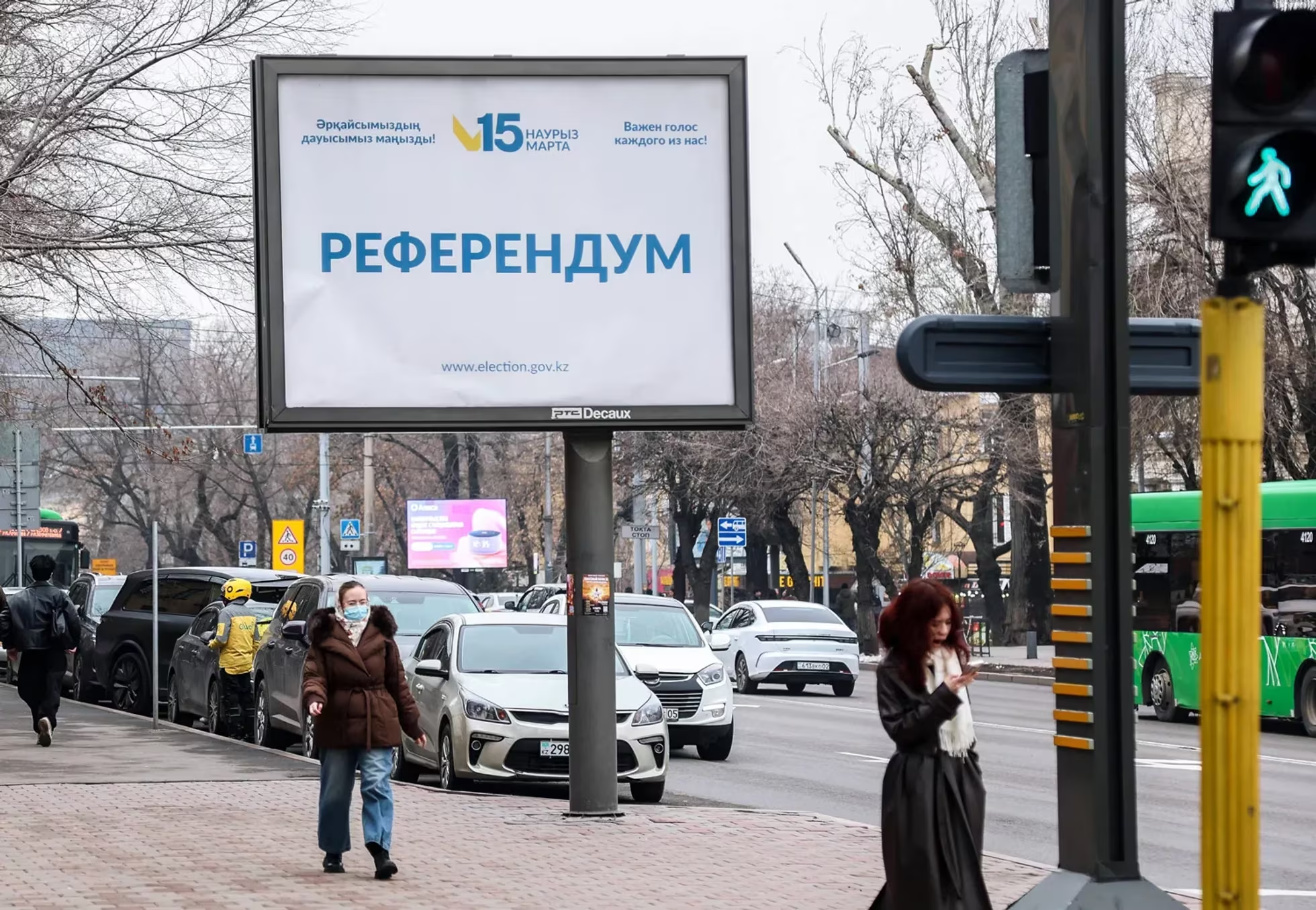
On March 15, Kazakhstan is holding a referendum on a new version of its Constitution. The draft of the basic law was prepared in just 22 days and envisions a sweeping overhaul of the state system. Among its key provisions are expanded presidential powers, the primacy of national legislation over international law, a ban on foreign funding for political parties, the constitutional definition of marriage as a union between a man and a woman, as well as changes affecting the use of the Russian language. The amendments would affect 84% of the articles of the current constitution. SFG Media examines what political objectives President Kassym-Jomart Tokayev is pursuing by advancing this project—and how the authorities are responding to its critics.
The Reform Was Meant To Be Drafted Over More Than A Year—But Was Ultimately Completed In 22 Days
President Kassym-Jomart Tokayev first announced his intention to reshape Kazakhstan’s political system on September 8, 2025, in an address to the nation. At the time, he said the Senate had fulfilled its “important historical mission of ensuring the stability of state-building,” and that the country could therefore transition to a unicameral parliament. The president stressed, however, that the process would not be rushed. “The discussion—given the extraordinary nature of the reform—will take no less than a year, after which a nationwide referendum could be held in 2027, followed by the necessary amendments to the Constitution,” he said.
The authorities subsequently formed a working group tasked with preparing the parliamentary reform. In October, Tokayev outlined the scale of the planned changes: “The amendments will affect about 40 articles of the Basic Law. After that, at least 10 constitutional laws and more than 50 codes and laws will have to be brought into line with it.”
However, the process accelerated sharply in winter. On January 21, the president established a commission on constitutional reform that included senior officials, representatives of pro-presidential parliamentary parties, and members of public organizations loyal to the authorities. In total, the body comprised 130 members, but only 53 had a legal education, and just four were specialists in constitutional law or legal theory.
The commission worked at an extraordinary pace. Just ten days after its creation it presented a draft of the new Basic Law, and on February 12 it published the final text—meaning the entire process took 22 days. At the same time, Tokayev decided not to postpone the vote until next year and scheduled the referendum for March 15.
What Will Change In The Constitution
The amendments affect 84% of the articles of the current Constitution. The most sweeping changes concern the system of legislative power.
⋅ At present, Kazakhstan’s parliament consists of two chambers—the Senate and the Mazhilis. The new version of the Constitution replaces them with a unicameral kurultai comprising 145 deputies elected for five-year terms exclusively through party lists. The kurultai will retain the right currently held by the Mazhilis—to initiate impeachment of the president, but only in cases of treason. Otherwise, its powers will be significantly curtailed. Parliament will lose the authority to appoint and dismiss a number of key officials, including the chairs of the Supreme Court, the Central Election Commission, and the Supreme Audit Chamber, the heads of the National Bank and the National Security Committee, as well as the prosecutor general. Candidates for all these positions will be nominated by the president. In addition, the head of state will gain the power to dissolve the kurultai if it twice refuses to approve the proposed candidates for the posts of vice president, prime minister, and speaker of parliament.
⋅ A new advisory body—the Halyk Kenesi (People’s Council)—will be created in the country. It will have the right of legislative initiative and will be able to submit bills to parliament. Unlike the kurultai, which will be formed through elections, all 164 members of the People’s Council will be appointed personally by the president.
⋅ The head of state may be a citizen of Kazakhstan over the age of 40 with at least five years of experience in public service—a requirement that did not previously exist. The president will be elected for a seven-year term without the right to re-election.
⋅ One of the key changes in the executive branch will be the restoration of the office of vice president. The position existed in the early years of Kazakhstan’s independence but was abolished in 1995. The vice president will be appointed by the president and will represent him in dealings with the kurultai, the government, and other state institutions. His primary role, however, concerns the continuity of power: if the president resigns, falls ill, or dies, the president’s powers—which currently pass to the speaker of the Senate—will, under the new constitutional draft, transfer instead to the vice president.
⋅ The Constitution will remove the provision that gives international law precedence over national legislation. In the new version, it merely states that Kazakhstan “respects the principles and norms of international law”.
⋅ The new Constitution also prohibits political parties and trade unions from receiving funding from foreign companies and stateless individuals, and requires non-profit organizations to disclose information about funds received from abroad.
⋅ Finally, the Basic Law enshrines the definition of marriage as a union between a man and a woman, excluding the possibility of the legal recognition of same-sex relationships.
The decision to hold a constitutional referendum is not unusual for Kazakhstan—nationwide votes of this kind take place in the country on a regular basis. The most recent was held in 2024 and focused on the construction of a nuclear power plant. Before that, a referendum took place in 2022, when voters approved amendments establishing a seven-year presidential term instead of a five-year one, as well as abolishing the status of “Elbasy”.
Constitutional amendments in Kazakhstan are introduced fairly often, and as the historian and Yale University professor Nari Shelekpayev has noted, society generally reacts to this calmly. The first constitution of independent Kazakhstan, which established a parliamentary form of government, was adopted in 1993. Just two years later it was replaced by a new version that significantly expanded presidential powers. Since then, the Basic Law has been amended six times, most recently after the January protests and the political crisis of 2022.
Nevertheless, the draft of the new Constitution has provoked far from a unanimous reaction in Kazakh society.
Kassym-Jomart Tokayev himself argues that the adoption of the new Basic Law represents a fundamental shift in the country’s political system. According to him, Kazakhstan is “finally parting with the super-presidential form of government and moving to a presidential republic with an authoritative and influential parliament”.
Supporters of the reform also present it as a step toward greater transparency in government. In their view, the new Constitution “strengthens the openness of power and its accountability to society.” The transition to a unicameral parliament and the restoration of the vice presidency, they argue, make the “functions of the state clearly defined,” while the People’s Council is meant to become a mechanism for постоян interaction between the state and the public.
Pro-presidential circles are confident that public support for the reform will be high. “Kazakhs support 98% of the provisions of the new Constitution,” said deputy Elnur Beisenbayev.
The New Constitution May Restrict The Use Of The Russian Language. Some Of Its Articles Also Repeat Provisions From Other Laws
Nevertheless, Tokayev’s critics largely view the constitutional reform with skepticism. The Kazakh sociologist Serik Beisenbayev, for example, argues that “behind these ‘historic’ changes there is nothing but the banal concentration of presidential power and the consolidation of the political regime.” In his view, such a course runs counter to public expectations, since there is a clear demand for democratization within Kazakh society.
A similar trend is reflected in data from the research center Paperlab. According to its estimates, the country’s largest political group consists of “progressive reformers”—around 26% of the population. They adhere to democratic values and hold “left-leaning views in economics.” By comparison, the share of “authoritarian loyalists,” who favor preserving the existing order and a strong presidential authority, is estimated at 19%.
Akezhan Kazhegeldin, a former prime minister of Kazakhstan, also argues that the new constitution creates a “model of façade law” designed to conceal a further concentration of power in the hands of the head of state. As an example, he points to the introduction of the office of vice president, which, in his view, will be entirely dependent on the president.
Kazakh political scientist Dimash Alzhanov reaches similar conclusions. Initially, he notes, the constitutional reform was presented as a step toward strengthening the role of parliament and democratizing the political system. In practice, however, this is not happening. On the contrary, the new Constitution reinforces the president’s position: first, he gains a mechanism for transferring power through the institution of the vice president, and second, he will be able to rely on the People’s Council—an organ fully dependent on the head of state and endowed with the right of legislative initiative, even though it is not a parliamentary body.
Alzhanov also doubts the integrity of the upcoming referendum. According to him, plebiscites in Kazakhstan are entirely controlled by the authorities, so there is little reason to expect the rejection of the draft constitution.
At the same time, parliament itself has long lacked strong legitimacy. After a sharp confrontation with President Nursultan Nazarbayev in 1993—1995, it effectively lost its independence, and the constitution adopted in 1995 significantly curtailed its powers.
The Senate, which the new Constitution abolishes, has also long provoked mixed reactions within society. Formally, the upper chamber could return draft laws to the Mazhilis for revision, but within the political system it was more often seen as a place where politicians were sent into honorable retirement. “The Senate is a relic of the 1990s, when Kazakhstan’s elites believed it would represent the interests of the regions. But then power became concentrated, and its weight in the political system ended up even smaller than that of the lower chamber, so its abolition changes nothing,” explained a Central Asia expert from a major European analytical agency who asked not to be named.
Special attention—particularly in Russian-language media—has been drawn to Article 9 of the new Constitution, which regulates the use of the Russian language in state bodies and local government. In the current version, Russian is used “on an equal footing” with Kazakh, whereas in the new text the wording has been changed to “alongside.” Pro-government Russian media have portrayed this as “a genuine tectonic shift that will determine the country’s future development along the path of ‘Nezalezhnaya,’ as it crowns the completion of the process of building a monoethnic state.”
Other observers, however, do not view the change as fundamental. A Central Asia expert notes that the authorities are indeed promoting the Kazakh language, but are doing so cautiously and without abrupt steps because they “understand how sensitive this issue is and how the Kremlin might react.”
Nari Shelekpayev, for his part, believes there is greater reason for concern about the future not of Russian but of the Kazakh language. According to him, far more content in the country is produced in Russian than in Kazakh—and it is often of higher quality. In such conditions, the researcher warns, there is a risk that Russian could gradually crowd out Kazakh. At the same time, activists advocating a broader use of the Kazakh language, on the contrary, consider the new Constitution insufficiently strict and are demanding the complete abolition of Russian’s official status.
Critics also point to problems in the text of the draft itself. Shelekpayev notes that several of the proposed provisions appear redundant, since similar norms are already enshrined in other legislative acts. The definition of marriage as a union between a man and a woman, for instance, is already contained in the Code on Marriage and Family, while issues of censorship and restrictions on freedom of speech are regulated by criminal, administrative, and civil legislation—including laws on the media, defamation, extremism, and the protection of honor and dignity. Likewise, requirements for transparency in the foreign funding of non-profit organizations and the ban on overseas financing of political parties and trade unions are already set out in laws governing political parties.
Diana Okremova, director of the Legal Media Center, for her part, argues that the Constitution deliberately uses “elastic, vague wording” that can later be interpreted in favor of the authorities. Article 23, for instance, declares a ban on censorship but simultaneously stipulates that “freedom of speech and the dissemination of information must not infringe on the honor and dignity of others, the health of citizens, or the morality of society, or violate public order.” The Kazakh lawyer and human rights advocate Aiman Umarova believes such a contradictory formulation could in the future be used to pressure independent media.
Why Tokayev Is Changing The Constitution
Over the past three decades, Kazakhstan’s Constitution has been revised repeatedly—and each time the changes have in one way or another reflected the interests of the sitting head of state. The reasons behind the current referendum are interpreted in different ways.
One explanation is that Kassym-Jomart Tokayev may in the future seek the post of United Nations secretary-general—the election for that position is expected to take place at the end of the year. According to a Central Asia expert who requested anonymity, this could explain Tokayev’s participation in Trump’s Peace Council, as well as his efforts to build closer ties with the U.S. president.
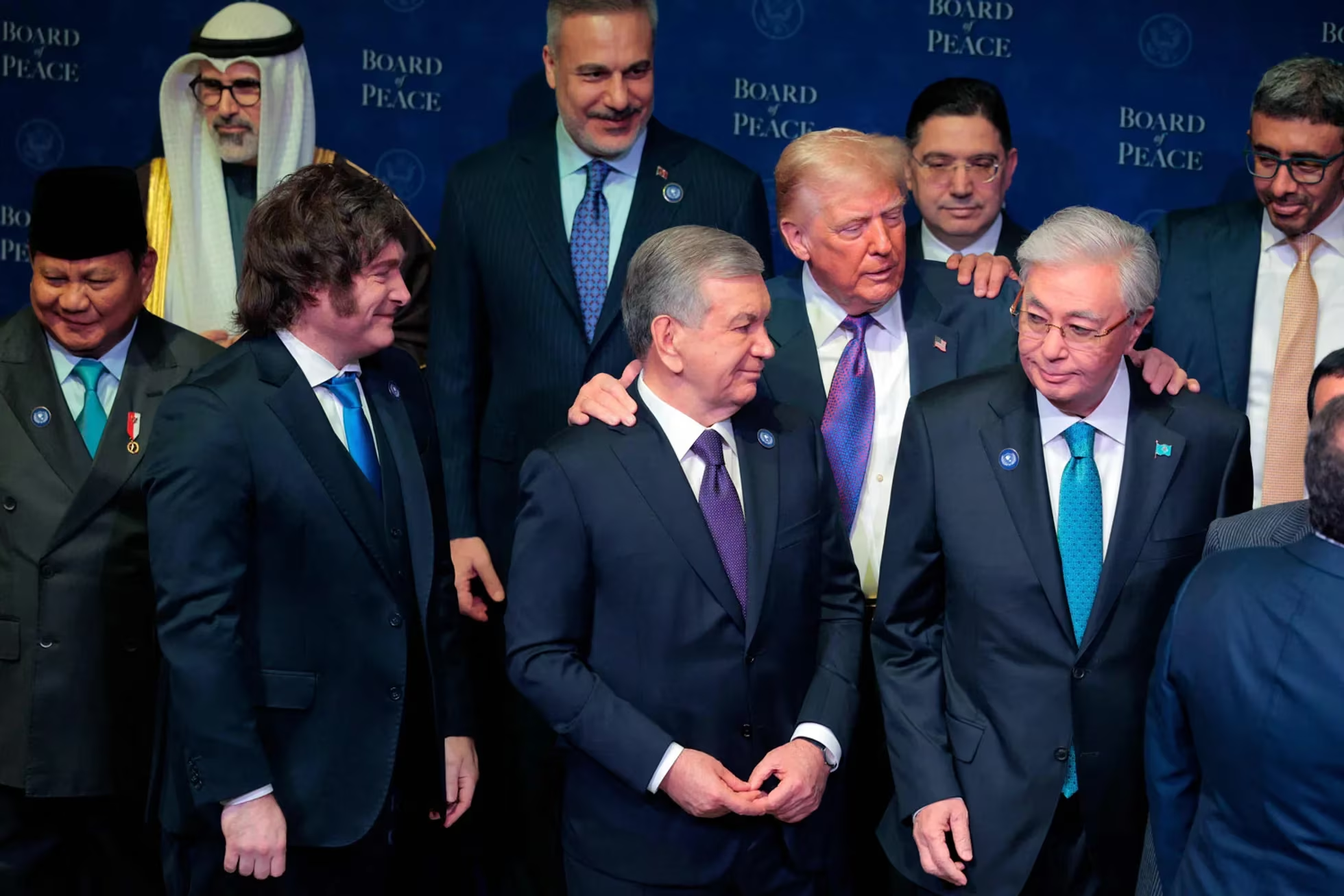
Donald Trump together with Uzbekistan’s president Shavkat Mirziyoyev and Kassym-Jomart Tokayev at a meeting of the Peace Council. Washington. February 2026.
“Leading the UN is more appealing to him than running Kazakhstan. In a certain sense Tokayev ended up in his current position by accident—he is, in fact, a career diplomat and feels more at home in the international sphere. It should also be remembered that for the young states of Central Asia, an appointment to such a post is considered extremely prestigious,” the expert says.
According to him, the creation of the vice presidency may also be linked to such calculations. Although the office “lacks any truly significant powers, Tokayev needs it to pass authority to ‘his’ person should he be elected UN secretary-general,” the expert explains. It is still too early, however, to speak of a specific successor. “It could well be one of the political heavyweights, but no names are being mentioned yet—Tokayev does not want to turn into a lame duck,” he notes.
Akezhan Kazhegeldin, a former prime minister of Kazakhstan, explains the president’s desire to tighten control over the system of power by the experience of his first years in office. In his view, between 2019 and 2022 the state apparatus and the security services—where many appointees of Nursultan Nazarbayev remained—effectively sabotaged the decisions of the new head of state.
The creation of the vice presidency, the restructuring of the parliamentary system, and the formation of the People’s Council, Kazhegeldin argues, allow Tokayev to strengthen the political vertical and prepare for a future transfer of power. Such a transition is expected to take place in 2029, when the next presidential election is scheduled. As Kristina Silvan of the Finnish Institute of International Affairs notes, Tokayev is trying to ensure that the transfer of power under his leadership “goes better than the previous” transition—the one that took place under Nazarbayev.
Another scenario is also being discussed. After the new Constitution is adopted, Tokayev could appeal to the Constitutional Court and seek to have his presidential term reset to zero. Reuters reported on such a possibility, citing a diplomatic source in Kazakhstan.
Political scientist Dimash Alzhanov believes that if such a move occurs, it would likely happen closer to 2029. “It would be a fairly typical step for countries of the former USSR,” says a Central Asia expert. However, he does not view this option as the main one. According to him, Tokayev’s political image is largely built on the idea that he came to power for only a single term, and an attempt to “reset” his mandate could provoke a strongly negative reaction from society—especially since the country has already seen the possible consequences of such discontent in 2022.
The Authorities Say The Changes Are Needed To Democratize The Country, But Are Already Prosecuting Those Who Criticize Them
The authorities have reacted harshly to criticism of the referendum and calls to boycott it.
In early February, a court in Almaty fined Marat Abdurakhmanov 86,500 tenge—about 170 U.S. dollars. The reason was a Facebook post in which he described the proposed amendments as a “draft Constitution of the dictatorship of totalitarianism and corruption.” Police officers have also regularly visited other critics of the reform—formally to conduct “explanatory work.”
In late February, Orazaly Erzhanov, the head of the public foundation Elge Qaitaru, was arrested. He was sentenced to ten days in detention for criticizing the draft of the new Constitution—the authorities accused him of spreading false information and misleading citizens. Bakhytzhan Toregozhina, head of the human rights foundation “Ar.Rukh.Khak,” says the police have applied various forms of pressure to at least 45 people—from preventive conversations to arrests.
In addition, the authorities blocked the website of the independent news agency KazTAG after it published an article criticizing the constitutional reform.
All of this sits uneasily with official statements that the adoption of the new Constitution will mark an important step toward the democratization of Kazakhstan. The democratic image Tokayev is trying to project cannot conceal either the authoritarian methods employed by the authorities or the effort to reshape the state system in the interests of the incumbent president.