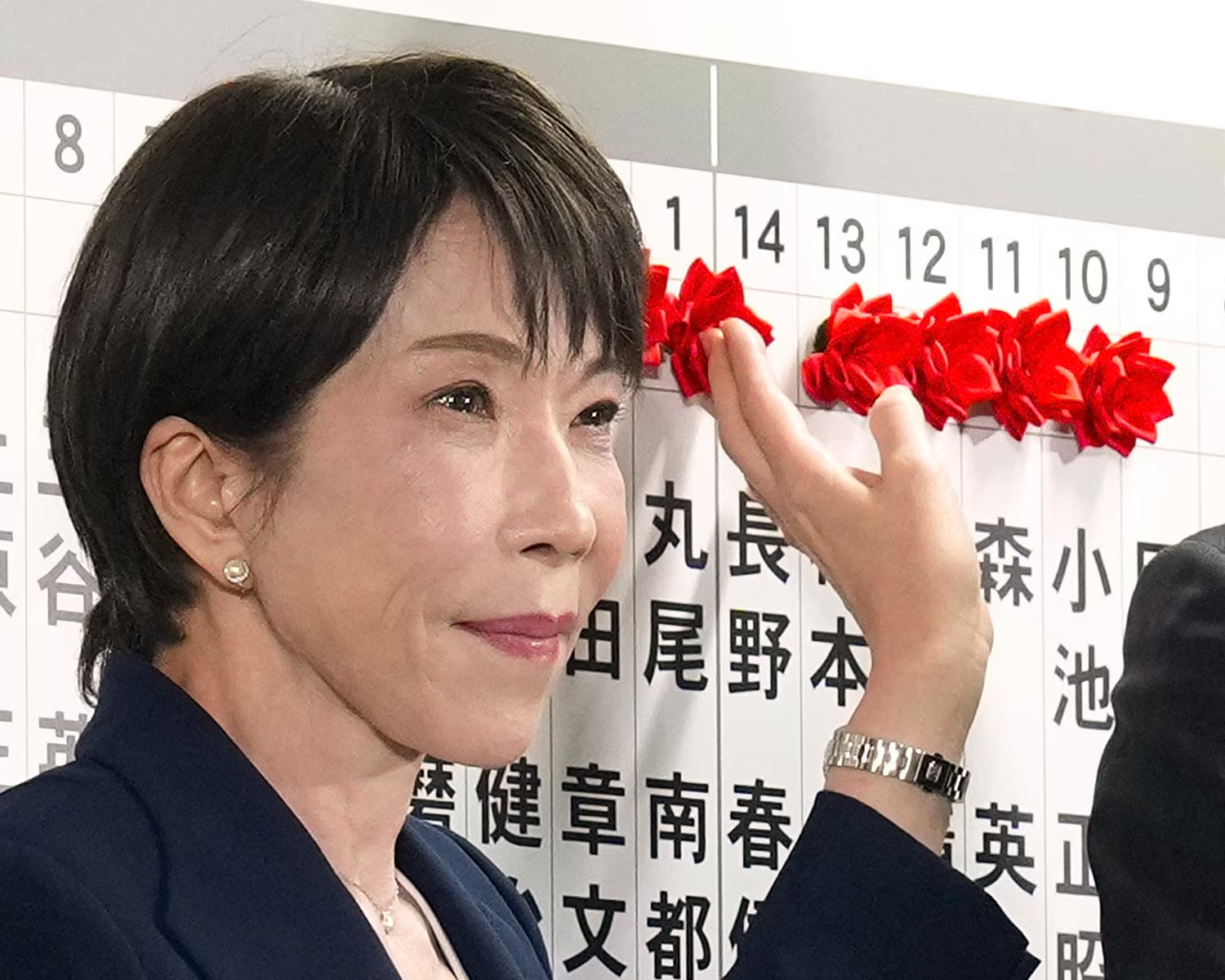
Japan’s stock market hit a record high after the Liberal Democratic Party, led by Sanae Takaichi, secured a decisive victory in Sunday’s election.
The LDP won 316 of the 465 seats in the lower house of parliament—marking the first time since the creation of Japan’s parliament in 1947 that a single party has secured a two-thirds majority on its own.
The Japan Innovation Party, which is part of the coalition with the LDP, added a further 36 seats, giving the ruling bloc a constitutional majority of 352 lawmakers.
The landslide victory significantly eases Takaichi’s path to passing legislation—she became Japan’s first female prime minister and called a snap election in January—since she can now bypass the upper house of parliament, where she lacks control.
After the LDP’s victory, Japanese equities rose on Monday, bonds fell, and the weakened yen recouped part of its losses. Markets interpreted the election outcome as a signal that more forceful fiscal stimulus is likely.
The Nikkei index hit a record high on Monday, breaking above the 56,000 mark for the first time at the opening. It then quickly pushed past 57,000 before ending the day up 3.9%, at 56,363 points.
Gains were echoed across the region. South Korea’s Kospi climbed 4.4%, Hong Kong’s Hang Seng rose 1.8%, and Australia’s S&P/ASX 200 added 1.9%.
In currency markets, the yen initially weakened by 0.3% against the dollar, touching a two-week low, before reversing course and strengthening by as much as 0.7%. By the close, it was 0.5% firmer, at 156.43 yen per dollar.
Takaichi aims to push through a 21 trillion yen stimulus package (£99 billion) and has pledged to suspend the 8% sales tax on food for two years.
Investors were unsettled by the lack of clarity over how the initiative would be financed in a country with the highest debt burden among advanced economies.
The uncertainty triggered a sell-off in government bonds and pushed the yen to historic lows against other currencies.
Some analysts had suggested that the strong mandate might allow Takaichi to step back from the plan—particularly given that opposition parties advocating even more radical tax cuts suffered a crushing defeat.
However, the prime minister rejected that interpretation in a series of brief television interviews as results came in on Sunday, saying she would move quickly to deliver on the LDP’s pledge to suspend the tax.
“While the yen’s initial weakness may not fully materialise, the broader outlook remains one in which the currency will struggle to strengthen,” said Sim Moh Siong, a currency strategist at OCBC in Singapore.
“At least in the near term, concerns about possible intervention persist, which could cap gains in the dollar—yen pair.”
Japanese authorities are concerned about sharp swings in the foreign-exchange market and are monitoring the situation with a high degree of urgency, Minoru Kihara, a senior government official, said at a press conference on Monday.
The central challenge for Takaichi is to find revenue sources to offset the repeal of the tax. The budget shortfall is estimated at around 5 trillion yen a year—a sum comparable to Japan’s annual spending on education.
She has ruled out issuing new debt but has yet to clarify alternative sources of funding, saying only that concrete solutions will be developed through cross-party discussions on social policy and taxation.