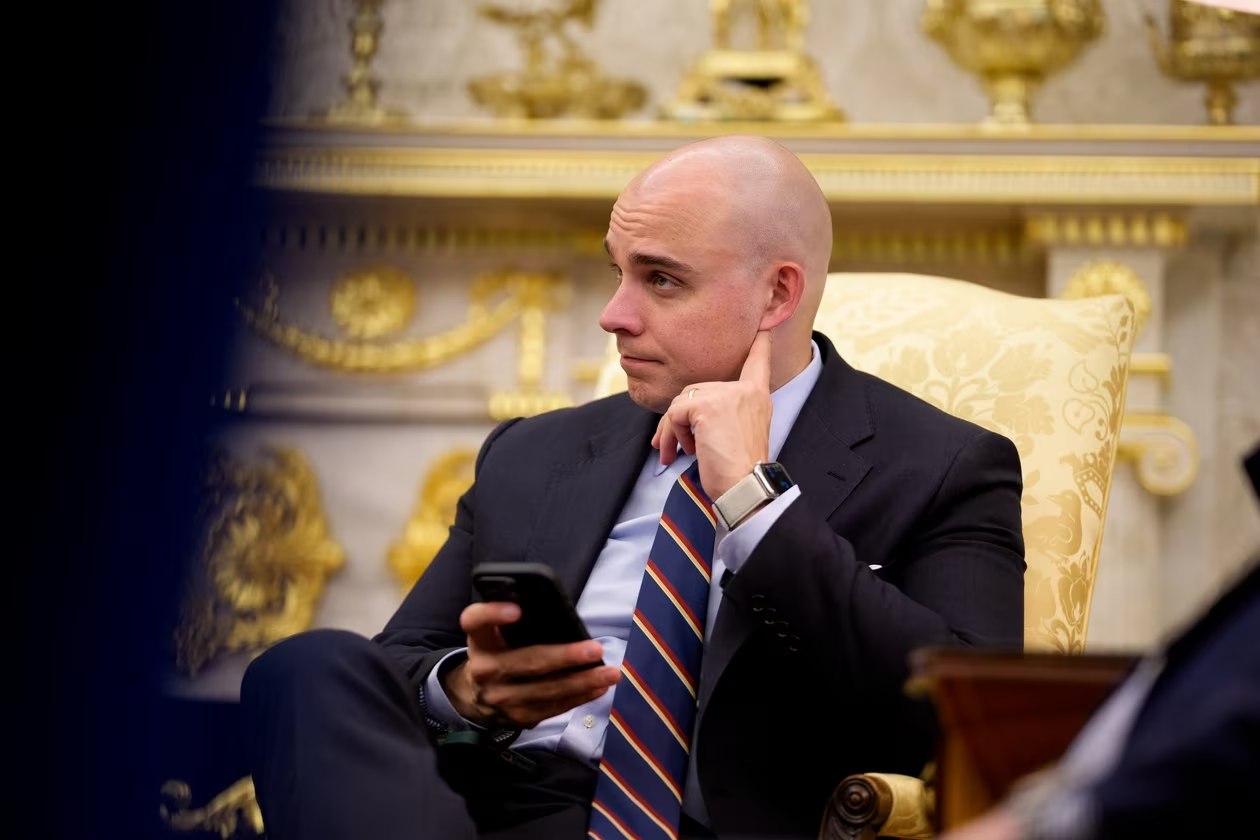
In early 2021, James Blair sat before a panel of senior Republican operatives—including then-Republican National Committee chair Ronna McDaniel and RNC chief of staff Richard Walters—for an interview for one of the party’s most influential behind-the-scenes roles. The position was political director of the RNC for the 2022 midterm elections. The decision came quickly.
According to two people involved in the selection process who requested anonymity, Blair lacked strong ties to the committee’s 168 members. The job ultimately went to Elliott Echols, a longtime RNC official. Just four years later, Blair now leads the White House’s political operation and is responsible for Donald Trump’s strategy for the 2026 midterm elections—the most consequential assignment of his career. The outcome of that campaign will shape not only the final two years of Trump’s presidency but also Blair’s standing ahead of a potential J.D. Vance presidential bid in 2028.
The meteoric rise of the young strategist—met with skepticism at nearly every step—was largely the result of several risky decisions he made last year while serving as political director of Trump’s campaign. At the time, those moves drew fierce criticism, but they ultimately proved central to Trump’s return to the White House. Blair pushed the campaign to focus on voters with low and moderate electoral participation and decided to move a substantial share of voter-mobilization efforts outside the campaign apparatus, outsourcing them to external organizations.
“He convinced us to focus precisely on voters with low and moderate engagement,” said White House chief of staff Susie Wiles. “There were traditionalists in the campaign, but in the end they agreed. His plan worked completely. He delivered.” According to sources, Wiles was not the only member of Trump’s inner circle to reach out to the newsroom unsolicited to praise Blair—a measure of the trust and backing he enjoys within the Trump camp.
Blair’s decision to outsource the voter-mobilization program to external contractors in 2024 also drew skepticism from Republican strategists across the country. In the end, however, it allowed the campaign to save millions of dollars on staffing and administrative costs, redirecting funds toward advertising. “He was relentlessly criticized for that decision, and it turned out to be a thousand percent right,” said one Trump ally, describing the gap between the initial reaction and the final outcome. “He was fully vindicated.” A year later, Blair, now 36, is once again facing doubts within the party: some Republicans are questioning why the White House is spending political capital attacking fellow party members—such as Reps. Thomas Massie and Marjorie Taylor Greene—instead of focusing on vulnerable districts or backing candidates capable of defeating Democrats.
“People are angry at him and at the White House,” said one Republican strategist, who also requested anonymity to discuss sensitive conversations. According to him, there is a broad understanding within the party that the current political environment is unfavorable, making the central question straightforward: “How do we save the House?” “One obvious step is to give strong candidates the space to campaign and raise money in the 13 Republican-leaning districts that Trump carried but that are still held by Democrats. Why are those endorsements taking so long?” he asked.
A White House official, also speaking on condition of anonymity, dismissed accusations that the administration is paying insufficient attention to vulnerable districts or opportunities to expand the caucus. According to the official, Trump has already endorsed 162 House Republicans, 15 senators, and two Senate candidates in races for open seats. The president has also backed Mike Rogers in Michigan, while the White House supported the candidacy of John E. Sununu in New Hampshire for a vacant Senate seat.
Midterm elections have traditionally been difficult for the party of the sitting president, and 2026 is expected to be no exception. Trump is facing the adverse effects of redistricting in Indiana, persistent voter anxiety over the rising cost of living, and the continuing fallout from the gradual release of materials related to the Epstein case—an issue that has held the attention of his MAGA base for an extended period. Even so, Blair continues to retain the president’s confidence.
“There’s a reason President Trump calls his deputy White House chief of staff ‘Brilliant James,’” said White House press secretary Karoline Leavitt. Blair, she added, is one of the most astute political operators in American politics and played a central role in delivering “the most successful start to a presidency in modern U.S. history.”
Trump initially regarded him with skepticism—partly because of Blair’s reserve. According to a person close to the president, Blair was cautious and tentative in his personal interactions with Trump. “I don’t know what it was—maybe he was just overwhelmed by the presidency itself,” Trump said earlier this month at a holiday reception at the White House.
Others, however, persuaded him of Blair’s professional strengths. “I kept hearing from people around me that he’s an absolute political genius,” Trump said at the same reception. “But I didn’t see it. Then I realized—he’s not quiet at all. He’s outstanding. James, thank you for the work you’ve done.”
Richard Walters noted that as far back as 2021, Blair was “more than qualified” for the role of political director of a national campaign. At the same time, he said, Blair lacked strong ties to the 168 members of the party’s governing body during his RNC interview—an essential requirement for that particular position.
Blair’s career ascent was swift and unfolded largely outside the public spotlight. A Florida native, he entered politics in Tallahassee, working as an aide to then-state House speaker Richard Corcoran. Ahead of the 2016 elections, Blair served as political director of the legislative arm of the Florida Republican Party and later became deputy chief of staff to Governor Ron DeSantis.
When Susie Wiles ran Trump’s Florida operation in the 2020 election, she brought Blair onto the team. After he failed to secure a position at the Republican National Committee, Blair worked on several campaigns and, alongside Wiles, helped build Trump’s post-White House political operation. In 2022, he was lead strategist for Tudor Dixon’s unsuccessful gubernatorial bid in Michigan and worked on the congressional campaign of Ohio Rep. Max Miller.
Pivotal to his career were races that cemented his standing within Trump’s political orbit. He worked with Trump adviser Alex Bruesewitz on the first two campaigns of Florida Rep. Anna Paulina Luna and helped launch Rep. Byron Donalds’ super PAC in 2019. Blair also collaborated with Andy Surabian—a Republican strategist and spokesperson for Donald Trump Jr.—on Sen. Jim Banks’ PAC and the successful effort to oust then-Rep. Liz Cheney, forging relationships that would later anchor his influence.
He has also maintained close ties with J.D. Vance and figures in his orbit, including Surabian and pollster Tony Fabrizio. “I’ve worked with thousands of people, and only a handful show the willingness to make tough calls, take calculated risks, and speak truth to power the way James does,” Fabrizio said.
Unlike many other senior figures in the Trump administration, Blair has shown little appetite for the spotlight. Colleagues describe him as “analytical,” “budget-focused,” and intensely data-driven. His reputation solidified quickly both within Trump’s campaign and on Capitol Hill, and in late 2023 he moved directly into the campaign from MAGA Inc., where he had served as a senior adviser.
After Brian Jack, who had overseen the campaign’s outreach to Congress, left in March 2024 to run for the House, Blair inherited that portfolio, significantly expanding his influence among lawmakers. He played a visible role in building support for Trump’s signature legislation—the “One Big Beautiful Bill”—including by presenting Republicans with polling data on the bill’s most popular provisions and urging them to emphasize that changes to Medicaid would remove undocumented immigrants and deceased individuals from the rolls while introducing work requirements.
According to Wiles, “James was not only the chief strategist but also the chief lobbyist.” “Working closely with the president and the team, he helped push through the largest legislative package in decades—and possibly the largest in history,” she said. Blair also became one of the lead negotiators on tax policy in the so-called “Big Six” format, alongside Treasury Secretary Scott Bessent and National Economic Council Director Kevin Hassett, and took part in discussions over the bill’s most contentious provisions, including changes to state and local tax deductions.
“Before joining the campaign, he had virtually no national experience, but he conquered Washington at remarkable speed,” said Bruesewitz, who first began working with Blair in 2020. “On Capitol Hill, he is treated with real respect—not only by Republican leadership but by rank-and-file lawmakers as well. Everyone wants a relationship with James Blair.”