Israel launched two new strikes on Tehran and said it had killed a senior Hezbollah commander on Wednesday—there are no signs of de-escalation, despite Donald Trump’s claims that Iran’s leadership is supposedly seeking a ceasefire.
The U.S. president wrote on social media that the Iranian leader had “just asked” for a truce and that American forces would “leave Iran fairly quickly,” underscoring his intention to pull the country out of the conflict. At the same time, he added to the confusion by mistakenly referring to the president as the “leader of the new regime.”
Masoud Pezeshkian has held office since 2024, long before the war that has now been under way for a month began. Supreme Leader Ali Khamenei was killed in the opening minutes of the attack, and was succeeded by his son Mojtaba, who is widely regarded as more hardline, particularly after other members of the family were killed in the same strike.
Nevertheless, later the same day Trump again declared that Iran had undergone a “complete regime change.” He said any agreement to a ceasefire would depend on lifting Iran’s blockade of the Strait of Hormuz. Iran’s foreign ministry denied that, calling the U.S. president’s claims “false and baseless.”
Asked about the timeline for exiting the conflict, Trump said: “I can’t tell you exactly... we’ll be out fairly quickly.”
“I see a very good chance of making a deal because they no longer want to be bombed,” he told Reuters. “I did not need regime change, but it happened because of the losses of war.” After withdrawing troops, he added, the United States could continue carrying out occasional airstrikes, which he described as “pinpoint strikes.”
Ebrahim Azizi, chairman of the Iranian parliament’s National Security Commission, mocked those remarks. “Trump has finally achieved his dream of ‘regime change’—but in the region’s maritime order!” he wrote on X. “The Strait of Hormuz will certainly remain open, but not for you; it will be open to those who comply with Iran’s new laws.”
Hours before Passover began, Iran fired about 10 missiles at central Israel. Later the same day, Tehran’s allies—Hezbollah in Lebanon and the Houthis in Yemen—also attacked Israel with missiles and drones.
Qatar said that, in the morning, an Iranian missile struck a fuel oil tanker used by the country’s state energy company. A crew of 21 was on board—no injuries or environmental damage were reported.
The Israeli military said it had struck roughly 400 Iranian regime targets over the past two days, including two waves of attacks on Wednesday. Iranian media reported strikes on northern, eastern, and central parts of Tehran.
According to estimates by the International Federation of Red Cross and Red Crescent Societies, at least 1,900 people have been killed in Iran since the war began, and about 20,000 have been injured, though the exact figures remain uncertain.
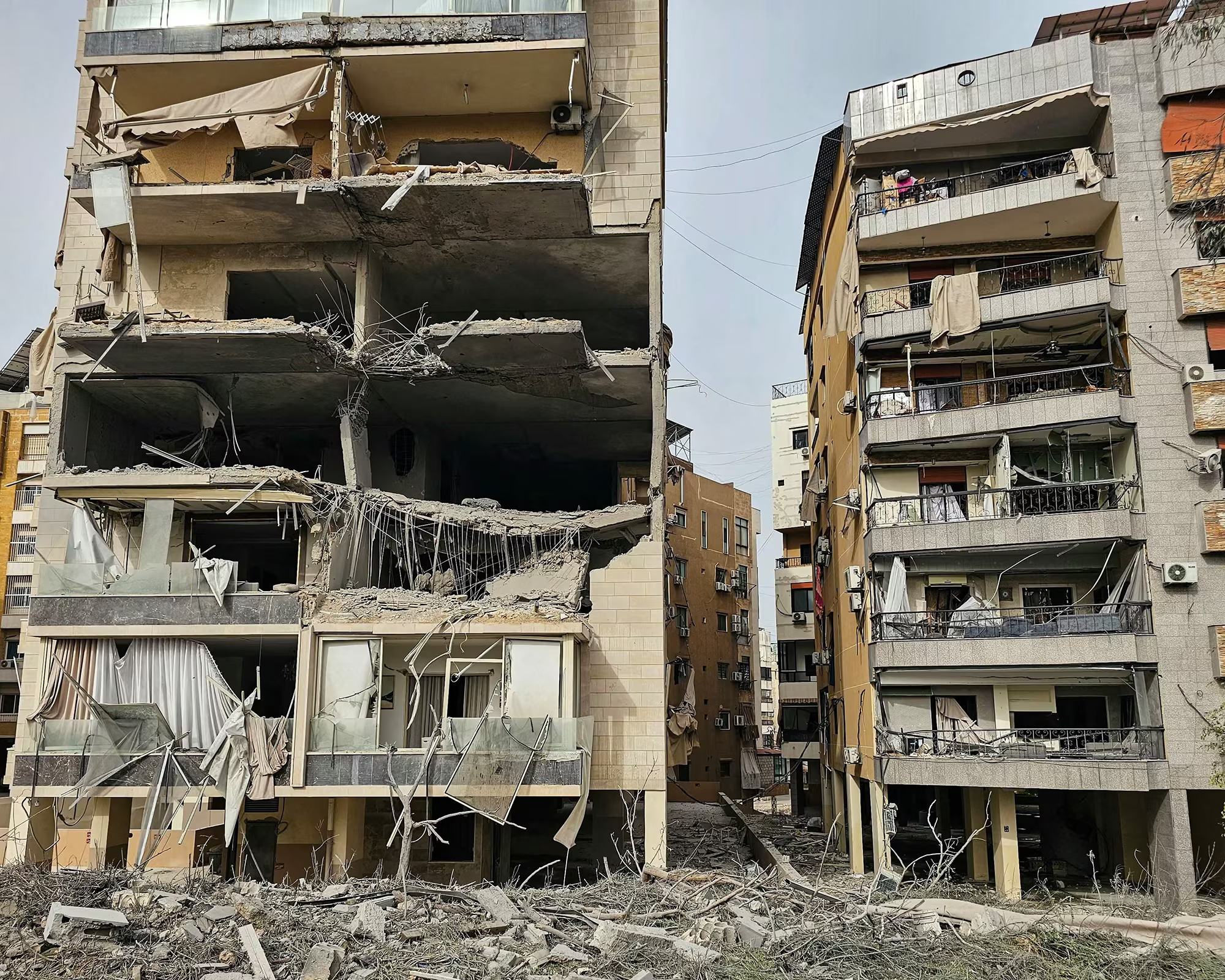
An Israeli naval strike on Beirut killed seven people, among them Youssef Hashem, Hezbollah’s southern front commander—the highest-ranking figure in the group to be killed since the conflict began.
Israel said Hashem had more than 40 years of combat experience, and that his death would deal a “significant blow” to Hezbollah’s ability to resist Israel’s plans to occupy southern Lebanon as part of its rapidly expanding ground operation.
Hezbollah confirmed his death, describing him as a “beacon of Islamic resistance” and a “top-level commander.” It is one of the most significant losses in a conflict that has claimed 1,260 lives in Lebanon.
Most of the dead are Lebanese civilians, though Hezbollah itself estimates that about 400 of them were its fighters. Israel said 10 of its soldiers have been killed since March 2, when fighting began on the Lebanese front.
In Israel, an 11-year-old girl is in critical condition after being wounded by shrapnel in a missile strike on Bnei Brak, east of Tel Aviv. Another 13 people sustained less serious injuries.
Later in the day, fresh attacks, including about 10 ballistic missiles, triggered air-raid sirens across densely populated areas of central Israel—just hours before the start of Passover, which begins with the traditional family seder meal.
IDF spokesperson Brigadier General Effie Defrin said it was “possible” that Iran and Hezbollah “will strike Israeli territory in an attempt to harm civilians during the holiday period,” which will last for a week from Wednesday evening.
Yemen’s Houthis said in the morning that they had launched a missile attack on southern Israel—the third since entering the war four days ago, in coordination with Iran and Hezbollah. The Israeli military said it intercepted the ballistic missile—there were no casualties.
Since the start of the conflict, 19 people have been killed in Israel in missile attacks and 515 have been wounded, according to the Magen David Adom emergency service.
The Strait of Hormuz has in effect been closed to oil and gas tankers, as well as commercial shipping, since the war began, driving up oil prices and worsening shortages of critically important goods around the world.
According to S&P Global Market Intelligence, 10 vessels passed through the strait on Wednesday—making it the fourth-busiest day since the conflict began. Even so, shipping volumes remain more than 90% below prewar levels.
Trump’s unfounded claims of “regime change,” echoed by Defense Secretary Pete Hegseth, have fueled speculation that the president is seeking to declare victory and pull the United States out of the war as the conflict’s consequences intensify—surging oil prices and shortages of fertilizer and medicines that are affecting the global economy.
In his remarks, Trump made no mention of the thousands of Marines and airborne troops concentrated in the region and capable of supporting a ground operation, including on islands in the Persian Gulf and around the Strait of Hormuz.
At the same time, he appeared to rule out a military operation to seize Iran’s 440-kg stockpile of highly enriched uranium—an amount that, with further enrichment, would be sufficient to produce roughly a dozen nuclear warheads.
Since the operation began, Trump has repeatedly claimed that Iran was close to acquiring nuclear weapons, asserting without evidence that the country needed two to four weeks to obtain one and potentially use it against the United States. Experts have unanimously dismissed those claims as unfounded.
The president himself said he was not concerned about the uranium stockpiles, which are believed to be buried deep underground in Iran’s mountainous areas. “It’s so deep underground that I’m not worried about it,” he told Reuters. “We’ll always be watching it by satellite.”
“They will not have nuclear weapons because right now they are incapable of that, and then I will leave, taking everyone with me, and if necessary, we will come back and carry out pinpoint strikes,” he added.
Reuters also reported that U.S. Vice President JD Vance had been in contact with Pakistani intermediaries, conveying that the administration was prepared to consider a ceasefire under a set of conditions, including the reopening of the Strait of Hormuz.