The Israeli military on Wednesday expanded its strikes into central Beirut, destroying buildings and forcing residents to flee neighborhoods that had previously been considered relatively safe—marking a clear escalation in its campaign against the Iran-backed Hezbollah group.
Until now, most strikes had targeted Dahiya—a densely populated southern suburb of Beirut where Hezbollah maintains influence—as well as eastern and southern Lebanon. Israeli forces have now begun striking the capital’s center, often without the advance warnings that accompanied earlier attacks. Israeli officials say the targets are Hezbollah infrastructure and personnel in Beirut.
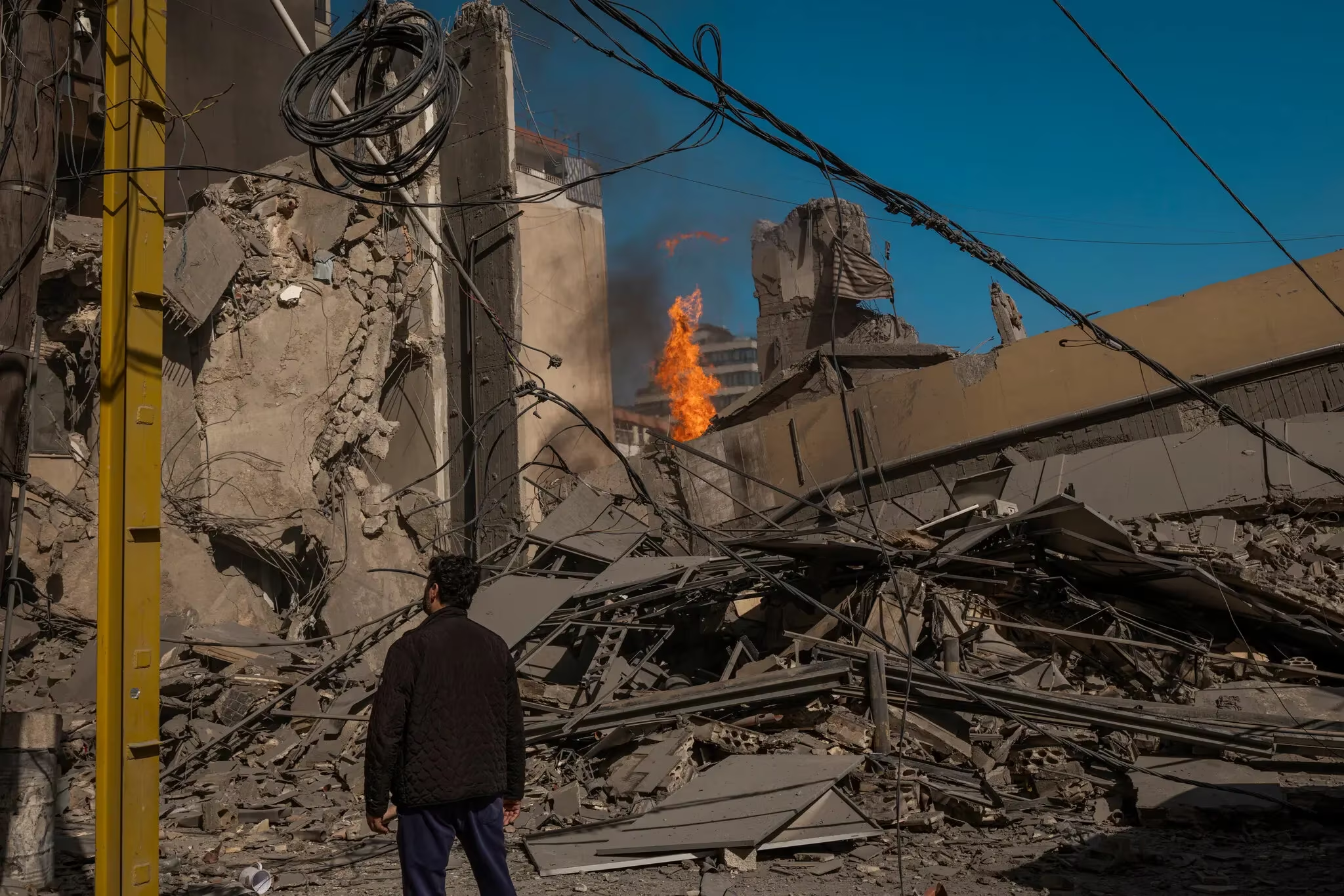
The intensity of the bombardment increased early Wednesday morning—airstrikes hit at least four buildings in the city center, one of which collapsed entirely. It is the first time since the start of the war that a whole building has been destroyed in central Beirut.
According to Lebanon’s health ministry, at least 10 people were killed and another 27 injured in the overnight strikes. The bombardment shook the capital amid a renewed evacuation warning covering large parts of southern Lebanon, and just days after Israeli forces dropped leaflets over central Beirut urging residents to rise up against Hezbollah.
“You saw what happened in Gaza? The same will happen here,” said Hassan Jawad, 40, who lives near the collapsed building in the Bachoura district of central Beirut. The Israeli military said the site had been used by Hezbollah.
An hour after the strike, Jawad stood opposite the destroyed building—now reduced to a heap of debris with twisted rebar protruding from the rubble. Dust and smoke lingered in the air, while municipal crews nearby worked with excavators to clear the roads.
He had woken several hours earlier to the sound of strikes in a nearby district. After the Israeli army posted an evacuation warning for the building on social media, he heard gunfire—a commonly understood informal signal among residents that a strike was imminent. He woke his wife, daughter, and son, and the four of them left the area on his motorcycle.
“I think this war will last longer than the previous one,” Jawad said, standing beside the ruins. “My father and my grandfather lived through times like this. Nothing changes—it all repeats itself again and again.”
This was the only strike in central Beirut overnight for which the Israeli military issued an advance evacuation warning.
Another strike without warning early in the morning in the Zokak al-Blat district set the upper floors of a building on fire—thick plumes of smoke rose into the sky, and ambulances arrived to evacuate and treat the wounded.
In the Fathallah district, Hezbollah fighters blocked the road near the site where another building had been struck. Crumpled and burned-out cars lined the roadside, while fragments of mattresses, bicycle tires, and pieces of clothing lay scattered nearby.
Abu Hussein, 67, who asked to be identified only by his nickname for security reasons, left his home on the outskirts of Dahiya about a week ago after a large-scale evacuation warning. He said he had fallen asleep on Tuesday evening and woke at around 1:30 a.m. to a loud blast.
“I was very frightened—it happened right in front of us,” he recalled. He said his 82-year-old aunt began screaming as the building shook. “This is not street fighting—the danger comes suddenly, from the sky.”
Abu Hussein said they had to leave on foot—the street was blocked by debris, making it impossible to use a motorcycle. He supported his aunt with an arm around her shoulders as they carefully stepped over chunks of concrete and shattered glass.
“Beirut is no longer safe—absolutely not,” he said, standing near a building that was struck later the same day. Gathering his belongings, he added that he intended to leave the city and go to relatives in the coastal town of Byblos, north of the capital.