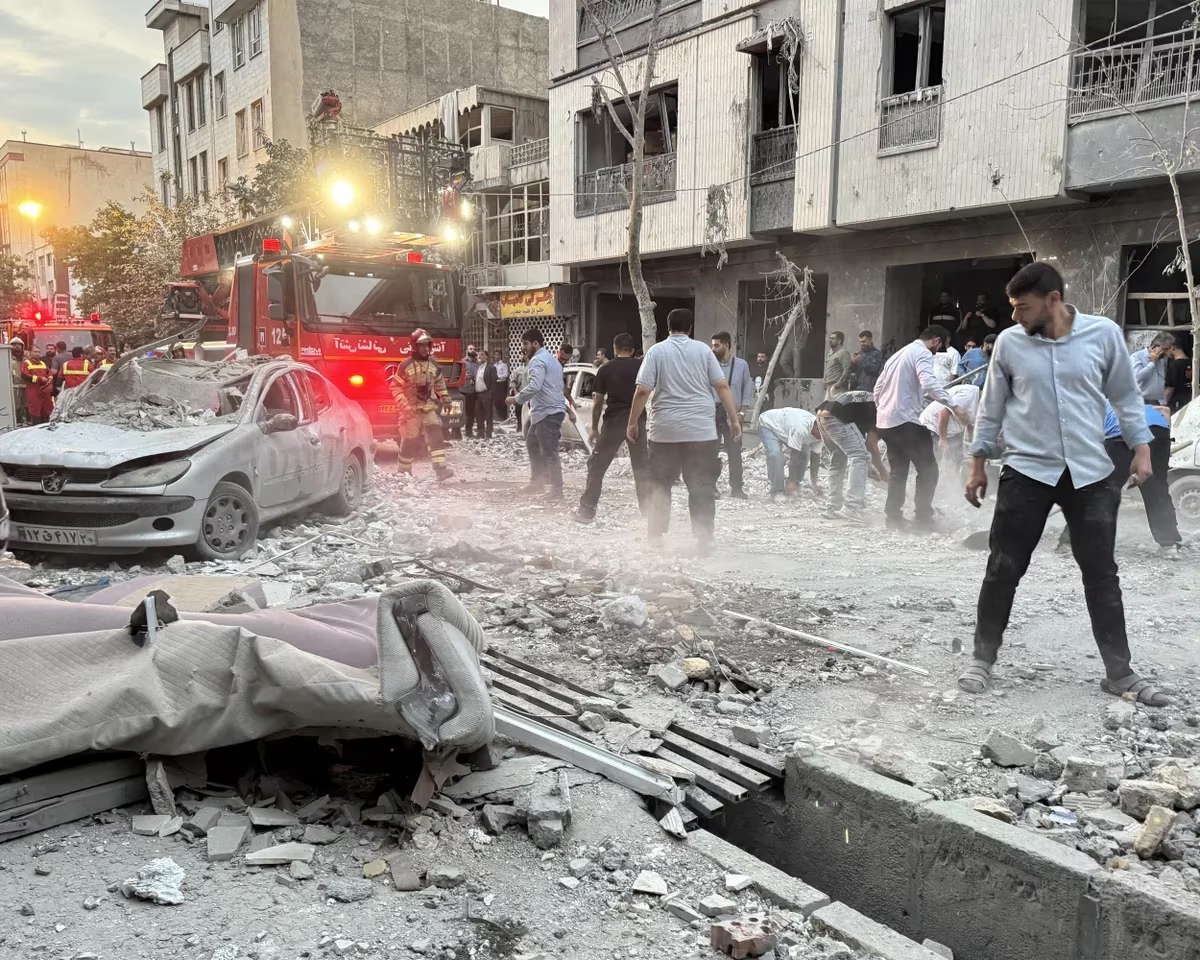
The United States and Israel continue to strike targets across Iran, while Tehran responds with missile attacks across the Persian Gulf—pushing oil prices higher once again as there are still no signs of any imminent agreement.
On Monday, the Israeli military said it had carried out fresh airstrikes on Iranian military sites—a day after attacks triggered power outages in Tehran and surrounding areas. The United Arab Emirates issued warnings overnight, while Saudi Arabia and Kuwait also reported strikes.
“Big day in Iran,” US President Donald Trump wrote on social media late Sunday evening. “Many long-planned targets have been destroyed by our GREAT MILITARY.”
The war—now in its second month—shows no sign of de-escalation, even after the United States extended the deadline for Tehran to agree to reopen the Strait of Hormuz, through which roughly a fifth of global oil and liquefied natural gas supplies typically pass.
Brent crude, on track for a record monthly gain, rose as much as 3.7% on Monday to $116.75 a barrel.
Speaking to reporters aboard Air Force One on Sunday, Mr Trump said a deal to end the fighting could be reached soon, claiming that Iran had “given” the United States most of the 15 demands it had set out, without elaborating. Tehran has not confirmed any such concessions—on the contrary, it publicly rejected the proposed terms last week.
Iran is insisting on its own terms for a settlement, having put forward a five-point plan that includes demands—notably the payment of war reparations—that Washington and Israel appear unwilling to accept.
Fears of a prolonged military campaign in the Middle East are weighing on equity markets: Asian stocks and emerging-market assets fell on Monday. Oil has risen by roughly 90% since the start of the year, reinforcing expectations of slower global growth and faster inflation.
Iran-backed Houthi forces in Yemen effectively entered the conflict over the weekend, launching missile and drone strikes on Israel and opening an additional front. Saudi Arabia intercepted several drones early Monday morning. Kuwait said it had shot down four targets after a fresh Iranian attack involving 14 ballistic missiles and 12 drones, which left 10 servicemen wounded at a military base.
The overall death toll has surpassed 4,750, with roughly three-quarters of the victims in Iran.
In an interview with the Financial Times on Sunday, Mr Trump said he intended to “take the oil in Iran”, implying the seizure of control over the country’s main export hub—Khark Island, which also hosts a naval base. Such a move would mark a sharp escalation involving American ground forces.
“Our people are waiting for American soldiers to enter the ground war,” Mohammad Bagher Ghalibaf, Iran’s parliamentary speaker, was quoted as saying by Tasnim.
According to three diplomatic sources, Mr Trump also considered earlier this month a military operation to seize Iranian uranium enriched to a level close to weapons grade.
Pakistan said it was prepared to help facilitate peace talks between the United States and Iran in the coming days, following a meeting of the foreign ministers of Saudi Arabia, Turkey and Egypt. Foreign Minister Ishaq Dar, without specifying either a timeline or the likelihood of such talks, called for the creation of conditions for a structured dialogue.
Mr Trump is pressing for negotiations as gasoline prices rise in the United States in an election year for Congress. He has already twice extended the deadline by which Tehran must agree to reopen the Strait of Hormuz—where shipping has largely come to a halt—or face the destruction of its power plants.
Iranian strikes on aluminium facilities in the Middle East over the weekend are heightening risks for an already fragile market, increasing the likelihood of record metal prices for a commodity used in aviation, food packaging and solar energy.
On Sunday, the International Atomic Energy Agency reported extensive damage to the heavy-water reactor at Khondab as a result of US-Israeli strikes. Heavy water is used in nuclear power generation and in the production of weapons-grade plutonium.
One of the declared aims of the war is the destruction of Iran’s nuclear capacity—Mr Trump had claimed that the republic was already approaching the creation of a bomb even before the start of the American military campaign. Tehran has repeatedly stressed that its nuclear programme is purely civilian in nature and not intended for weapons development.
The conflict began on February 28 with US and Israeli strikes on Iran and has since spread to more than a dozen countries across the region, leading to lower oil production in Arab states and a sharp reduction in shipping through the Strait of Hormuz.
The positions of vessels stranded in the Persian Gulf became clearer after electronic interference eased over the weekend. Despite the continuing threats to shipping, the large-scale signal jamming that had obscured ships’ real coordinates has diminished, according to the Joint Maritime Information Center.
A strike on Prince Sultan Air Base in Saudi Arabia on Friday wounded at least 15 American servicemen and damaged an E-3 Sentry aircraft equipped with a radar system used to track drones and missiles. Such an aircraft costs about $300 million. Unverified images appear to show its tail section destroyed, rendering it unfit to fly.
The US military said that about 3,500 sailors and Marines had arrived in the region aboard an amphibious assault ship. The newly deployed Tripoli Amphibious Ready Group also includes strike fighters, along with amphibious and tactical assets.
According to governments and non-governmental organisations, the overall death toll has exceeded 4,750. Roughly three-quarters of the victims are in Iran, while more than 1,100 people have been killed in Lebanon, where over one million people have been forced from their homes. Dozens of deaths have also been recorded in Israel and the Gulf states.