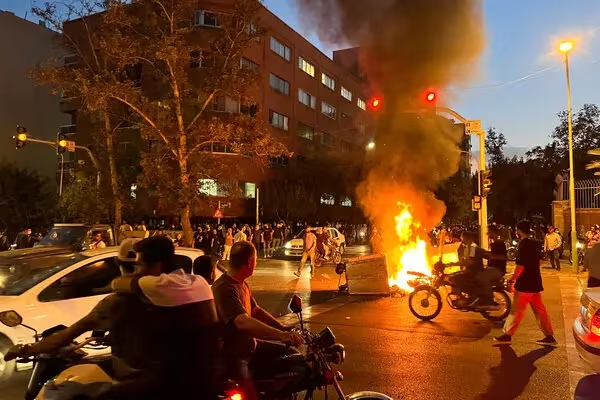
Iran warned the United States against military intervention in response to protests sweeping the country, after President Donald Trump said Washington was “ready to help.”
Two weeks of civil unrest have become the most serious internal challenge to the Islamic regime in years. US media reported that the Trump administration is weighing military options in response to the protests, although, according to those reports, no decision on intervention has been made. The White House did not respond to a request for comment.
Despite tougher measures by the authorities, protesters continued to take to the streets in cities including Tehran on Saturday.
The US president has repeatedly said that Washington is ready to “help” Iranians if the authorities begin killing protesters. On Saturday he wrote on social media: “Iran is looking at FREEDOM, perhaps like never before. The US is ready to help!!!”
The remarks came amid a tightening crackdown and efforts by the authorities to contain the largest protests in years, as reports point to a rising death toll.
According to the exile-based Human Rights Activists News Agency, 116 people have been killed since late December, when the demonstrations began, including members of the security forces, and more than 2,600 people have been detained. The figures cannot be independently verified: since Thursday, Iran has been effectively cut off from the outside world after the imposition of an almost total internet blackout and communications shutdown.
Iran’s parliamentary speaker, Mohammad Bagher Ghalibaf, speaking on Sunday, warned the United States against a “miscalculation.” “Let us be clear: in the event of an attack on Iran, the occupied territories [Israel], as well as all US bases and ships, will be legitimate targets for us,” he said. Ghalibaf is a former commander of the Islamic Revolutionary Guard Corps.
The United States has several military bases in the region. In June, Tehran launched a missile strike on a US base in Qatar in response to Trump’s decision to bomb the republic’s main nuclear facilities, when he briefly joined Israel’s 12-day war against Iran.
Iran’s president, Masoud Pezeshkian, said on Sunday that the authorities were ready to “sit down and listen” to citizens’ demands. “It is our duty to address their problems. But an even greater responsibility is not to allow a group of rebels to destroy the whole of society,” he said in an interview with Iranian television. “These are not people. They are not from this country.”
He placed responsibility for stoking the protests on the United States and Israel. On Saturday, Pezeshkian also warned Washington against intervention. “Assuming that the Islamic Republic of Iran is like other countries, the United States resorts to the same methods, encouraging certain individuals to create chaos and disorder,” he said at a meeting with Oman’s foreign minister.
According to state television, he said the Iranian people would “support the country and the Islamic system even more strongly than before.”
Oman has previously acted as a mediator between the United States and Iran.
The current unrest is unfolding at a moment when the Islamic Republic is in one of its most vulnerable positions in years—amid mounting internal pressure and an increasingly desperate and angry population.
Despite the authorities’ harsh measures, videos continue to circulate online that purportedly show protesters returning to the streets and defying the crackdown. The authorities have warned that those detained will be held to account swiftly and without leniency.
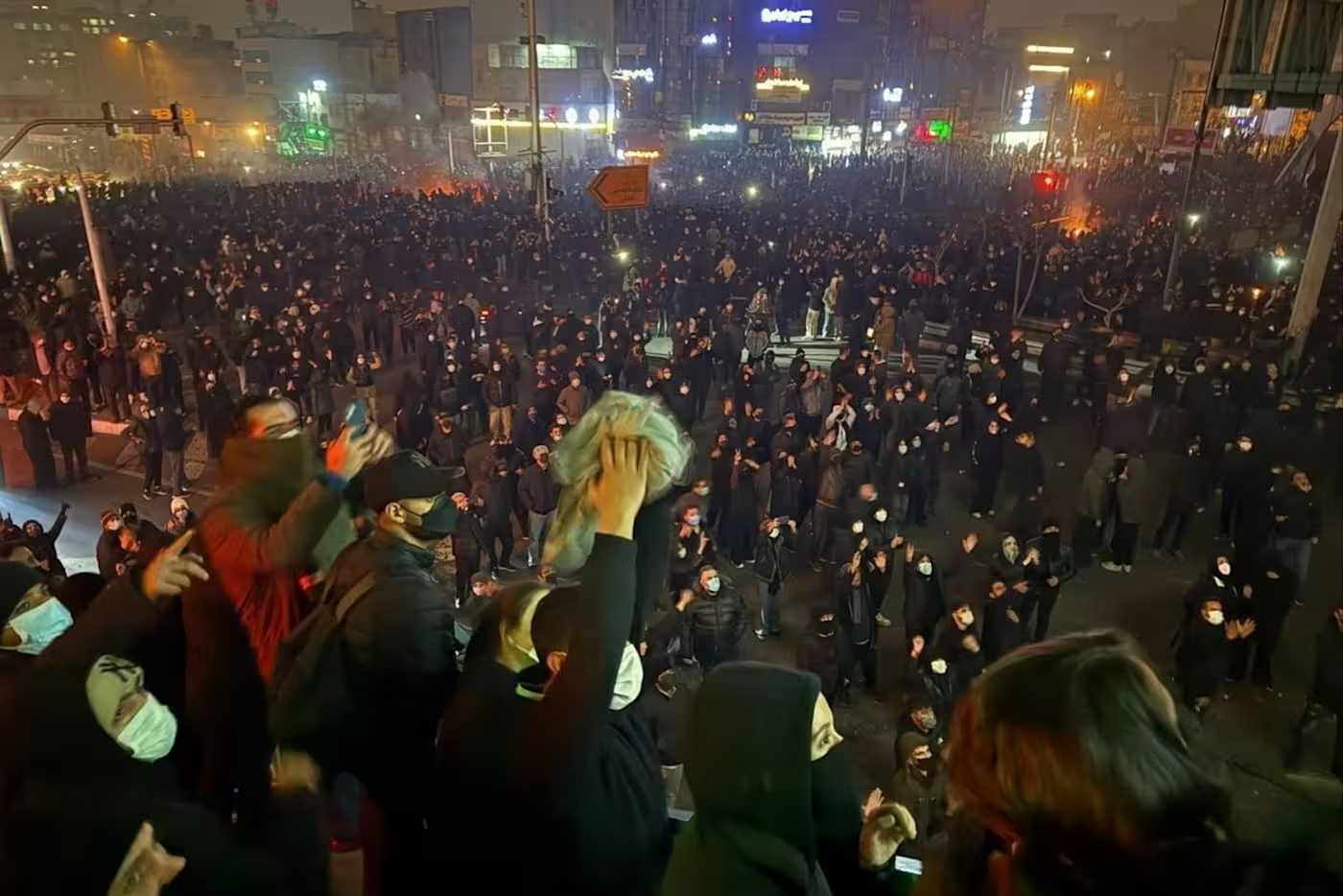
Tehran’s state prosecutor said that people who attack public buildings and security forces with weapons could face charges of “waging war against God,” an offence that carries the death penalty.
State-affiliated media reported that hundreds had been arrested and that dozens of security personnel had been killed in the unrest, which sharply escalated on Thursday—the first day of Iran’s weekend.
The governor of Isfahan province said on Sunday that 30 security personnel had been killed in the region since the protests began, according to Iranian state television.
The authorities accused “armed groups” of attacking “public and private property in several provinces,” reporting extensive damage, including to mosques.
The protests initially erupted over economic grievances, after shopkeepers in Tehran shuttered their businesses in protest against soaring prices. Over time, they evolved into nationwide anti-regime demonstrations.
Masoud Pezeshkian, who came to power 18 months ago on promises to reform the economy, initially sought to calm demonstrators. As the protests intensified, however, the authorities’ rhetoric grew markedly harsher.
“For the Islamic Republic, this is uncharted territory, because we are seeing organic pressure from below—segments of society that have historically been pillars of the regime are protesting, and this has grown into something far larger,” said Ellie Geranmayeh of the European Council on Foreign Relations. “There are no easy answers to this pressure, particularly as it is compounded by pressure from above from the United States and Israel.”
These protests mark the most serious internal challenge to the regime since 2022, when Mahsa Amini was detained for allegedly wearing her hijab improperly and died in custody. According to Amnesty International, more than 300 people were killed in the crackdown on those demonstrations.
Iran’s economic and military position today is weaker than before, in part as a result of Israel’s devastating 12-day war against the Islamic Republic in June.
During the conflict, Israeli forces eliminated senior Iranian military commanders and nuclear scientists, destroyed air-defence systems, and—together with the United States—struck the country’s nuclear facilities.
During the Israeli attacks, Iranians rallied around the flag—the external threat triggered a surge of nationalism that temporarily eclipsed disillusionment with the leadership. Yet social and economic problems continued to mount: after the war, the rial lost more than 40 percent of its value, further fuelling already high inflation.
A source familiar with the matter said that Israeli authorities are closely monitoring developments in Iran, and that Prime Minister Benjamin Netanyahu discussed the situation with US Secretary of State Marco Rubio in a phone call on Saturday.