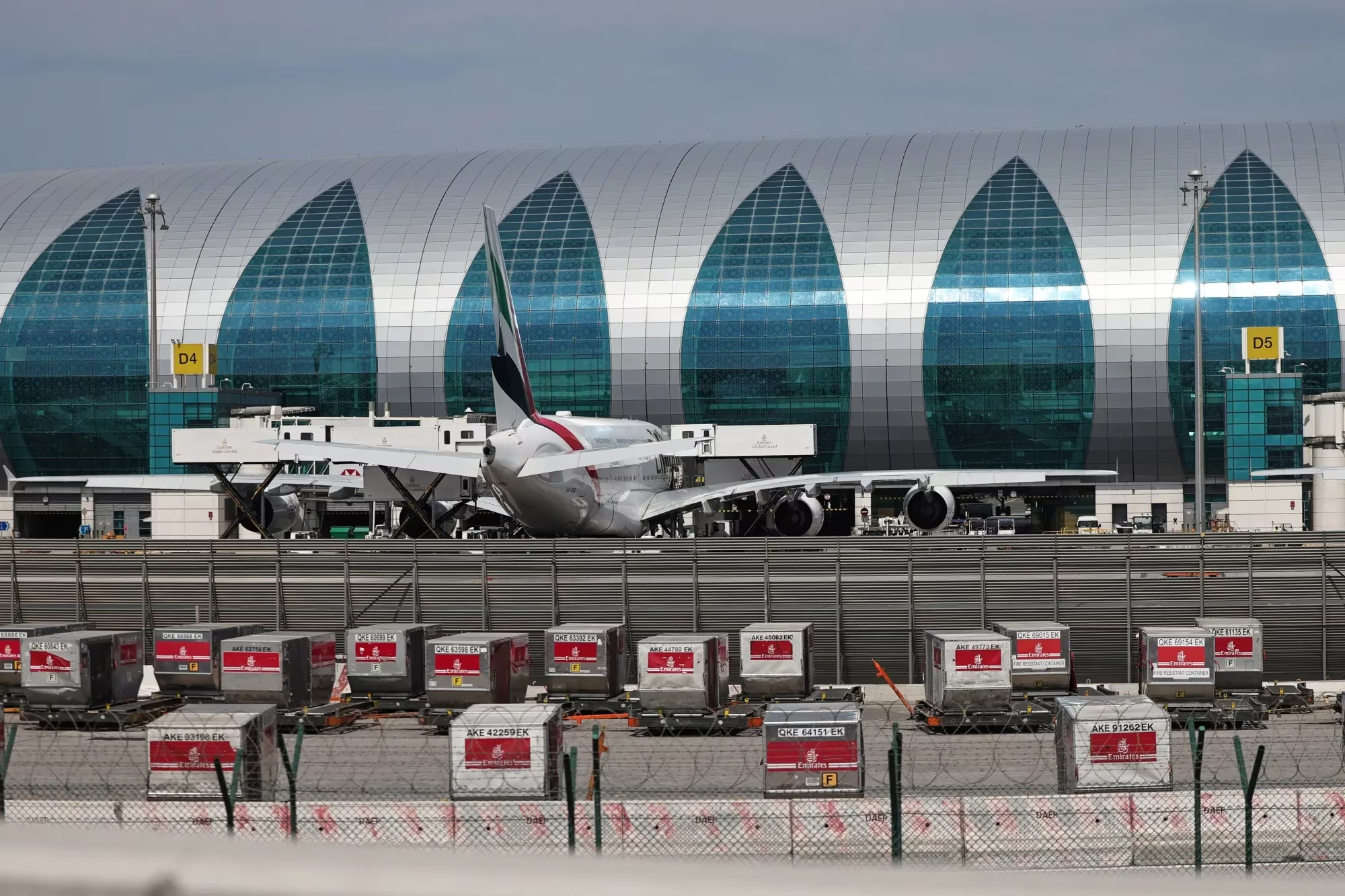
For years, American and European airlines watched as Middle Eastern carriers expanded passenger traffic through their hubs in Dubai and Doha—offering competitive fares and operating some of the newest aircraft in the skies.
Emirates, Qatar Airways, and Etihad Airways capitalized on their advantageous position at the crossroads of three continents—Europe, Africa, and Asia.
With the outbreak of war with Iran, that picture changed overnight: airspace was shut, flights were canceled, and regional carriers were hit by disruptions. Although the overall volume of long-haul travel declined, Western airlines began moving into the space left behind.
Deutsche Lufthansa AG, British Airways, and Air France-KLM moved quickly last month to reallocate aircraft to routes serving India, Thailand, and Singapore, hoping to capture displaced demand. For now, however, gains in market share remain limited, and any durable advantage will take time to secure.
The unanswered question is whether this amounts to a short-term disruption or a deeper transformation—one in which regions once considered secure come under the prolonged shadow of war.
A further challenge for European carriers has been the rise in fuel prices triggered by turmoil in energy markets: they are being forced to choose between raising fares and absorbing the added costs themselves—all amid complete uncertainty over how long the conflict will last.
Middle Eastern airlines “have not abandoned their ambitions to become global hub carriers,” said Rob Walker, an aviation industry analyst at consulting firm ICF. “All the Europeans can do is try to seize the moment.”
The most notable increase in capacity so far has been recorded in the United States, although much of it reflects plans drawn up before tensions in the Middle East escalated.
United Airlines and Delta Air Lines increased long-haul wide-body capacity by 11% and 12%, respectively, according to Flightradar24, expanding frequencies to Europe and launching new routes aimed at affluent American travelers.
Costs and the Limits of Expansion
American carriers do not hedge fuel risks in advance, but last month they recorded stronger demand as passengers rushed to book tickets in anticipation of higher fares.
According to Rob Walker, an analyst at ICF, the disruptions in the Middle East are benefiting nonstop flights from the United States to Asia, as well as transatlantic routes, where American carriers operate in partnership with European airlines through codeshare agreements.
The longer the war goes on, the more serious the consequences for Middle Eastern airlines become. President Trump this week declined to offer any timeline for the conflict’s end, while promising to intensify pressure on Iran.
Turkish Airlines increased its market share in the month following the outbreak of war, while Qatar Airways lost more ground than any other carrier, according to Bloomberg data.
Lufthansa has reported a short-term rise in demand and is seeking to lock in the rerouting of capacity. Chief financial officer Till Streichert said it was “absolutely” possible to shift part of that capacity to Asian routes on a permanent basis.
Yet such decisions run up against practical constraints: narrow-body aircraft serving Gulf routes are not suitable for flights to Asia, deliveries of wide-body jets are booked out years in advance, and launching new routes takes months—requiring slot approvals, scheduling adjustments, and staffing.
Further pressure is coming from fears of a shortage of aviation fuel. Lufthansa is already weighing contingency measures, including the possible suspension of some flights.
Since the start of the war, Lufthansa shares have fallen 17%, IAG SA—the parent company of British Airways—13%, and Air France-KLM 27%. Morgan Stanley and UBS have cut target prices for several European carriers, citing rising fuel costs.
A Narrow Window of Opportunity
The timing of the war’s end remains uncertain. What is already clear, however, is that Middle Eastern airlines will return determined to recover their position quickly through price competition.
“I expect Gulf carriers to offer extremely attractive fares to win passenger traffic back through their hubs. That means European airlines may have only a brief window to capitalize on elevated demand and pricing,” said Richard Evans, a senior consultant at analytics firm Cirium.
The Middle Eastern hub model delivered rapid growth for Emirates and Etihad: in 2025, Emirates carried 55.6 million passengers—more than four times as many as it did 20 years earlier.
Dubai became the world’s largest international airport, though rivals have long argued that unfair subsidies were the foundation of such rapid expansion.
“It irritates me when people say, ‘These Gulf carriers are so impressive—they have new aircraft and modern airports,’” Air France-KLM chief executive Ben Smith said. “But when the playing field is uneven, that is not hard to achieve.”
Asian carriers are also expanding long-haul routes: Singapore Airlines has added flights to London and Melbourne, Cathay Pacific has broadened its presence in Paris, Zurich, and London, Air India has announced additional services, and Qantas is seeking to increase capacity on European routes.
Flights between Asia and Europe had already become more complicated after Western airlines began avoiding Russian airspace in 2022.
The conflict with Iran has made matters worse: with the airspace of Iran and Iraq closed, routes now run through narrow corridors over Georgia, Azerbaijan, and the countries of Central Asia.
“The main challenge for European carriers on Asian routes is access to airspace and competition from Asian airlines that still retain the ability to fly through Russia,” said Conroy Gaynor, an analyst at Bloomberg Intelligence. “We expect much of the additional capacity to be redirected to transatlantic routes, though the question remains whether demand will be strong enough to absorb such a substantial increase.”