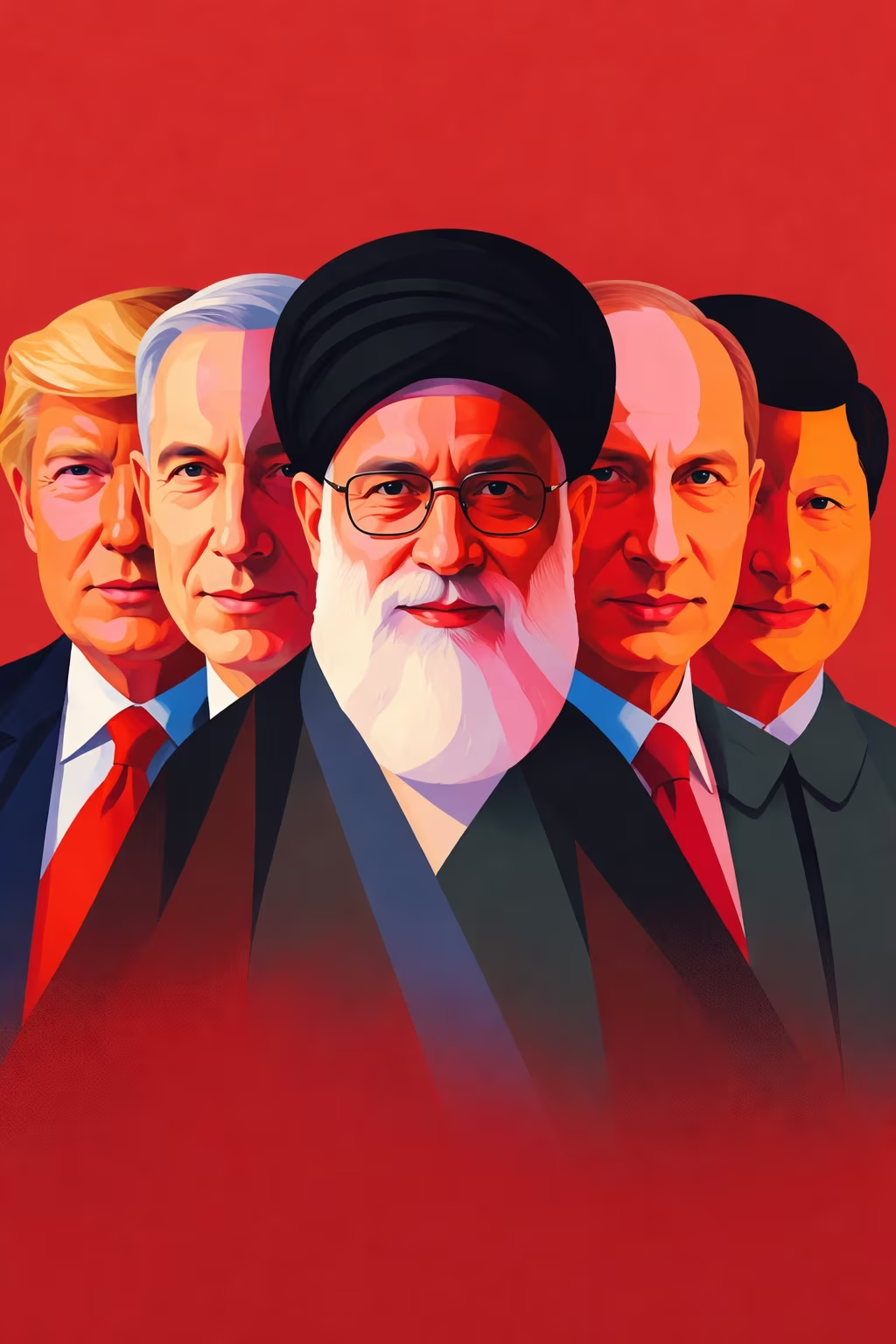
A map of alliances, proxy networks, and silent actors involved in one of the most dangerous regional confrontations of recent decades—following the joint US–Israel strike of February 28, 2026.
Geopolitical Alignment Map
The Western Bloc vs Iran’s “Axis of Resistance”
The US–Israel Axis: A Unified War Machine
On February 28, 2026, the United States and Israel launched operations Epic Fury and Rising Lion—within 12 hours, nearly 900 joint strikes were carried out, resulting in the killing of Supreme Leader Ali Khamenei, as well as attacks on Iran’s nuclear and military infrastructure.
🇺🇸 United States
The key partner in the strikes. B-2 and B-52 bombers, carrier strike groups, cyber operations. “There is no ceiling to American support” for Israel—War on the Rocks. The operation was personally authorized by Donald Trump.
🇮🇱 Israel
The leading strike power. F-35I fighter jets, Jericho missiles, intelligence integration with the CIA. Benjamin Netanyahu’s 15-year campaign against Iran’s nuclear program culminated in the February 28 strike.
🇬🇧 United Kingdom
A defensive partner only. Allowed the deployment of US bombers at RAF Fairford and Diego Garcia bases to “destroy Iranian missiles at the launch stage.” Did not participate in offensive strikes. UK base in Akrotiri, Cyprus.
🇩🇪 Germany and France
Together with UK Prime Minister Keir Starmer, condemned Iran’s retaliatory strikes. Called for a diplomatic settlement and an end to Iran’s nuclear program. Did not take part militarily.
🇦🇷 Argentina and Ukraine
Publicly supported the strikes, describing them as justified, and urged Iran to agree to a nuclear deal as soon as possible.
Tehran’s Proxy Network: Weakened but Still Fighting
Iran’s doctrine of “forward defense”—projecting power through armed proxies from Lebanon to Yemen—has suffered significant damage since October 2023, yet its components remain actively engaged in the current war.
🇱🇧 Hezbollah (Lebanon)
Iran’s most powerful proxy. On March 2, 2026, it carried out a large-scale coordinated attack on Israel using rockets and drones. Significantly weakened after the 2024 conflict, but still retains a substantial arsenal. The Lebanese government has attempted to disarm it.
🇾🇪 Houthis / Ansar Allah (Yemen)
Declared solidarity with Iran. After a pause since October 2025, they again threatened attacks on shipping in the Red Sea. Leader Abdul-Malik al-Houthi pledged military support, though his rhetoric remained restrained and “disciplined,” reflecting the priorities of the Yemen ceasefire.
🇮🇶 Iraqi Shia Militias
Kataib Hezbollah, Asaib Ahl al-Haq, and others. Claimed attacks on US bases near Baghdad and Erbil. Fragmented: some groups continue combat operations, while influential figures integrated into Iraq’s state structures seek to avoid escalation.
🇵🇸 Hamas and Palestinian Islamic Jihad
Hamas is focused on preserving its structure and negotiating disarmament. Iran’s role now amounts to “historical support rather than operational control” (RAND, 2026). Palestinian Islamic Jihad remains more directly dependent on Iranian leadership.
Strategic Partners and the “Grey Zone”
Russia, China, North Korea: Weapons Without Troops
None of Iran’s major allies have deployed troops. However, arms supplies, technology transfers, and diplomatic backing over many years have underpinned its military capabilities.
🇷🇺 Russia
Supplied S-300 air defense systems (destroyed by Israel in 2024) and began transferring Su-35 fighter jets. Conducts launches of Iranian satellites. GRU advisers operated in Yemen. Provided the Houthis with targeting data for maritime strikes. Shares advanced military technologies, reportedly including nuclear-related ones.
🇨🇳 China
A “comprehensive strategic partnership” since 2021 spans the military sphere, intelligence, and cyber operations. Chinese-designed C-802 anti-ship missiles were supplied to Hezbollah and the Houthis. In early 2025, Iran ordered solid-fuel missile components from China. Ahead of the February strikes, China urged its citizens to leave Iran.
🇰🇵 North Korea
A long-term supplier of ballistic missile technologies and underground infrastructure to Iran and its axis partners. Transferred nuclear technologies, including a plutonium reactor destroyed by Israel in Syria in 2007.
Gulf States and Turkey: Between Two Fires
Gulf monarchies quietly welcomed Iran’s weakening, but Tehran’s retaliatory missile strikes on their capitals and on US bases on their territory have forced a reassessment of their strategy.
🇸🇦 Saudi Arabia
Interested in weakening Iran, yet wary of full-scale destabilization. Iran carried out drone strikes on Riyadh and the Eastern Province. The head of Saudi Aramco warned of “dramatic” consequences for the global economy. Saudi Arabia supported the US decision to designate a Muslim Brotherhood faction in Sudan linked to the “axis” as a terrorist organization.
🇶🇦 Qatar
Hosts the US Al Udeid air base—which came under Iranian attack. In early March 2026, Qatari authorities arrested an Iranian “sleeper” cell. Qatar had previously mediated between Hamas and Israel, but has now itself come under fire.
🇹🇷 Turkey
A NATO member that intercepted an Iranian ballistic missile over its territory. Asserted its right to self-defense. Its position remains complex: it supported Syrian HTS forces against Iran and the Assad regime, hosted refugees, and at the same time rhetorically opposed US military policy.
🇴🇲 Oman
A key diplomatic intermediary. Facilitated US–Iran nuclear talks in 2025–2026. Said the sides were “close to a breakthrough” before the February 28 strikes. Despite its neutral mediating role, Oman was also reportedly targeted by Iranian retaliatory strikes.
What This Balance of Power Means—in Five Points
Dynamic
What It Means in 2026
Key Risk
Entrapment in an Allied Conflict
The US entered Israel’s war because “Israel was going to strike anyway—we could either join or take the retaliation” (Rubio). A classic Snyder trap: unconditional commitments removed Israel’s incentives for restraint.
The US has no clear exit without effectively abandoning its “junior partner.”
Weakening of the Axis
Iran’s “forward defense” network (Hezbollah, Hamas, the Syrian corridor) has been significantly degraded since October 2023. Iraqi militias are fragmented. The Houthis remain the most intact proxy, but without direct Iranian control they lack coordination.
A cornered Iran may attempt to use its remaining uranium stockpile as leverage.
Convergence of Two Axes
The “Axis of Resistance” and the Russia–China–North Korea–Iran bloc are increasingly overlapping (Washington Institute). The war around Iran is becoming a testing ground for weapons already used in Ukraine—the same drones, the same missiles.
Material support from Russia and China continues despite their formally neutral stance.
Collapse of Gulf Neutrality
Iranian strikes on Saudi Arabia, Qatar, the UAE, and Kuwait have shown that neutrality offers no protection. This may push Gulf states toward closer de facto alignment with the United States.
Disruptions to oil flows through the Strait of Hormuz threaten to accelerate global inflation (IMF: +0.5% with a 10% increase in oil prices).
Domestic Political Divide in the US
For the first time in 25 years, more Americans sympathize with Palestinians than with Israelis (Gallup, February 2026). Political support for the “special relationship” is weakening even as military cooperation deepens.
A prolonged war of attrition—Iran’s strategy—may erode US political will.
From Proxy War to Open Conflict
For four decades, Iran and Israel waged their confrontation through intermediaries. Tehran financed and armed Hezbollah, Hamas, and the Houthis; Israel struck Iranian assets in Syria, Lebanon, and Gaza. The violence was real, but contained—the sides preserved plausible deniability and avoided a direct clash that could escalate into an existential conflict.
That phase ended decisively on June 13, 2025, when Israel launched the Twelve-Day War—a large-scale surprise campaign targeting Iran’s nuclear sites, missile factories, senior military commanders, and nuclear scientists. Iran responded by launching more than 550 ballistic missiles and over 1,000 kamikaze drones, striking civilian infrastructure and military targets across Israel. The United States intercepted Iranian attacks and struck three underground nuclear facilities using bunker-buster bombs. The ceasefire held—for eight months.
October 7, 2023
Hamas Attacks Israel
The war in Gaza begins. Iran-backed proxies across the region begin to mobilize.
April—October 2024
The First Direct Exchange of Strikes Between Iran and Israel
Israel struck the Iranian consulate in Damascus; in April, Iran fired more than 300 missiles at Israel; in July, Israel killed Ismail Haniyeh in Tehran, and in September—Hassan Nasrallah in Beirut.
June 13–24, 2025
The Twelve-Day War
Israel strikes Iran’s nuclear program. Iran responds with a large-scale attack. The United States enters the conflict. A ceasefire is reached under US pressure.
December 2025—January 2026
Mass Protests in Iran
The largest since the 1979 revolution. Security forces kill at least 30,000 people. Trump threatens intervention.
February 2026
Nuclear Talks Collapse
Indirect US–Iran talks in Oman were described as “close to a breakthrough”. Then, on February 28, the United States and Israel simultaneously launched operations Epic Fury and Rising Lion, in which Ali Khamenei was killed.
February 28, 2026
War With Iran
Iran launches hundreds of missiles and thousands of drones at Israel, as well as at US bases in Bahrain, Qatar, Kuwait, the UAE, Saudi Arabia, Turkey, and Cyprus. Hezbollah reenters the fighting. More than 2,000 people are killed.
An Axis Weakened, but Not Destroyed
Iran’s strategic architecture—what Chatham House describes as “forward defense”—was built on the premise that armed proxies would intercept threats before they reached the country’s own territory. Through Hezbollah in Lebanon, militias in Iraq and Syria, Palestinian armed groups in Gaza, and the Houthis in Yemen, Iran constructed a network of destabilization that enabled it to project influence while avoiding direct military confrontation with Israel and the United States.
Since October 2023, that network has been systematically degraded by Israeli military operations: Hamas has been reduced to a struggle for institutional survival, Hezbollah has lost a significant share of its arsenal and leadership, the Syrian corridor has been severed following the fall of the Assad regime, and Iraqi militias have become fragmented. The Houthis in Yemen remain the most intact component—largely due to their geographic distance from Israeli strikes and the combat experience gained during years of war with Saudi Arabia.
“Iran’s doctrine of ‘forward defense,’ built on the idea that proxy depth should absorb threats before they reach national territory, is approaching its limits”
RAND Corporation, March 2026
RAND Corporation, March 2026
Nevertheless, Iran demonstrated that even a weakened axis remains capable of delivering devastating retaliation. On February 28, Iranian forces launched hundreds of ballistic missiles and drones at Israel, US bases across the Persian Gulf, and civilian infrastructure throughout the region—including strikes on Saudi Arabia, the UAE, Qatar, Kuwait, Turkey, and Cyprus. The initial barrage triggered a wave of follow-on attacks—hundreds of missiles and thousands of drones deployed by Iran across the region—leaving more than 2,000 people dead in Iran, Lebanon, and Israel, forcing hundreds of thousands to flee their homes in Lebanon, and stranding hundreds of thousands of passengers across the Middle East.
Alliance Entrapment in Real Time
The joint US–Israel military operation has no modern precedent in its level of coordination. The United States and Israel may assign different names to their campaigns—Epic Fury and Rising Lion—but in practice they are inseparable. The fusion of intelligence, coordinated air operations, joint cyberattacks, and synchronized information campaigns has blurred the line between the two militaries.
Critics in Washington point to what political scientist Glenn Snyder termed “alliance entrapment.” Israel was going to strike. The United States could either join or absorb the retaliation—this is precisely how Snyder’s mechanism operates in real time, as acknowledged not only by critics but by members of the administration itself. Secretary of State Rubio effectively confirmed that Washington had no real choice but to participate once Israel had decided to proceed with the strike.
Washington’s stated strategic objectives include degrading Iran’s nuclear program, its ballistic missile arsenal, naval capabilities, and its mechanisms of control over proxy forces. The official position also encompasses drones and the management of “terrorist proxies,” and the United States has already made substantial progress toward these goals. However, analysts at the Atlantic Council warn that Iran views the situation as an existential conflict and assumes that a prolonged war of attrition will, over time, erode the resolve of the United States and the Gulf states.
Russia and China: Material Support Behind Neutral Rhetoric
Neither Russia nor China has entered the war. Both publicly call for restraint. Yet their contribution to the development of Iran’s military capabilities over the past decade has directly shaped Tehran’s ability to wage war. Russia supplied Iran with long-range S-300 air defense systems (destroyed by Israel in April and October), began transferring Su-35 fighter jets, conducts Iranian satellite launches, and is likely sharing advanced military technologies with Tehran, including nuclear-related ones.
China’s role is more economic and technological in nature. The 2021 “comprehensive strategic partnership” spans the military sphere, security, intelligence, and cyber cooperation. Chinese-designed C-802 anti-ship missiles, produced in Iran, were used by Hezbollah in 2006 and by the Houthis in 2016 against Israeli, American, and Emirati vessels. North Korea, for its part, has for decades remained a steady supplier of ballistic missile technologies and underground infrastructure to Iran.
What Comes Next
The defining asymmetry of this conflict is strategic patience. The United States and Israel can inflict large-scale military damage, but Iran’s leadership assumes that a prolonged war of attrition—eroding US political will, placing pressure on Gulf economies, and driving up oil prices—may ultimately yield results. From Tehran’s perspective, any cessation of hostilities would amount only to a temporary pause until the United States or Israel rebuild their military capacity and resume the conflict.
The nuclear question remains unresolved. Iran’s stockpile of enriched uranium—estimated at hundreds of kilograms of 60% enriched uranium prior to the strikes—may not have been fully destroyed. Whether Iran can reconstitute a weapons program, and whether new leadership (Khamenei’s son is reportedly being groomed as successor) will choose that path, will define the next phase of the war.
It is already clear that the Middle East’s alliance architecture has been irreversibly reshaped. However the war ends—through regime change or negotiation—Iran is likely to emerge weakened and far less capable of sustaining its previous level of regional influence. The question is no longer whether the “Axis of Resistance” will endure, but what will replace it.