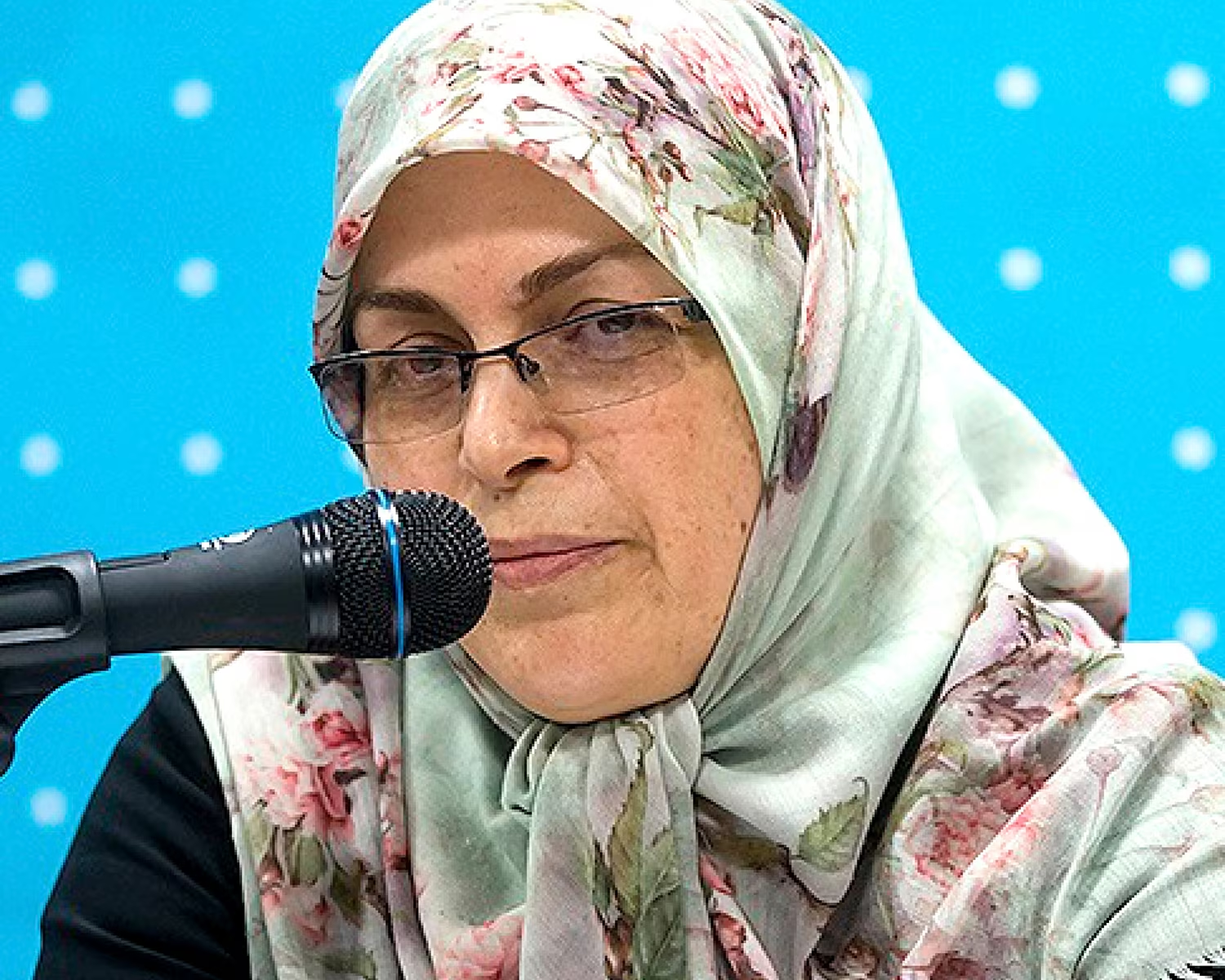
The head of Iran’s Reformist Front—an organization that played a pivotal role in the election of President Masoud Pezeshkian—has been arrested by the Islamic Revolutionary Guard Corps. The move is likely to further intensify tensions over how the authorities responded to the recent street protests.
Azar Mansouri, the secretary-general of the Islamic Iran People’s Party, publicly expressed profound grief over the deaths of protesters and stressed that nothing could justify such a tragedy. She did not, however, call for the resignation of Supreme Leader Ali Khamenei.
As part of what appears to be a targeted sweep of prominent reformist figures outside the government, Ebrahim Asgarzadeh, head of the Front’s political committee, and Mohsen Aminzadeh, who served as a deputy foreign minister under former president Mohammad Khatami, were also detained.
At least two other prominent members of the Reformist Front—an umbrella grouping that includes up to 27 reformist factions—have been ordered to report to police stations this week. The measures appear designed to curb the spread of criticism directed at the security forces for their role in suppressing the protests.
Officials acknowledge at least 3,000 deaths, though alternative estimates put the toll significantly higher.
Tehran’s prosecutor’s office said the detainees had allegedly done everything possible to “justify the actions of terrorist foot soldiers” and had acted in collusion with the United States and Israel. They were also accused of “undermining national unity, opposing the constitution, promoting capitulation, distorting the activities of political groups, and creating covert subversive mechanisms.”
Justifying an unprecedented tightening of repression, the head of the judiciary, Gholam-Hossein Mohseni-Ejei, said: “Those who issue statements against the Islamic Republic from within are aligned with the Zionist regime and America.” He described the authors of the statements as “pathetic and contemptible” and warned that they would “pay a price.”
In a statement published last week, Mansouri wrote: “We will not allow the blood of these dear people to be consigned to oblivion, or for the truth to be buried in dust. Defending one’s rights and striving to clarify the truth is a human duty for each of us. With our entire being, we declare our revulsion and anger toward those who ruthlessly and recklessly have thrown the youth of this country into earth and blood.
No force, no justification, and no passage of time can cleanse this great catastrophe,” she added. At the same time, Mansouri did not support foreign intervention.
Her detention followed the arrest of four other Iranian human-rights advocates who had signed a statement—endorsed by 17 prominent activists—calling for a “free and transparent referendum” on the establishment of a new democratic government in Iran. Initially detained were Vida Rabbani, Abdollah Momeni, and Mehdi Mahmoudian; it now appears that a fourth signatory—Dr. Ghorban Behzadian-Nejad, a senior adviser to reformist prime minister Mir-Hossein Mousavi—was also taken into custody.
The statement by the group of 17 declared: “The mass killing of justice-seekers who courageously protested against this illegitimate system has become an organized state crime against humanity.” It condemned the shelling of civilians, attacks on the wounded, and the denial of medical care as “acts against Iran’s security and a betrayal of the homeland.”
Separately, it was reported that Narges Mohammadi, a Nobel Peace Prize laureate arrested 59 days ago, has received a new seven-year prison sentence. On Sunday, she was allowed to speak briefly with her lawyer, Mostafa Nili, for the first time. She said she had been transferred to a hospital, only to be returned to prison before her treatment was completed.
Pezeshkian has ordered an investigation into the events surrounding the protests, though it is unlikely to scrutinize the IRGC. The arrests of his former allies starkly illustrate how limited the president’s influence is over the key centers of decision-making—a conclusion that will become even more apparent if he remains silent about the detention of his associates.
With turnout at 49.7%, Pezeshkian won the presidential election in June 2024, securing 16.4 million votes and comfortably defeating Saeed Jalili, who garnered 13.5 million. Even so, translating that mandate into action has proved difficult.
Israel’s prime minister, Benjamin Netanyahu, moved his visit to Washington forward in an effort to persuade President Trump to include Iran’s missile program in the ongoing talks between the United States and Iran.
The Muscat negotiations, mediated by Oman and launched on Friday, are set to resume this week. Trump has said he is prepared to limit the agenda strictly to curbing Iran’s nuclear program—a stance that is unsettling Israel and parts of the Republican Party.