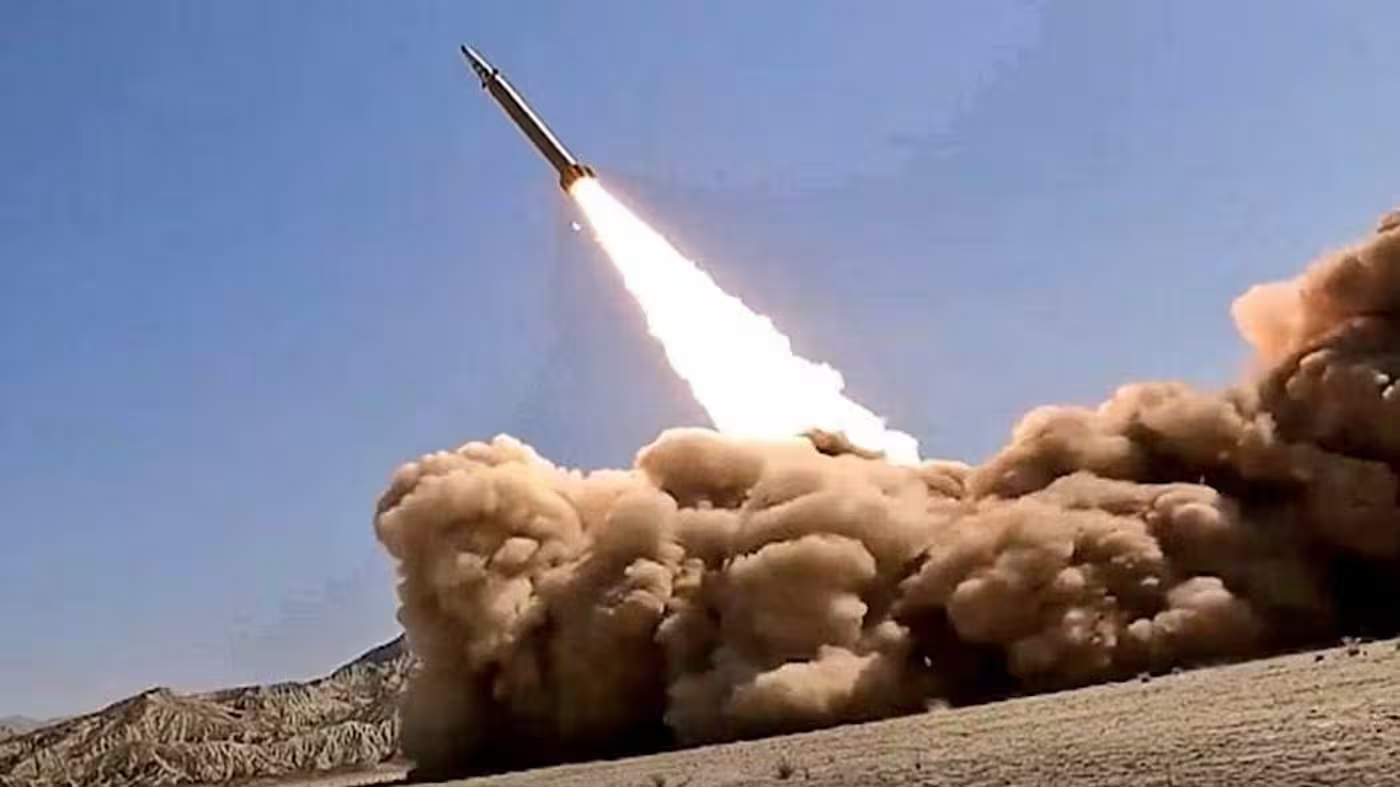
For the Gulf states, which are subjected to near-daily Iranian missile strikes, a central question remains—what has become of Tehran’s most advanced missiles.
In May last year, Iran’s defence ministry unveiled its latest missile, the Qassem Basir, declaring that it would enable strikes against adversaries “wherever they may be and whenever necessary.” The system is equipped with a 500kg manoeuvrable warhead and a terminal-phase optical guidance system that is said to be resistant to electronic jamming, making it one of the most sophisticated weapons in Iran’s arsenal.
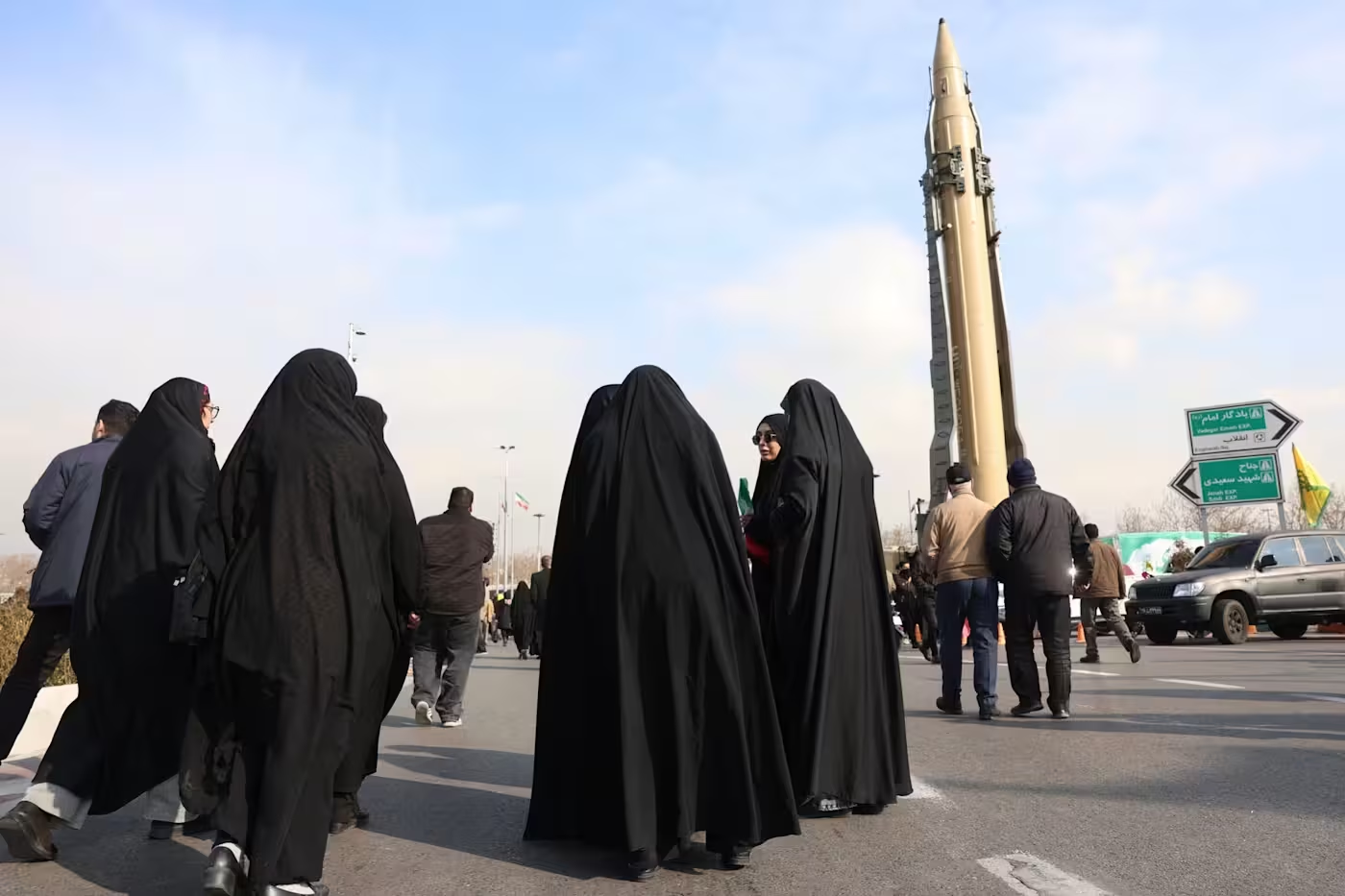
People walk past a model of the Etemad missile during an event marking the 46th anniversary of the Islamic Revolution. The Etemad missile has not yet been used in combat. February 2025.
Yet nearly a month into the conflict with Israel and the United States in the region, it has not been deployed. Analysts suggest this reflects a broader pattern: some of the most technologically advanced systems remain unused—either because they have been destroyed, have not yet entered service, or are being held in reserve for a moment when the adversary’s stock of interceptors begins to run low.
A strike on the Ras Laffan gas complex in Qatar last week underscored the risks facing the region. According to a source familiar with the details of the attack, missiles with manoeuvrable warheads were used.
“Tehran may be holding some of its most effective systems in reserve, although stocks of these newer missiles are likely limited,” said Jim Lamson of the James Martin Center for Nonproliferation Studies, a former CIA analyst.
Among the systems that have not been used, he cited the Qassem Basir, the Etemad—a modernised version of the Emad missile with a manoeuvrable warhead—as well as the Fattah-2, developed on the basis of the Fattah-1. According to Iran’s claims, the Fattah-2 is equipped with a hypersonic glide vehicle that is extremely difficult to intercept. Open-source data also suggest that the short-range manoeuvrable Raad-500 missile has not been used in the region.
At the same time, Iran’s nightly missile strikes on Israel and targets in the Gulf began with simpler and more outdated systems, but have gradually incorporated more advanced models. These include the solid-fuel Sejjil missile, the heavy Khorramshahr with a cluster warhead weighing up to 2 tonnes, as well as the Kheibar Shekan, unveiled in 2022 and carrying a warhead of around 1 tonne.
The number of missiles launched has been gradually declining, while the overwhelming majority are intercepted—both the medium-range missiles directed at Israel and the shorter-range systems used against targets in Gulf countries.
U.S. and Israeli aircraft continue to strike launchers on Iranian territory in an effort to deny it the ability to fire. According to the Israel Defense Forces, around 200 of approximately 470 launchers have been destroyed in strikes, with others damaged or buried.
Nevertheless, Iran has managed to carry out isolated strikes. In particular, an oil refining facility in Haifa was hit—using a new missile that Tehran has described as the Nasrallah system—as well as the Ras Laffan gas facility.
On Friday, March 21, Iran struck a joint U.S.-UK military base on Diego Garcia in the Chagos Archipelago, deploying two super-heavy Khorramshahr missiles. One failed in flight, while the other was intercepted.
The very fact of the strike surprised experts, as the target lies roughly 4,000 km away—beyond the presumed range of most Iranian missiles. In their assessment, the warheads were likely lightened to extend the missiles’ range.
“I do not think they are concealing any decisive capability,” said Danny Citrinowicz, an Iran expert at the Institute for National Security Studies in Tel Aviv. “The strike on Diego Garcia was unexpected, but was more political in nature. From a technological standpoint, if you are capable of delivering a 1.5-tonne warhead over a distance of 2,000 km, extending the range by reducing the payload is not a breakthrough.”
Both sides are, in effect, seeking to exhaust each other’s resources, waging a protracted confrontation shaped by calculation and displays of capability. Iran is avoiding the use of its most valuable missiles when there is a high likelihood they will be intercepted by Israel’s missile-defence systems—Arrow and David’s Sling. Israel, for its part, has little interest in expending interceptors on targets that do not pose a serious threat.
Analysts assess that Tehran is operating under the constraint of conserving its missile arsenal, which likely still numbers in the hundreds.
This allows Iran to sustain strikes at a more restrained but steady pace, despite a reduced launch capacity under U.S. and Israeli strikes. At the same time, Israel’s multi-layered air-defence system continues to intercept the majority of threats, though at significant cost and with limited interceptor stockpiles. Even the most effective systems do not provide complete protection, and a prolonged conflict raises the risk that supplies will be depleted faster than they can be replenished.