Late Tuesday night and into the early hours of Wednesday, sirens once again sounded across the Middle East—Israel and the United States continued striking targets in Iran, while Iranian forces retaliated with attacks against Israel and Washington’s allies in the region.
Late Tuesday, the Islamic Revolutionary Guards Corps said it was launching the 35th wave of its operation, targeting American military bases across the Middle East and sites in central Israel. The report was carried by Tasnim, a news agency affiliated with the IRGC.
The Israeli military also said late Tuesday that it had begun “an additional wave” of strikes against government facilities in Tehran. About 20 minutes later, the army announced that it had detected missiles launched from Iran and instructed the public to take shelter in protected spaces.
The situation soon repeated itself—Israeli military officials first told residents they could leave their shelters, but about an hour later some people were again instructed to return to protected spaces.
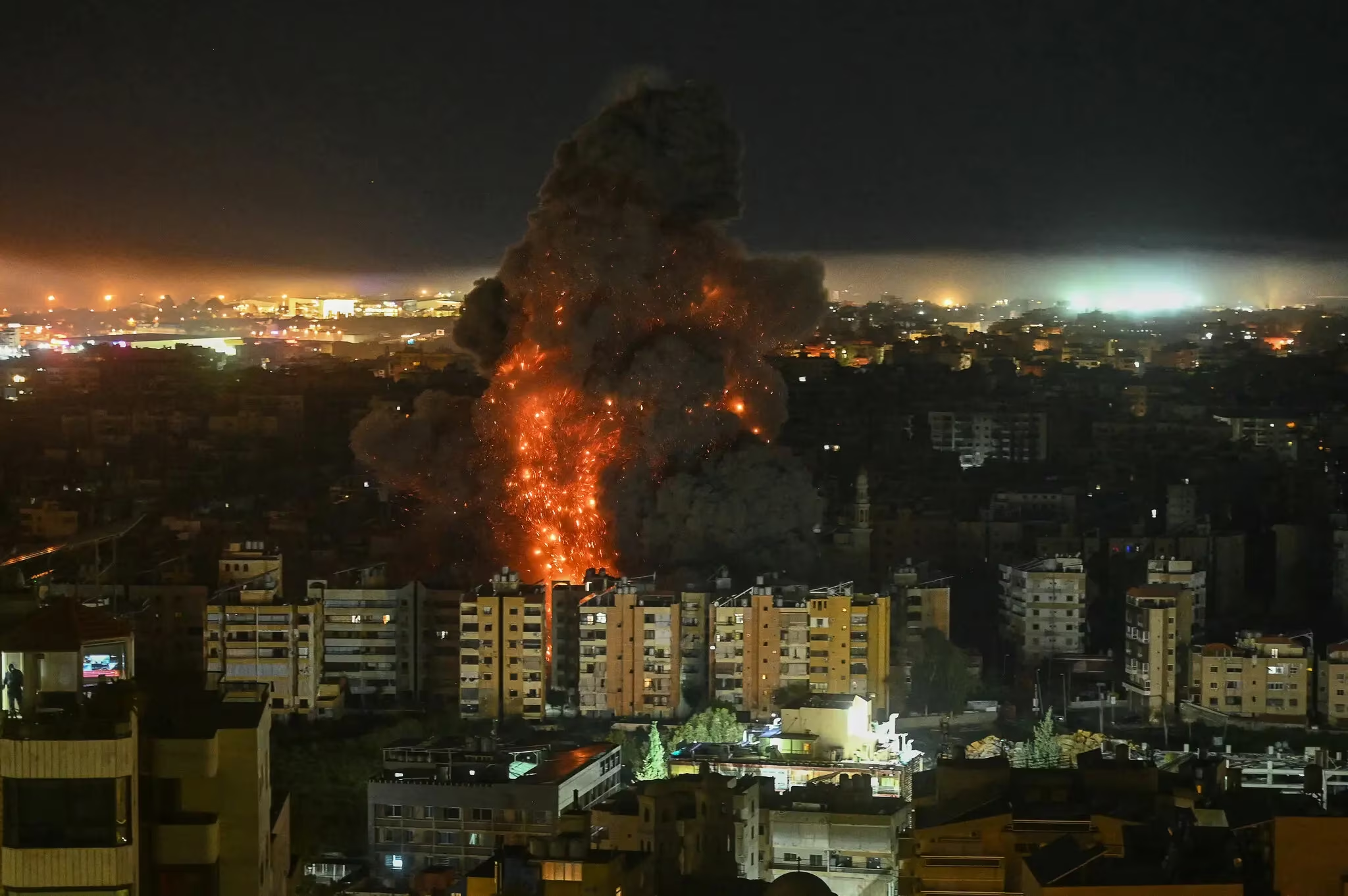
In Lebanon, residents of the capital, Beirut, reported explosions caused by Israeli airstrikes on the Dahiya district—a densely populated southern suburb of the city widely regarded as a stronghold of the Iran-backed Lebanese group Hezbollah. Residents said the blasts were seen and heard across the city and continued for several hours.
Local residents said the first explosions occurred in the afternoon—several hours after the Israeli military issued an evacuation warning. Earlier on Tuesday, an Israeli military spokesman wrote on social media that Hezbollah was concealing weapons in the area. Shortly after midnight Middle East time, the Israeli military said it was striking Hezbollah infrastructure in the Dahiya district “in parallel” with attacks on Iran.
Hezbollah said in a statement that it had carried out 30 attacks on Tuesday.
Lebanon’s Health Ministry said that at least 95 people were killed across the country on Tuesday as a result of Israeli strikes.
The consequences of the war were also felt in other parts of the Middle East.
Bahrain’s Interior Ministry urged residents to seek shelter after sirens sounded across the kingdom early Wednesday morning. Bahrain’s Defense Force said late Tuesday that it had intercepted 106 missiles and 176 drones since the start of the conflict.
Kuwait’s Defense Ministry said it had detected five drones that entered the country’s airspace on Tuesday.
Qatar’s Defense Ministry said in several statements on Tuesday that the country had faced seven missile attacks.
Early Wednesday morning, Saudi Arabia’s Defense Ministry said it had intercepted four drones and seven ballistic missiles during several attacks. A day earlier, the ministry said that since the outbreak of hostilities late last month more than 110 drones, at least nine ballistic missiles and six cruise missiles had been directed at the kingdom.
The United Arab Emirates’ Defense Ministry also said early Wednesday that it was repelling a series of ballistic missiles launched from Iran. Late Tuesday evening, the ministry said it had recorded nine ballistic missiles and 35 drones during the day. According to its data, since the start of the conflict 1,475 Iranian drones, more than 260 ballistic missiles and eight cruise missiles have been directed at the Emirates.