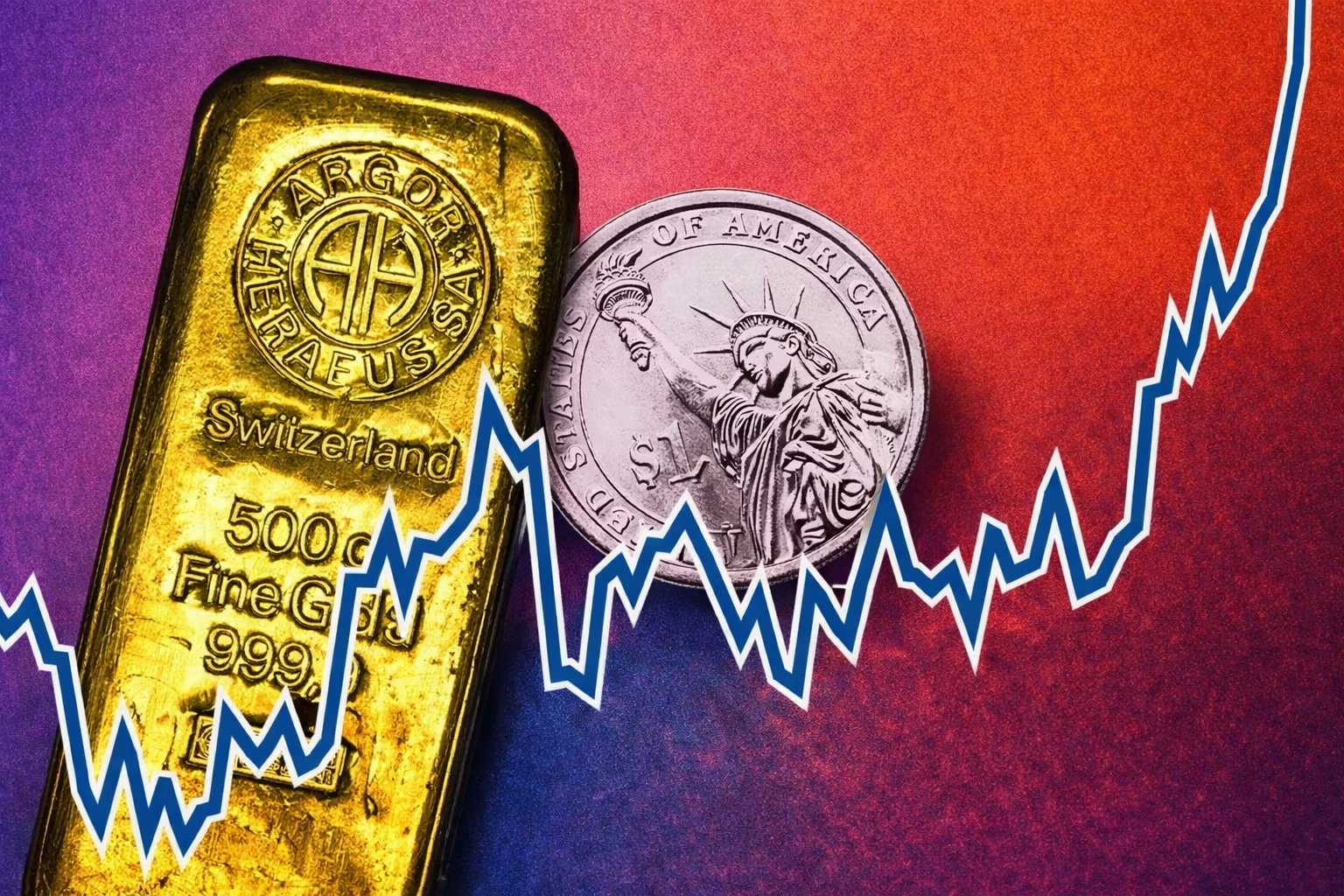
Large investors, amid rising anxiety over a potential inflation shock driven by the war around Iran, have favored gold and the US dollar over the traditional safe haven of government bonds.
On Monday, March 2, gold surged toward a record high, jumping 2.5 percent to more than $5,400 a troy ounce, after drone strikes on Qatar’s gas infrastructure intensified fears of a fresh bout of energy turbulence. Gains later eased to 1 percent. At the same time, the government bond market—typically a refuge in periods of instability—came under pressure: investors began to price in faster inflation, pushing the yield on two-year German bunds up 0.07 percentage points to 2.08 percent.
According to Seb Barker, chief market strategist at hedge fund Marshall Wace, the market is once again showing that bonds are failing to provide protection during risk-off episodes, while gold continues to do so. Events in the Persian Gulf, he said, only reinforce the case for increasing allocations to non-bond safe-haven assets. Analysts at the BlackRock Institute concluded that the market reaction underscored the unreliability of long-term government bonds as portfolio ballast amid the stagflationary risks posed by an escalation of the current Middle East conflict. Robert Tipp, PGIM’s head of global bonds, described the situation as the emergence of a “global uncertainty premium” for gold, calling into question the very notion of a safe and neutral asset.
After Iran expanded its strikes on energy infrastructure, hitting not only Qatar but also Saudi Arabia, some market participants began to brace for a prolonged confrontation. “Wars always last longer than they initially appear,” said a senior trader at a major Wall Street bank, calling the dollar and gold the key defensive bets. On Monday, the US currency strengthened by 0.9 percent against a basket of other currencies, once again playing its familiar role as a haven in the foreign-exchange market during bouts of tension not directly involving the United States.
Rising uncertainty has prompted large asset managers to cut their equity exposure. French investment firm Carmignac is reducing its holdings in equities, including in Japan, and is considering taking profits in the oil sector, which has surged sharply, said investment committee member Kevin Thozet. According to him, the firm is deliberately dialing down risk as the range of possible scenarios remains too wide. In addition to buying put options on the S&P 500 to hedge against a potential downturn, Carmignac is keeping part of the funds withdrawn from equities in cash, given the inflation threat facing the government bond market.
At Citi, strategists downgraded Japanese equities from overweight to underweight, citing their vulnerability to rising oil prices, while upgrading the UK market, where companies in the defense and energy sectors account for a large share, said Beata Manthey, head of global equity strategy. According to her, if conditions deteriorate further, investors will seek to cut risk wherever possible, leading to a more coordinated sell-off, although for now the process remains selective.
Gold emerged as one of the main beneficiaries of this wave of risk aversion, having almost fully recouped the losses suffered during the sharp correction in January. As Imaru Casanova, portfolio manager for precious metals at VanEck, emphasized, gold has once again reaffirmed its role as the ultimate haven in periods of heightened uncertainty. Analysts at Natixis believe that a prolonged conflict around Iran could add up to 15 percent to the price of gold, with a significant share of that increase potentially materializing in the first few weeks.
The inflationary fallout from higher energy prices—in Europe, natural gas prices jumped by nearly 50 percent during Monday’s trading—has forced markets to reassess expectations for interest-rate cuts, pushing bond yields higher worldwide. In the UK, two rate cuts by the Bank of England of 0.25 percentage points by year-end are no longer fully priced in: swap contracts now imply only about a 60 percent probability of a second move. Yields on two-year gilts, which are highly sensitive to rate expectations, rose by as much as 0.14 percentage points. In the euro area, the probability of another rate cut this year has fallen to about 10 percent, from roughly 55 percent a week earlier.
The central question for large investors is how long elevated oil and gas prices will persist and how severe disruptions in the Strait of Hormuz—a critical chokepoint for global seaborne commodity trade—will prove to be. The longer the conflict drags on, the more central banks will have to factor inflationary pressure into their forecasts, pushing interest rates higher, said Nicolas Trindade, a senior portfolio manager at BNP Paribas Asset Management.