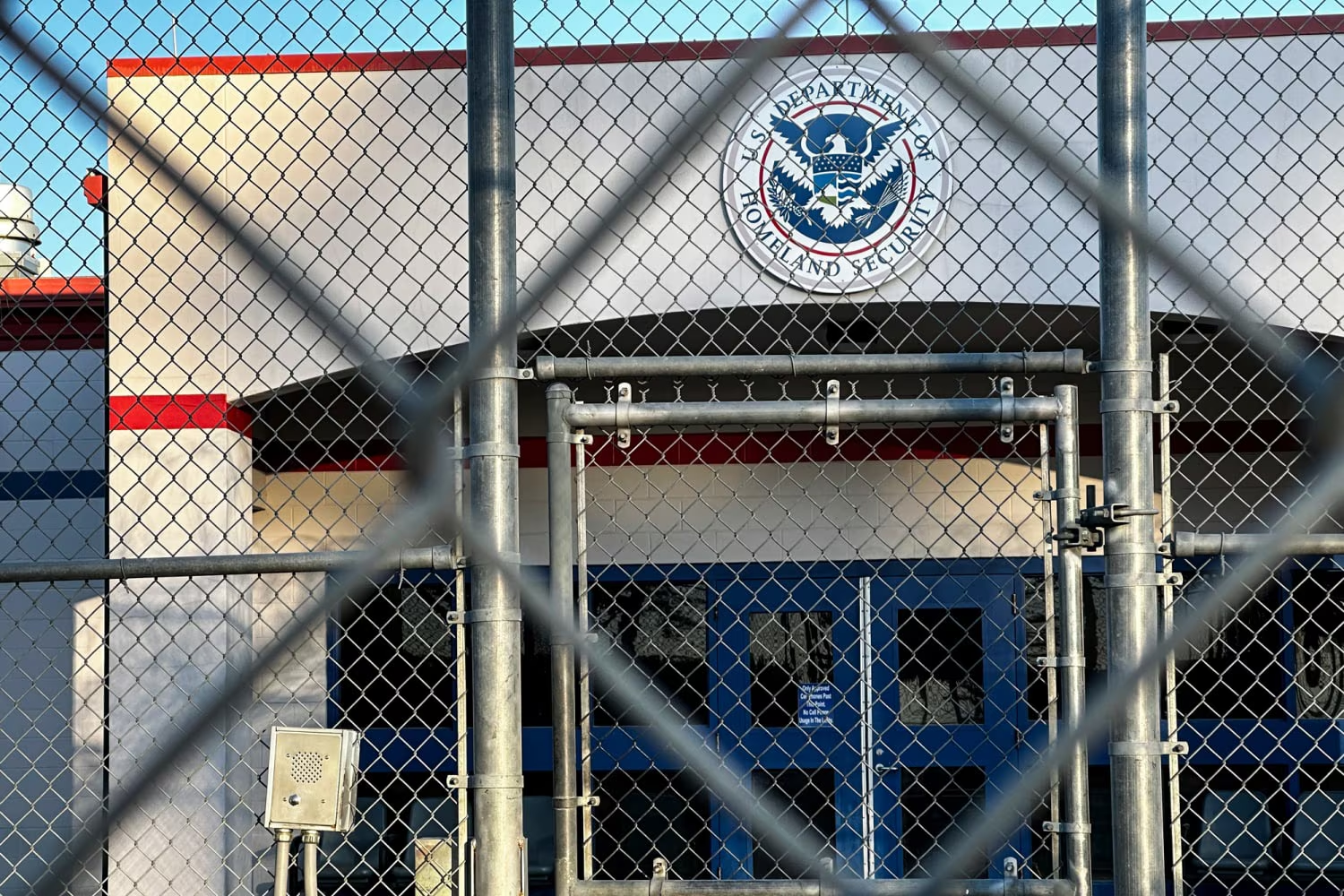
U.S. Immigration and Customs Enforcement (ICE) is pursuing a multibillion-dollar campaign to expand its network of migrant detention centers, but is increasingly running into resistance from an unexpected quarter—from Republicans.
The Donald Trump administration has bet on a sharp expansion of immigration detention capacity, committing tens of billions of dollars to the effort. ICE, however, has a limited window to spend the allocated funds. While Republicans at the federal level broadly back the White House’s hard-line immigration stance, it is Republicans on the ground who are increasingly leading opposition to plans for new facilities, effectively reviving the familiar formula of “not in my backyard.”
Republican officials in Mississippi, New Hampshire, Tennessee, and several other states have spoken out against the construction or conversion of facilities in their regions. New Hampshire Governor Kelly Ayotte, for example, welcomed the Department of Homeland Security’s decision to drop a proposed ICE center that had sparked public backlash in the Merrimack suburb. She thanked department head Kristi Noem for her “attention to residents’ concerns.”
In Tennessee, Republican Congressman Clark Boyd said a potential site near Nashville would have “pushed infrastructure to the breaking point,” telling the Tennessee Lookout that Senator Marsha Blackburn would seek to block the project at the federal
In Georgia, Congressman Mike Collins, who is contesting the Republican primary for a U.S. Senate seat, backed opposition from residents of the small town of Social Circle to the placement of a facility already purchased and designed to hold roughly 10,000 migrants.
According to an internal Department of Homeland Security memo, ICE plans to purchase warehouse facilities and convert them to accommodate nearly 100,000 people. A bill titled “One Big Beautiful Bill” allocates $45 billion for immigration detention, of which the administration intends to spend $38 billion by November, acquiring properties across the country.
Despite protests in Democratic-led states and criticism from Democratic lawmakers, it has been intraparty resistance from Republicans that has proved capable of slowing the aggressive real-estate buying spree. In a February letter to Kristi Noem, Senator Roger Wicker of Mississippi warned that a large-scale center in his state could undermine economic prospects and place excessive strain on local resources. He later said the secretary had agreed to consider alternative sites.
The Department of Homeland Security insists the projects meet established standards. Lauren Bis, a deputy assistant secretary, said the facilities “will be well-run detention centers that meet our standard requirements” and will undergo assessments of their impact on local communities. According to Bis, “Secretary Noem is committed to working with members of both parties to expand capacity and help ICE carry out the largest deportation campaign in U.S. history.” She confirmed that the department has already acquired properties in Michigan, New Jersey, Georgia, Pennsylvania, Arizona, Texas, and Maryland.
Still, amid mounting resistance, ICE will need to find alternatives for roughly 48,000 beds, according to early assessments and local media reports on deals that have fallen through. Potential agreements and discussed sites have also reportedly been scrapped in Texas, Missouri, Virginia, and Utah, where property owners withdrew from sales under pressure from public opposition.
In several states, however, deals did go through despite mass protests and objections from elected Democrats—notably in Maryland and Pennsylvania. Some local authorities acknowledge that their legal tools for blocking ICE projects are limited.
Oklahoma City Mayor David Holt, a Republican who has publicly praised property owners who declined to work with the agency, recently captured the dilemma on C-SPAN: “You can, in principle, support many different things, but that does not mean you want them to happen right here.” Speaking about the need to debate land use at the local level, he added: “I may like a restaurant where I had a steak. But that does not mean I want it in my backyard.”