In early 2026, attention to international law flared again after events surrounding Venezuela. The capture and removal of a sitting head of state by U.S. forces, followed by statements about trying him on American soil, immediately triggered a wave of comparisons and questions far beyond Latin America.
For many, this episode became less a story about Venezuela than a prompt to reconsider how the global order is structured. In public debates, the same question has surfaced with growing frequency: if such actions are possible when undertaken by the United States and do not lead to the collapse of the system, why are similar steps by Russia treated as a flagrant violation of international law and grounds for isolation. It is precisely this asymmetry—real or perceived—that shifts the discussion away from individual cases and toward how international law actually functions today, and who defines the boundaries of what is permissible.
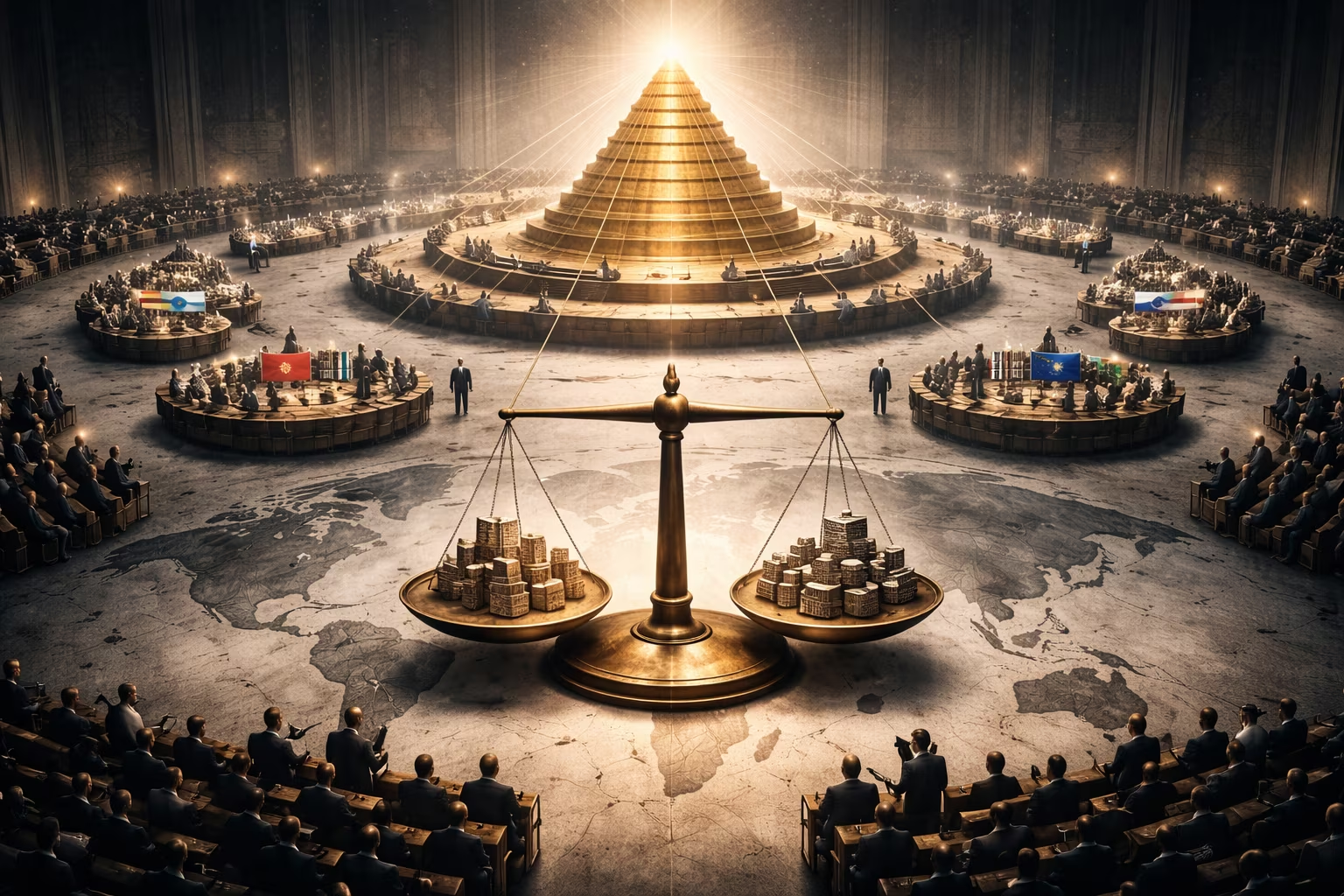
The question “why America is allowed to do this while Russia is not” is usually asked with irritation or bitterness, assuming the answer lies in hypocrisy and double standards. That impression is not illusory, but on its own it explains very little. To make sense of what is happening, one must abandon the familiar view of international law as a neutral and universal system of rules and instead see it as it has always operated in practice—an instrument for managing the world, built around a hierarchy of power.
International law has never existed as an independent, supranational authority capable of constraining everyone equally. It emerged as an agreement among the victors of major wars—above all the Second World War—and from the outset reflected a balance of power rather than abstract justice. The UN Charter, the Security Council system, the veto power, the architecture of international institutions—all of these are not mechanisms of equality but mechanisms of stabilization in a world where inequality was fixed and institutionalized.
The United States sits at the center of this architecture not because it always abides by the rules, but because it took part in their creation and, for decades, has underwritten the functioning of the entire system—from financial markets to military alliances. This fundamentally distinguishes it from states that either joined the system later or never exercised real influence over the formation of its norms.
Sovereignty, long regarded as the cornerstone of the international order, has for some time ceased to be absolute. By the late twentieth century, it had become clear that it could be constrained, reinterpreted, or temporarily suspended if a state was designated a source of threat—humanitarian, terrorist, criminal, or otherwise. Interventions, special operations, extraterritorial arrests, and sanctions have become part of routine practice rather than rare exceptions. The line between what is deemed permissible and impermissible in such cases has been drawn not by the letter of the law, but by who is acting and how their actions are received by the key centers of power.
History offers ample examples of the United States disregarding the sovereignty of other states and acting directly. The capture of Manuel Noriega in Panama and his transfer to the United States for trial remains one of the most illustrative cases. At the time, there was also talk of violations of international law, of the inadmissibility of the use of force, of a dangerous precedent. Yet the system did not collapse, allies did not turn away, and international institutions confined themselves largely to rhetoric. The precedent was absorbed by the system and became part of its history.
The decisive factor here is not the violation itself, but the capacity to manage its consequences. In the real world, international law functions as a system of risk and cost assessment rather than as an absolute prohibition. If a state can afford a particular action—withstanding the political, economic, and diplomatic fallout—that action becomes permissible after the fact. The United States possesses a unique ability to control such consequences—through the financial system, a network of allies, and its influence over the global agenda and institutions.
Russia has found itself in a different position not because its actions are fundamentally unique in nature, but because they have been perceived as a challenge to the architecture itself rather than as a deviation within it. What matters here is not only what was done, but how it was articulated. The United States, acting forcefully and at times bluntly, has always emphasized the exceptional character of its steps, presenting them as compelled responses that do not negate the rules-based system as such. Russia, by contrast, has increasingly spoken in recent years about the injustice of the entire construction of the international order, its lack of legitimacy, and the right to act outside established frameworks.
This distinction is fundamental. A breach of the rules by the system’s architect and a rejection of the rules by one of its participants are not the same thing. In the first case, the system may crack but it endures. In the second, there emerges a sense that it is being dismantled altogether. It is precisely this perception that activates the mechanisms of isolation, sanctions, and political pressure.
Legitimacy in the contemporary world is shaped not by norms, but by coalitions. If a critical mass of tacit consent or passive acceptance forms around an action, it ceases to be extraordinary. If, however, a coalition of resistance takes shape, the same action is declared a crime against the international order. This is a harsh and uncomfortable conclusion, but it describes reality more accurately than any appeal to universal principles.
As a result, the world is increasingly moving toward a model of selective law, in which the same norms are applied differently depending on a state’s status. The weak are required to observe the rules to the letter. Middle powers may expect flexibility if they proceed cautiously. The strong can afford violations—provided they are willing to pay the price and manage the consequences.
The most troubling aspect of this picture lies not in the confrontation between the United States and Russia, but in the position of everyone else. For most states, international law is no longer a guarantee of protection. It remains a language, a rhetoric, a framework for argument—but not a shield. Real protection is found instead in one’s place within the hierarchy, the density of alliances, and the ability to fit into the balance of power.
The question “why some are allowed to act while others are not” ultimately turns out to be neither a moral question nor one of formal legality. It is a question about the structure of a world in which law serves power rather than constrains it. America is allowed not because it is always right, but because it remains one of the centers of permissibility. Russia is not allowed not because it alone violates the rules, but because it challenges the system itself without possessing the resources to rewrite it on its own terms.
And it is this—rather than hypocrisy or double standards—that provides the principal explanation for what is unfolding.