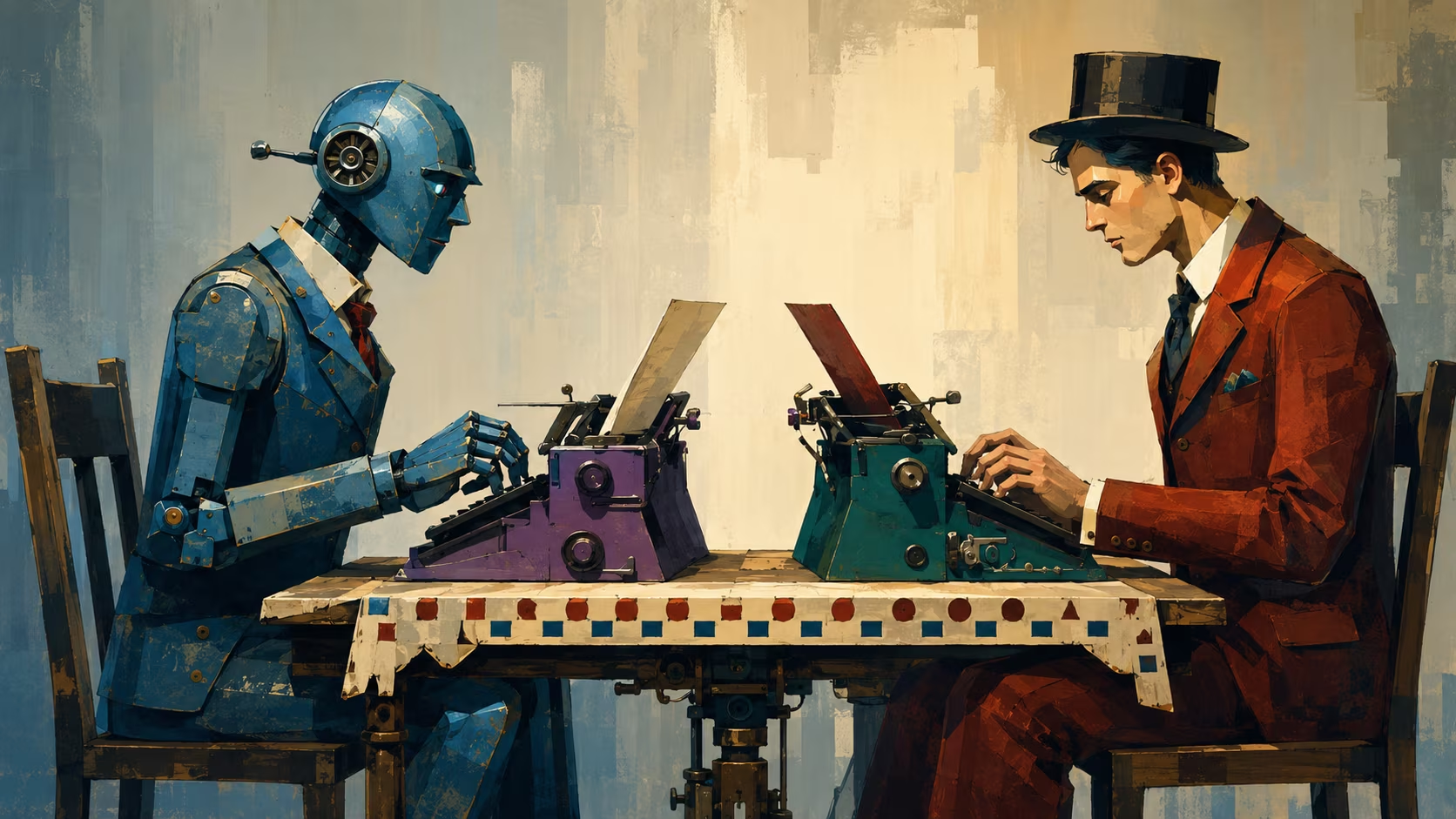
The surge in AI-generated writing following the launch of ChatGPT appears to have slowed. A new study suggests that the share of content written primarily by artificial intelligence has remained largely unchanged for more than a year, easing fears that human-created material would be completely displaced online.
According to an analysis by marketing agency Graphite, roughly half of all new online articles, blogs, and listicles are now produced mainly with the help of AI. However, that share has shown almost no growth since early 2025.
Humans vs AI: Share of Texts in a Sample of 55,400 English-Language URLs
Researchers see this as an important signal amid concerns that the internet could turn into a closed loop in which AI systems are trained primarily on text generated by other AI systems.
“These models are smart because of the information people put on the internet without the help of these models,” UC Berkeley professor Dan Klein told Axios. “If we stop creating knowledge independently of AI, what will continue to feed the models themselves?”
According to Graphite, within a year of ChatGPT’s launch in November 2022, the share of primarily AI-generated articles had reached 35.9 percent. Two years later, the figure climbed to 48 percent. After that, however, growth largely stalled, with AI-generated material accounting for roughly half of all new publications since early 2025.
For the study, Graphite randomly selected 55,400 English-language pages from Common Crawl, one of the largest open internet data archives frequently used to train AI models.
The sample included articles and listicles containing at least 100 words, published between January 2020 and March 2026. The texts were then analyzed using Pangram, GPTZero, and Copyleaks—services designed to detect AI-generated content.
The authors acknowledged that determining the origin of a text is becoming increasingly difficult. In many cases, content is created jointly by humans and AI, with algorithms used for outlining, drafting, editing, or rewriting material.
Graphite classified a text as primarily AI-generated only when most of the material was identified as written or substantially reworked by artificial intelligence.
The study also noted that the quality of AI-generated content is improving rapidly.
“In many cases, AI-generated texts are already no worse—or even better—than material written by humans. People often struggle to determine whether a text was created by a person or by artificial intelligence,” the report said.
The researchers concluded that AI is now producing roughly as much content as humans, though there is still no sign of machine-generated material fully dominating the web.