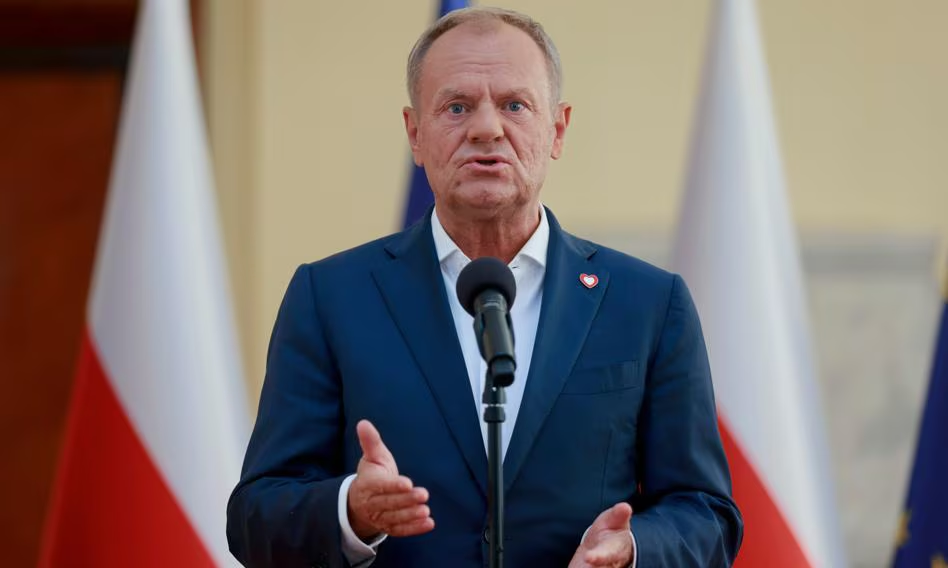
In recent weeks, Greenland has once again moved to the center of the transatlantic agenda after U.S. President Donald Trump publicly declared that the island is “necessary” for Washington from a national security standpoint and suggested that its future could become the subject of further action. The remarks, delivered against the backdrop of a U.S. military operation in Venezuela and a sharp escalation of debates over America’s role in the world, triggered a firm response in Denmark and unease among European allies. It was in this context that Poland’s prime minister, Donald Tusk, issued a warning about Europe’s future, linking the Greenland issue to a broader problem—the EU’s inability to act as a unified and robust political entity.
Poland’s prime minister, Donald Tusk, delivered a stark warning about Europe’s future, arguing that the continent is “finished” if it fails to preserve its unity. The remarks followed a week in which divisions among EU member states on foreign policy became particularly visible. The pro-European centrist wrote on social media on Monday that Europe would not be taken “seriously” if it remained “weak and divided—neither an enemy nor an ally.” In his view, the conclusion is already clear: “We must finally believe in our own strength, continue to rearm, and maintain a unity the likes of which we have never seen. One for all and all for one. Otherwise, we are doomed.”
The statements came amid a renewed escalation in relations with the United States. President Donald Trump has again returned to the idea of establishing control over Greenland—a self-governing territory of Denmark, in which he has previously expressed interest. “We need Greenland from a national security standpoint,” he told journalists aboard Air Force One on Sunday. “We will deal with Greenland in about two months. Let’s talk about Greenland in 20 days,” Trump added, without clarifying what exactly he meant.
The remarks came shortly after the United States struck Venezuela and, in a bold overnight operation, arrested its leader, Nicolas Maduro. The high-profile action intensified fears in Europe that Washington could seek to pursue a similar use-of-force scenario with regard to Greenland. Against this backdrop, Denmark’s prime minister, Mette Frederiksen, delivered a firm response, saying on Sunday that the annexation of the Arctic island was “absolutely meaningless.” Her stance was backed by other Nordic countries—Norway, Finland, and Sweden.
The European Union’s response to the U.S. intervention in Venezuela proved uneven. The EU’s high representative, Kaja Kallas, called for “restraint” in a statement backed by 26 member states, with Hungary as the sole exception. Spain, for its part, distanced itself from the common European line and, together with five Latin American countries, signed a far tougher text condemning Washington’s encroachment on Venezuela’s sovereignty and urging that its natural resources not be exploited amid Trump’s promises to take control of the country’s oil fields.
Most EU governments confined themselves to cautious statements urging respect for international law. Italy, however, adopted a more accommodating stance, describing the military action as “legitimate in response to hybrid security threats.” By contrast, Slovakia’s prime minister, Robert Fico, sharply criticized the U.S. operation, saying the invasion of Venezuela was “yet another proof of the disintegration of the world order.” On Monday, Hungary’s prime minister, Viktor Orban, echoed that assessment, writing on Facebook that “the liberal world order is in a state of disintegration.”