The four-day crisis over Greenland, which rattled global markets, put the transatlantic alliance at risk and dominated the Davos agenda, ended on Wednesday the same way it began—with a post on Truth Social.
Details of Donald Trump’s “framework for a future deal” with NATO remain scarce. Yet the most acute phase of the crisis appears to have been defused in a way that allows almost every side to claim victory—or at least take a breath.
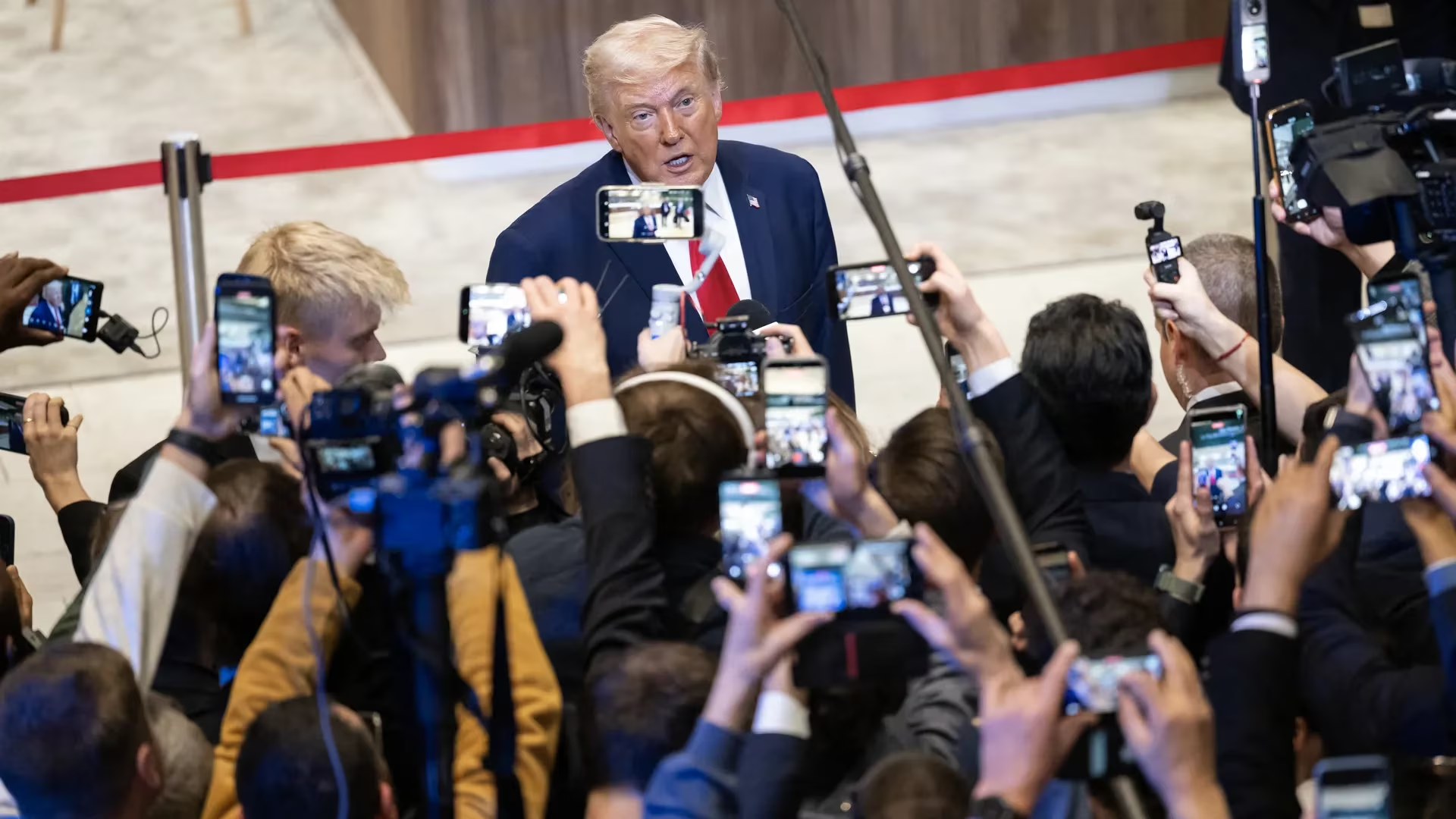
Trump, whose speech at the World Economic Forum drew such demand that a crush nearly formed at the entrance, says the Greenland deal delivered the United States “everything we needed.” Even though the concessions fall well short of full control over the island, the president can frame the outcome as proof of his “art of the deal” and move on from an issue that polls even worse for him than the Epstein affair. The “Trump Always Chickens Out” (TACO) jibes popular on Wall Street may sting, but the MAGA apparatus is already selling the agreement as an unequivocal win.
For Denmark and Greenland, the most critical and potentially explosive threat was lifted the moment Trump ruled out the use of military force. The preliminary framework he discussed with NATO Secretary General Mark Rutte also предусматривает respect for Denmark’s sovereignty over Greenland, two sources familiar with the proposal said. At the same time, the long-term objective—strengthening security in the Arctic and containing Chinese and Russian influence—is a shared strategic interest of the United States, Denmark, and their allies.
Europe avoided a potentially catastrophic trade war, demonstrated unity in the face of Trump’s threats, and used the crisis to accelerate plans to reduce its dependence on the United States. In this, it was not alone. Canada’s prime minister, Mark Carney, emerged as an unexpected star of Davos, drawing applause and widespread media attention for his blunt formulation of a “rupture” in the US-centric world order.
Markets, for their part, showed that they can act as a real constraint on Trump’s behavior. The president acknowledged from the stage that the stock sell-off had “cost us a lot of money.” Once the tariff threat receded, equity markets surged and long-term bond yields fell.
Even Davos itself emerged from the episode with a renewed sense of its own relevance, having become the venue where a full-fledged geopolitical crisis was aired, worked through, and steered away from the brink. The conference is often mocked as a factory of buzzwords, but this year’s theme—“The Spirit of Dialogue”—turned out, unexpectedly, to be prophetic.
The crisis around Greenland has eased for now, but the unstable new era it came to symbolize has not gone anywhere.