Google unveiled a series of new artificial intelligence products, including autonomous AI agents, coding tools built directly into search, and a new line of smart glasses. The company is accelerating the overhaul of its core business amid intensifying competition from OpenAI and Anthropic.
The new search features will run on the Gemini 3.5 Flash model. Google chief executive Sundar Pichai described it as “a major leap forward” in the development of more autonomous AI agents — systems capable of carrying out tasks without constant user involvement.
“We’ve been bringing agents to developers and enterprise customers for some time,” Pichai said during the Google I/O conference in Mountain View. “Now we are focused on making these capabilities available to everyday users.”
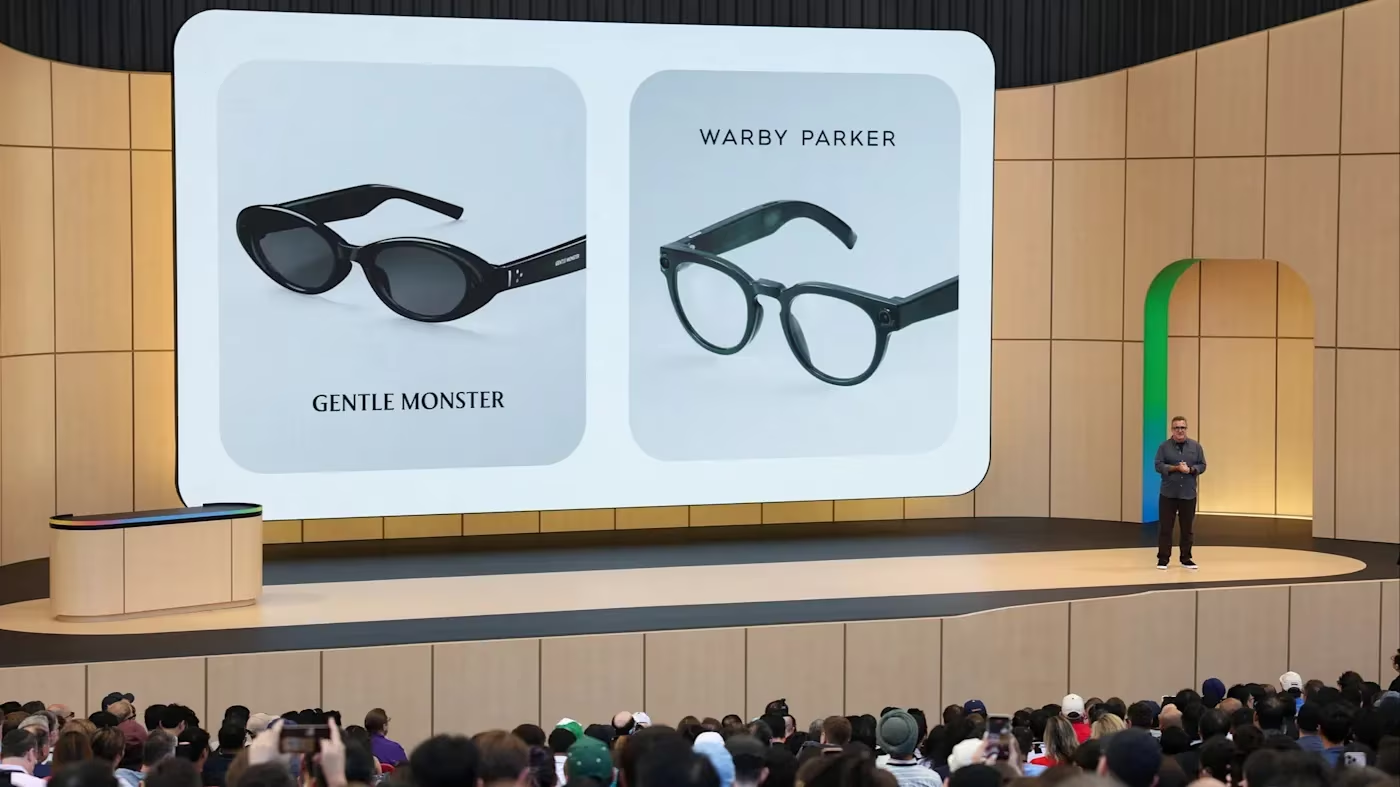
Google also announced its return to the smart-glasses market more than a decade after shelving the original Google Glass project. The company is working with Samsung, Warby Parker, and Gentle Monster on devices equipped with built-in cameras and speakers.

Google shelved the original Google Glass project. 2015.
Alphabet hopes to strengthen its position in the race against AI startups by leveraging its search engine, ecosystem of services, and vast troves of user data.
One of the main announcements was a new AI assistant called Spark. According to the company, it will help users organize everyday tasks, automate routine processes, and reduce administrative workloads.
Users will be able to allow Spark to remember past actions and access data from Gmail, Maps, and other Google services to personalize recommendations and tasks.
The assistant will be integrated into Google’s redesigned search bar. Users will be able to instruct the system to independently search for products, monitor news, locate specific items, or book events without constant human supervision.
Coding capabilities will also be embedded directly into search. Users will be able to create interfaces and run simulations inside the browser.
In this way, Google is trying to mainstream AI-agent and programming tools that until now have largely been used by more technically sophisticated audiences through specialized services.
Liz Reid, head of Google Search, described the changes as “the next stage in combining the capabilities of traditional search and artificial intelligence.”
After the release of ChatGPT in late 2022, Google began aggressively reshaping its search engine in response to changing user habits. Last year, the company introduced “AI Mode” — the biggest change to search in the service’s 28-year history — replacing traditional search results with a chatbot-style interface. Earlier, it launched AI Overviews, automatically generated AI summaries displayed at the top of search results.
Pichai had previously faced criticism for allowing OpenAI and Anthropic to rapidly strengthen their positions despite DeepMind’s long-standing leadership in AI research.
Over the past 18 months, the company has partially narrowed the gap through a strategy built around full control of AI infrastructure — from proprietary chips and data centers to foundational models and end-user products. In 2026, Google plans to spend up to $190 billion on those areas, funding the push through record advertising and cloud-computing revenues.
Investors have responded positively to the company’s strategy. Over the past 12 months, Alphabet shares have risen by roughly 130%, pushing the company’s market value close to $5 trillion. Only Nvidia remains ahead by market capitalization.
At the same time, analysts estimate Google’s share of the professional coding and business automation market at only 10–15%. Those segments are viewed as the most promising for AI monetization. OpenAI and Anthropic are each estimated to control roughly 40% of the market.
Google DeepMind chief Demis Hassabis said Gemini 3.5 is comparable in capability to Anthropic’s Claude Code and OpenAI’s Codex, while running faster and costing roughly half as much.
Companies developing AI models are also facing growing shortages of computing capacity. Some services have already begun limiting user access because of insufficient resources. Google hopes its proprietary chips will allow it to run models at lower cost.
Next month, Google plans to release a more powerful version of Gemini 3.5 Pro.
Hassabis also said the emergence of artificial general intelligence — systems capable of outperforming humans across most tasks — is “already on the horizon.” At the same time, he stressed the need for caution and for using all available tools to ensure the safety of autonomous AI systems.
Google also reported growth in Gemini’s audience. Over the past year, the number of monthly users of the app has more than doubled to 900 million people. The company still trails ChatGPT, however, which has around 900 million weekly users.
Alphabet is also using its financial strength to intensify pressure on competitors, many of which continue operating at a loss in pursuit of growth. On Tuesday, Google announced price cuts for its most expensive AI subscription tier.
Among the other products unveiled was Gemini Omni, capable of generating video from text, images, and audio, as well as editing footage using voice commands.