New research suggests that actual sea levels around the world are already “much higher” than assumed in most scientific assessments, leaving coastal areas even more vulnerable to ocean rise driven by global warming.
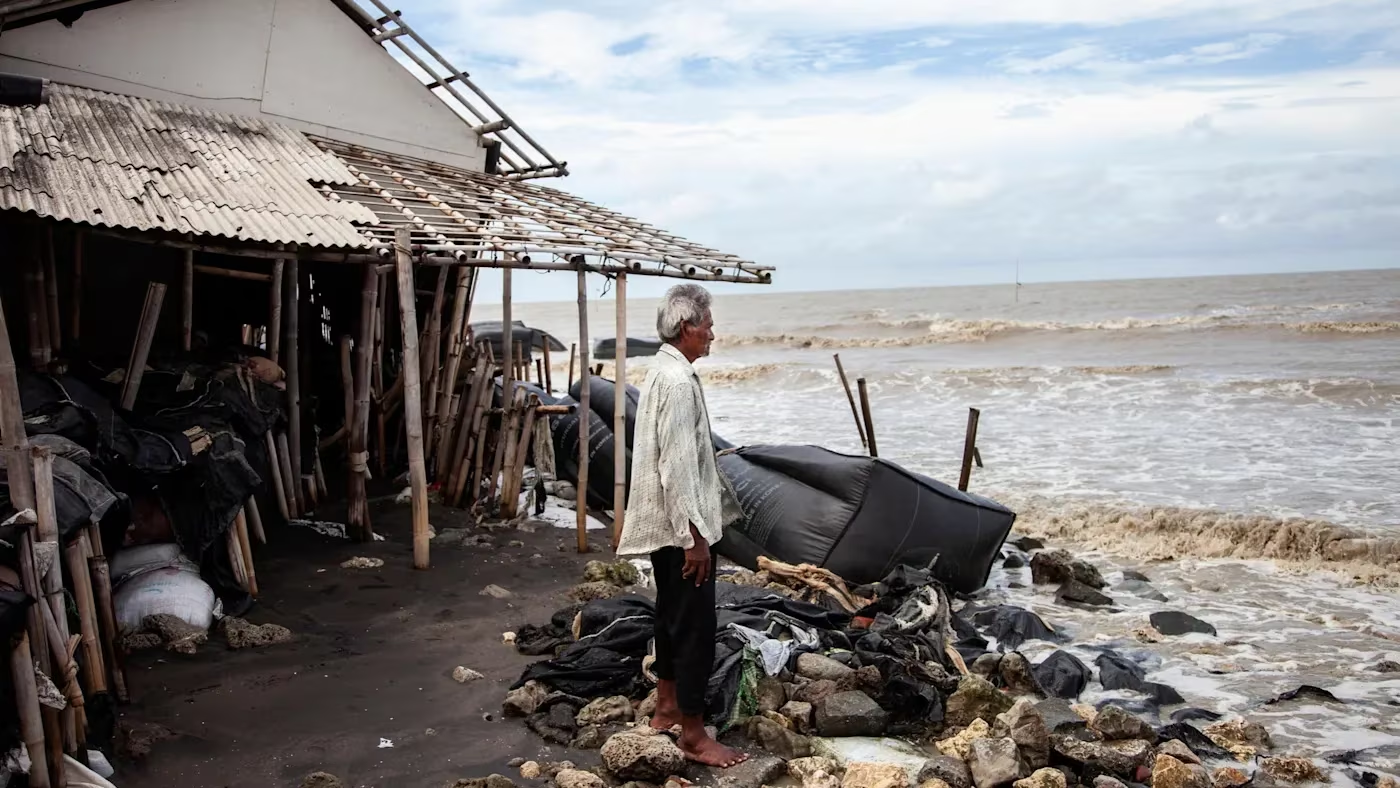
A study conducted at Wageningen University in the Netherlands found that the real global average sea level is roughly 30 cm higher than the figures produced by conventional scientific models. The gap between calculations and observed reality varies significantly by region and is particularly pronounced in Southeast Asia and Oceania—along some stretches of coastline, the ocean stands 1–1.5 m higher than most impact assessments assume.
Project leader Philip Minderhoud said the findings, published in the journal Nature, could reshape understanding of the scale of measures required to protect coastlines and adapt to rising seas. “Simply put, if the sea level for your island or coastal city is in reality higher than previously assumed, the consequences of sea-level rise will arrive sooner than projected,” he said.
According to researchers from Wageningen, a one-metre rise in sea level—a scenario many oceanographers consider likely by 2100 as a result of melting ice sheets and the thermal expansion of seawater—would leave an additional 77 to 132 million people living in coastal areas below sea level beyond earlier projections.
The discrepancy arises because the vast majority of sea-level research has so far relied on measurements of coastal land elevation using so-called “geoid models,” which are based on parameters of Earth’s gravity and rotation.
“In reality, sea level is determined by additional factors—such as winds, ocean currents, temperature, and water salinity,” Minderhoud said. “Our results show how important it is to account for this difference by using actual sea-level measurements rather than the widespread assumption that geoid height equals the present mean sea level.”
His colleague Katharina Seeger added that only about 1 percent of existing scientific publications have “correctly combined data on land elevation and sea level and referred to actually measured sea levels.”
“Whether policymakers will incorporate the recommendations of this work into coastal risk assessments—and how it may influence policy decisions—remains to be seen,” said Jonathan Dale, a coastal geographer at the University of Reading in the United Kingdom who was not involved in the study.
Anders Levermann, a professor at the Potsdam Institute for Climate Impact Research, emphasized: “These intriguing results vividly illustrate how difficult it is to translate the global problem of sea-level rise into the regional and local scales required for coastal protection.”
According to him, planning should proceed from the assumption that the oceans respond slowly to climate change but ultimately produce a substantial rise in water levels. “Over the past 100 years, sea levels have risen by about 20 cm. But the 1.5 °C of warming already observed means that, ultimately, we will face an increase of three to four metres,” he said.