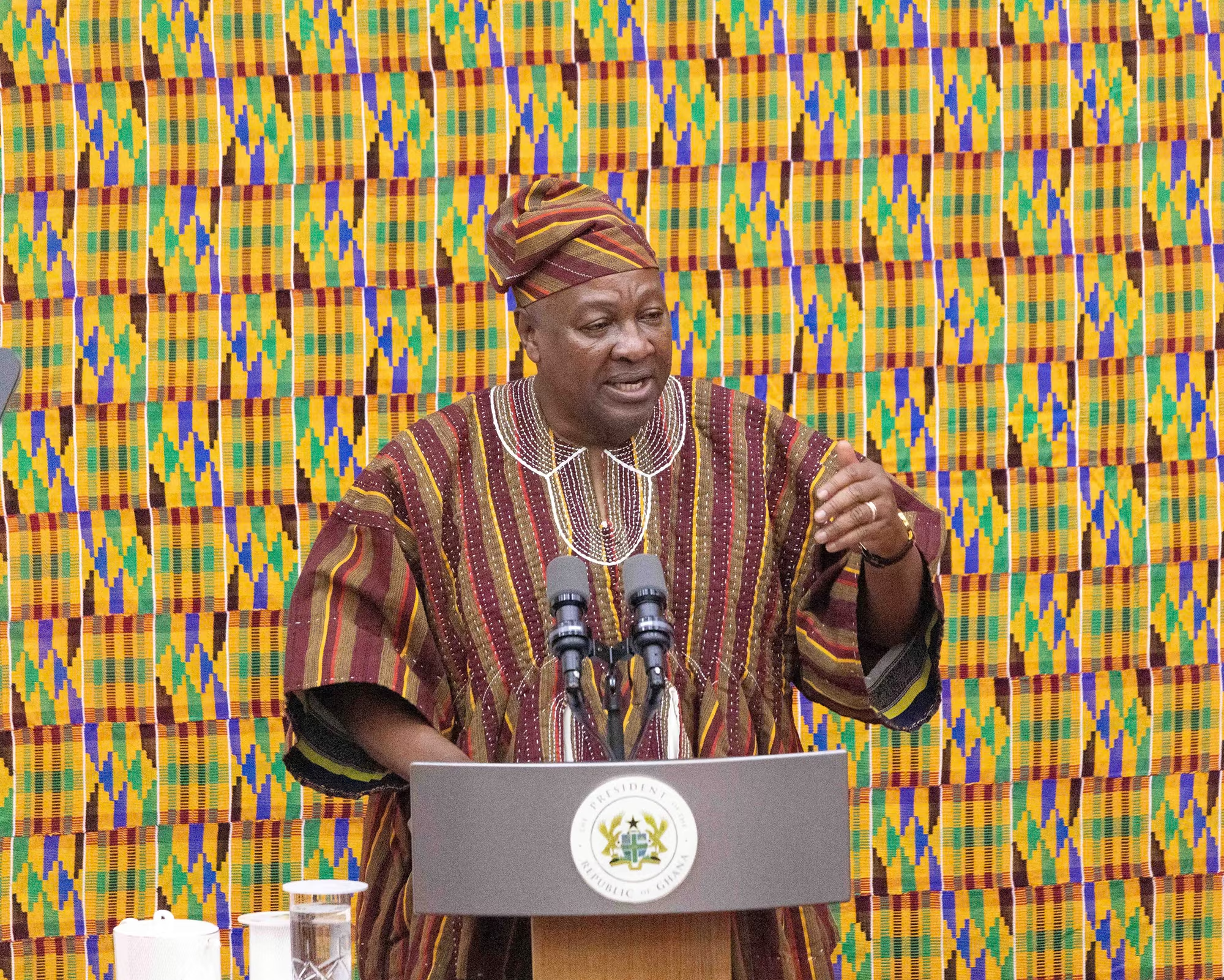
John Mahama is no stranger to challenging the political mainstream. On Wednesday, March 25, less than two years after returning to the presidency of Ghana—having decisively defeated the ruling party’s candidate—he managed to rally international support and secure the adoption by the UN General Assembly of a resolution against the transatlantic slave trade, despite opposition from Western countries historically implicated in that system.
The document, which describes the practice as “the gravest crime against humanity,” was approved by a substantial majority and received broad support across Africa. Yet the distribution of votes showed that the international community still has not arrived at a common judgment on the scale and consequences of the enslavement of more than 15 million people over four centuries.
In that sense, what is telling is not only the number of countries that voted in favor—123 in all—but also the composition of those that abstained or opposed it. The resolution was backed by countries across Africa, Asia, the Caribbean, most of Latin America, as well as the Arab world, which itself has a history of trans-Saharan slave trading. Russia described the decision as “long-overdue recognition.”
At the same time, the Western bloc—Australia, Canada, Britain, and the EU countries—chose to abstain, effectively postponing the question of acknowledging their own historical responsibility.
Three states openly opposed the resolution: Argentina, where between 1580 and 1640 as much as two-thirds of the value of all imported goods entering the port of Buenos Aires was accounted for by enslaved Africans; Israel; and the United States, where eleven states seceded rather than comply with the Emancipation Proclamation.
U.S. Ambassador Dan Negrea, speaking during the debate, stressed that Donald Trump “has done more for Black Americans than any other president” and also said that Washington “does not recognize a legal right to reparations for historical wrongs that, at the time they were committed, were not considered unlawful under international law.”
Human-rights advocates believe such a sharp reaction to a resolution with no binding legal force reflects concern that it could become the basis for demands for compensation and formal acknowledgments. Ahead of the vote, the chamber was palpably tense. Representatives of EU countries referred to the inadmissibility of retroactive application of international law, though behind those arguments one could also discern an effort to limit any broader reassessment of the past.
The Holy See’s permanent observer to the United Nations, Archbishop Gabriele Caccia, recalled in his remarks papal condemnations of slavery and described the resolution as a “partial narrative.” Yet he did not mention the more consequential historical decision—the papal bulls issued by Pope Nicholas V in 1452 and 1455, which sanctioned the enslavement of non-Christians in Africa by the Portuguese and helped lay the groundwork for the transatlantic slave trade.
The question now moves to what comes next. Having secured a significant result despite resistance from powerful states, Ghana and the African Union are likely to keep pressing this agenda. On Wednesday, UN Secretary-General Antonio Guterres called for “far more decisive action.”
Attention will now turn to the African Union, which has designated 2026-2036 as the “decade of reparations” and appointed Mahama to lead that effort. The organization will have to find ways to pursue compensation even in the face of stiff resistance from Western governments.
The resolution itself was the product of lengthy coordination. Its drafting took months of consultations with various institutions across Africa and the diaspora. According to participants in the process, the same collective approach is now being applied to shaping the next phase of strategy—amid the conviction that ideas whose time has come cannot be stopped.
An expert committee of the African Union is already drafting a framework for reparatory justice and engaging with descendants of enslaved people around the world. Despite the evident obstacles, Mahama, who could assume the chairmanship of the African Union in 2027, is hoping to secure another breakthrough.
“We are walking this long road—each step guided by the desire to be better and to do better, each step bringing us closer to the world we would like to leave to our children,” Mahama told the UN General Assembly.