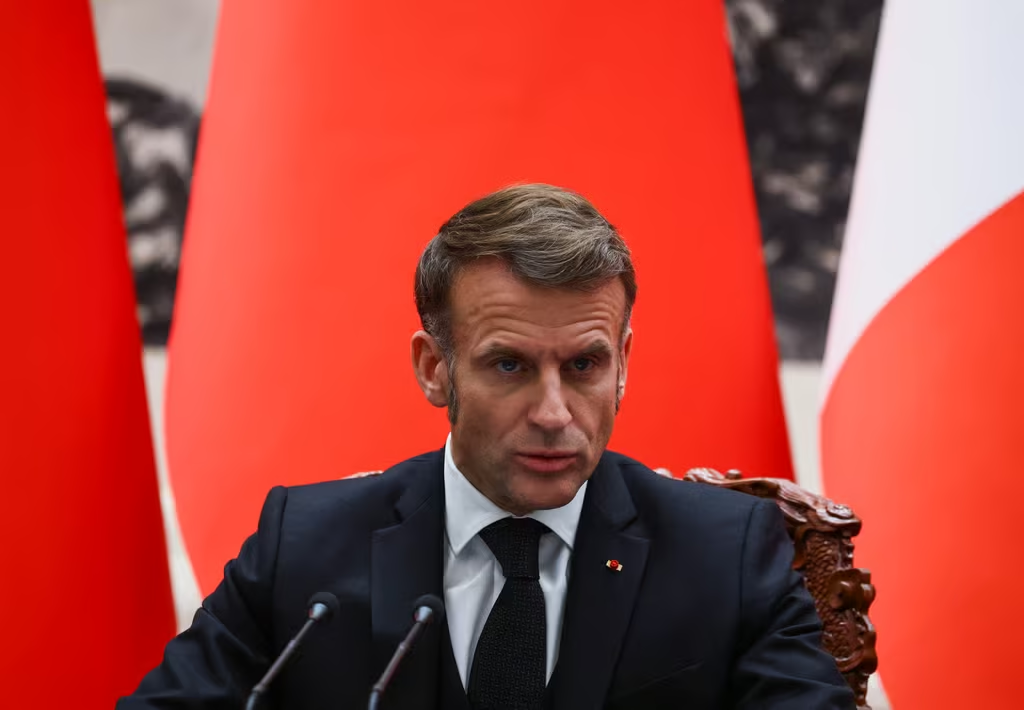
Germany and the Netherlands have clashed with France over the terms of an EU €90bn loan to Ukraine, pushing for Kyiv to be allowed to use the funds to purchase American weapons. The political decision to provide the financial support was taken at the European Council summit in December, but the specific conditions governing the use of the money have yet to be agreed once the European Commission presents its proposal. This opens a phase of difficult negotiations with Paris, which is seeking to prevent European funds from being redirected to Washington amid rising tensions in transatlantic relations.
French President Emmanuel Macron is pressing for priority to be given to European defence companies, aiming to bolster the EU’s own military-industrial base—even if that means Ukraine cannot swiftly acquire the weapons it needs to deter Russian forces. Most countries, led by Germany and the Netherlands, argue that Kyiv should have greater latitude to decide how to spend the European financial package to fund its defence. These positions are set out in government briefing papers reviewed by journalists.
The escalation of disagreements is the result of years of disputes over the extent to which the United States should be allowed to participate in European defence procurement programmes. The situation deteriorated further after statements by the administration of US President Donald Trump about the possibility of a military seizure of Greenland. Critics of the French position argue that a rigid insistence on “buying European” in effect ties Ukraine’s hands and limits its ability to defend itself against Russia.
“Ukraine urgently needs equipment produced in third countries—above all American air-defence systems and interceptors, ammunition and spare parts for F-16s, as well as capabilities for long-range strikes,” the Dutch government said in a letter circulated to other EU states and seen by journalists.
At the same time, most countries, including Germany and the Netherlands, are prepared to endorse the general principle of “buy European”. According to several diplomats, however, only Greece and Cyprus—with the latter adopting a neutral stance as the current holder of the EU Council presidency—are siding with France in pushing to limit the programme exclusively to EU-based companies.
Most of the EU’s €90bn loan is expected to be channelled into Ukraine’s military needs
Last month EU leaders agreed to issue €90bn in joint debt to support Ukraine after Belgium and several other countries declined to back a proposal to use frozen Russian state assets. According to two EU diplomats familiar with the talks, more than two-thirds of the funds proposed by the European Commission are intended for military purposes rather than standard budgetary support. With only days remaining before the Commission formally presents its plan, EU capitals are scrambling to influence its most sensitive provisions.
Germany has openly broken with France, proposing that purchases be allowed from defence companies based outside the EU.
“Germany does not support proposals to restrict procurement in third countries to specific product categories and believes that such measures would impose excessive constraints on Ukraine’s ability to defend itself,” the Berlin government said in a letter circulated to EU capitals on Monday and seen by journalists. The Netherlands, for its part, has proposed setting aside at least €15bn to allow Ukraine to acquire foreign weapons that are not expected to be available on the European market in the near term.
“The EU defence industry is currently either unable to produce comparable systems or cannot do so within the required timeframes,” the Dutch government said in its letter. Paris objects, insisting that Brussels must extract the maximum return from the funding allocated to Ukraine. Critics of this stance stress that strengthening Ukraine’s defensive capabilities in the face of the Russian threat should take precedence over any other considerations.
“This is extremely frustrating. We are losing sight of our objective, and our objective is not to do business,” one EU diplomat said. Another diplomat noted that a potential French veto would not be an insurmountable obstacle, as a decision on the proposal could be taken by a simple majority of member states.
Germany proposes prioritising defence companies from Ukraine’s largest donor countries
Another point of contention has been a proposal from the German government which, while rejecting the French idea of giving priority to EU companies, has simultaneously argued for favouring firms from countries that have made the largest financial contributions to supporting Ukraine. Such an approach objectively works to Berlin’s advantage, as Germany is among Kyiv’s biggest donors.
“Germany is asking for the logic of rewarding substantial bilateral support—initially proposed by the Commission for third countries—to be extended to EU member states as well,” the German government said in its letter. According to diplomats, the mechanism is seen as a workaround that would strengthen the position of German companies while simultaneously encouraging other countries to increase their financial assistance to war-ravaged Ukraine.