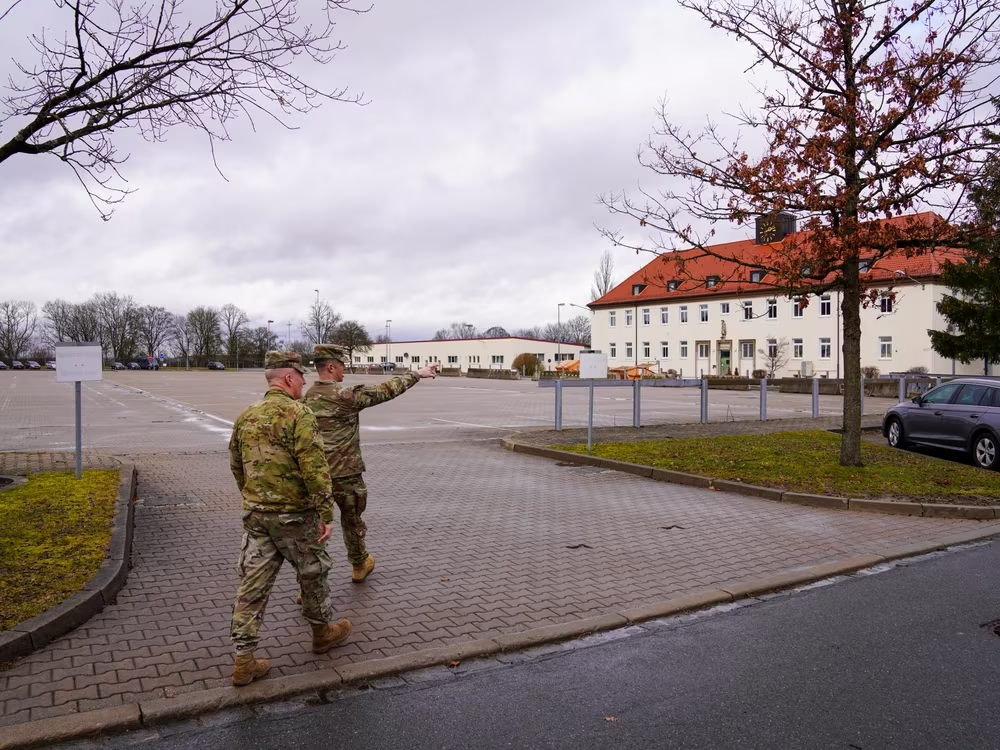
Even amid Germany’s sharp surge in military spending, everyday problems inside the armed forces have not disappeared. At one Berlin barracks, medical staff waited 22 years for a new lift, while parts of the Naval Support Command remain closed because of mould.
These details are contained in the Bundeswehr’s 2025 annual report, released on Tuesday. It is the first such briefing presented by the new Armed Forces Commissioner, Henning Otte.
In his assessment, Germany has made noticeable progress since 2022, after Vladimir Putin’s full-scale invasion of Ukraine forced Berlin to radically rethink its approach to defence.
Since 2022, the EU’s largest country has signed contracts for weapons and military equipment worth roughly €200bn. At the same time, the authorities launched a campaign to boost recruitment and established a new permanent brigade in Lithuania to reinforce NATO’s eastern flank.
As Otte noted, the rise in spending is finally beginning to translate into more modern weaponry and improved conditions for service personnel. Yet he described the state of infrastructure as one of the most pressing unresolved problems: over the next two decades, it will require about €67bn in investment.
At Blücher Barracks in the capital, doctors first requested the installation of a lift back in 2003 to transport X-ray equipment. It was put into operation only last year. In the northern city of Wilhelmshaven, parts of the Naval Support Command have been closed since 2019 because of mould, Otte added.
In the 1970s-era barracks in the Bavarian town of Pfreimd, home to a tank battalion, “almost all” buildings require renovation. New housing originally scheduled for completion by 2020 will not be ready before 2029, causing “widespread frustration on site.”
At another military facility in North Rhine–Westphalia, there is no lighting in the basement, dirty hot water runs from the taps, and there are too few functioning toilets.
Defence Minister Boris Pistorius has made the modernisation of military infrastructure a priority and has pledged to accelerate the bureaucratic procedures that in the past slowed such work.
Yet, according to Otte, the sheer scale of the task—around 8,000 projects—and their lengthy timelines pose an “enormous challenge” for the armed forces and a “significant burden for personnel.”
He also voiced concern about troop numbers. At the end of last year, Germany had 184,000 active-duty service members, and the country remains well short of its goal of raising the number of professional soldiers to 260,000 by 2035, despite a modest uptick in recruitment.
Otte separately pointed to an imbalance in the force structure, where the number of officers is almost equal to that of enlisted personnel. He warned that such staffing problems could lead “to a divergence between political ambitions and military reality.”
At the same time, he praised the professionalism and motivation of German service members, as well as a growing awareness of how modern warfare is evolving—including the threat posed by drones, hybrid methods, and sabotage.
Otte also sharply criticised initiation practices and degrading rituals within the armed forces. In one case, he said, a reserve officer ordered a subordinate to lie in a puddle for 90 minutes at an air temperature of 44.6°F. In another episode, recruits “immersed a comrade’s head in a toilet and flushed it.”
“Such treatment has nothing to do with discipline, training, or the acquisition of the necessary military resilience,” he said.