intro_Germany's economy is enduring its longest stagnation since the Second World War, and Berlin is trying to turn that downturn into a defense boom. The Wall Street Journal writes in an April 19 piece.
Per the WSJ, even as the country's export model buckles under Chinese competition and sagging demand, the German government is systematically rerouting capacity, capital and skilled labor into the one sector still growing at scale—defense.
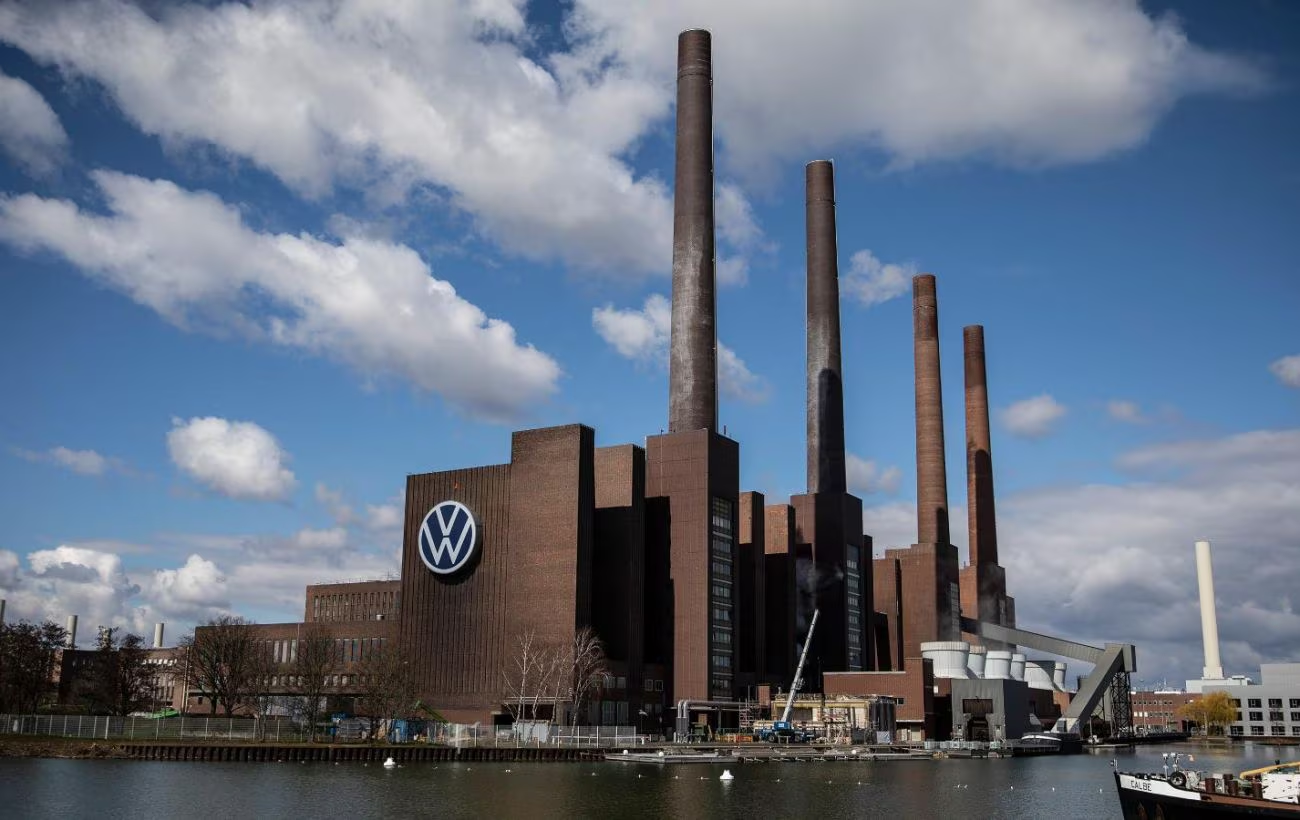
The picture of industrial retreat drawn by the WSJ is stark. Every month, roughly 15,000 jobs vanish from German manufacturing, the auto sector included. Mercedes-Benz's profits fell 49% in 2025; Volkswagen's fell 44%. The world's second-largest automaker has announced plans to cut 50,000 jobs in Germany by 2030.
The WSJ puts the character of the government's response bluntly—"Berlin's approach is not to revive the old economy but to replace it." Idle factory floors and a swelling stream of laid-off specialists are being channeled into the defense industry.
The specifics of that conversion, the paper reports, are already taking shape. Volkswagen is in talks with Israeli firms to begin producing components for the Iron Dome system by 2027. Some plants have added a third shift to turn out weapons and munitions for Kyiv. Patriot interceptors, historically an exclusively American product, are slated for assembly in Germany to meet rising European demand.
The WSJ's reporting raises a sharper question than the familiar "Europe is rearming." Germany's industrial reorientation in 2026 is not a clean response to an external threat. It is the point at which two processes have converged.
The first is genuine defense demand. The war in Ukraine, America's retreat from its European security commitments and the scramble among European capitals to rearm have produced a market on a scale that did not exist five years ago. Without that demand, Germany's industrial pivot would be technically impossible—there would be no one to sell the military output to.
The second is internal. Germany is not merely reacting to a threat. It is using defense demand as a lifeline for a dying industrial model. The crisis in the auto sector and the decline of exports have created political room for industrial conversion on a scale that, in 2019, would have been unthinkable to voters, companies and trade unions alike.
These two processes reinforce each other. The external threat generates both the demand and the political legitimacy for large-scale military production. The internal crisis generates the supply—idle capacity, cheap skilled labor, companies desperate for any growing market. The narrative of Europe's rearmament helps frame industrial conversion as a national necessity. And that conversion, in turn, makes defense spending economically convenient for Berlin, recasting it from a budgetary burden into a pillar of employment.
Germany's initial political decision to rearm—the Zeitenwende and the €100 billion fund for the Bundeswehr—was taken in 2022, when the German economy was not yet in ruins. It was genuinely driven by security concerns. But what the WSJ is describing now is the next stage. Berlin has moved from a political decision to rearm to a structural reordering of its industry around the military sector. And at this stage, the motive is double.