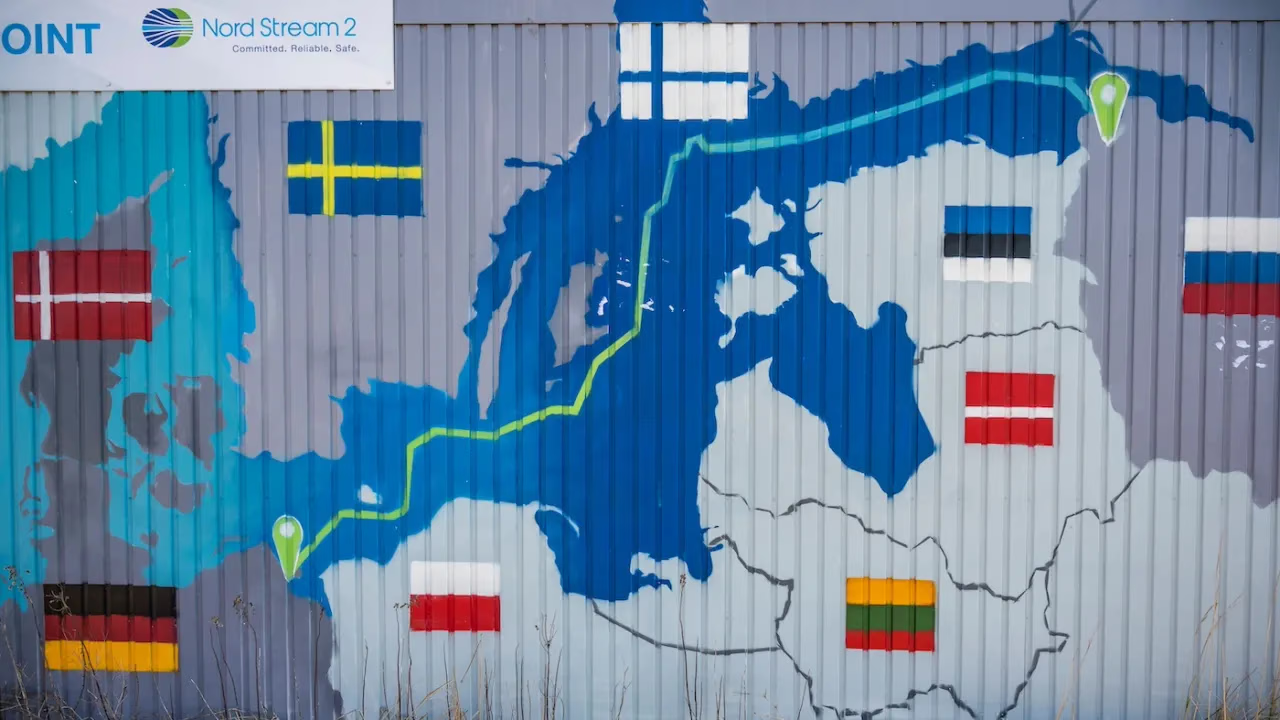
Two years after the explosions on the Nord Stream pipelines, the investigation has registered its first substantive breakthrough. In August 2025, Italian authorities detained Ukrainian citizen Serhii Kuznetsov — a suspect whom German investigators consider a possible participant in the operation. Since his arrest, Germany has sought his extradition, but the process stalled as the defense attempted to overturn rulings by Italian courts.
Now, following a decision by Italy’s Court of Cassation confirming the legality of his extradition, Kuznetsov will be transferred to Germany within 10 days. His handover will mark the first time one of the alleged saboteurs comes under the control of German investigators, a development that may shape the future course of the probe into the events of 2022.
It is often said that “truth is the first casualty of war.” The warrant issued this week in Germany may lead to serious accusations not only against Volodymyr Zelensky’s government but also against former U.S. president Joe Biden.
This week, a German court issued an arrest warrant for Ukrainian national Serhii Kuznetsov, a step that may reinforce long-circulating suspicions that Ukraine was involved in the destruction of the Nord Stream pipelines in waters near Denmark and Sweden in 2022.
The Biden administration may have been alerted in advance. According to sources, American officials years ago received information from a Ukrainian informant claiming that a group of six Ukrainian special-forces operatives planned to rent a vessel, dive to the seabed and destroy the pipeline. The operation was allegedly overseen by the commander-in-chief of the Ukrainian Armed Forces, Valerii Zaluzhnyi.
Yet after the explosions, the Biden administration and many media outlets continued to promote the idea that Russia had blown up its own pipeline, despite evidence and arguments pointing in the opposite direction. This narrative fit neatly into a convenient framework portraying the incident as a supposed Russian false-flag operation, allowing Washington to dismiss the possibility that Ukraine might not only have committed an environmental crime but also deliberately misled its allies.
Over the years, some observers have questioned the Biden administration’s official line on the evidence and the presumed perpetrators. The notion that Moscow would destroy its own infrastructure always seemed improbable. But at the time, Washington was channeling tens of billions of dollars to Ukraine — support that is now estimated to have surpassed $180 billion. Had it emerged that Kyiv sabotaged pipelines vital to European allies, it would have provided an awkward argument amid growing American scrutiny of the costs of assistance.
The U.S. administration was not alone in trying to shield Ukraine from criticism. Zelensky denied any involvement despite mounting suspicions. In Poland, a court refused to extradite another suspected participant to Germany and released him. The rationale was not Kyiv’s official statements but the judge’s view that the actions were carried out “in the name of a just war.” Poland remains a country on the front line of Europe’s resistance to Russian aggression.
An Italian court rejected such reasoning. It ordered the extradition of Kuznetsov, believed to be a key member of the operation. According to investigators, the group rented a yacht in Rostock, Germany, used forged documents and relied on a network of intermediaries. Kuznetsov maintains that during that period he was serving in the Ukrainian army with the rank of captain.
If investigators’ conclusions are correct, it was not only Kyiv that misled the public. Biden, it appears, had also been briefed by intelligence services on the available evidence, yet continued to insist that Moscow was concealing the truth. He assured the public: “Russia is spreading disinformation and lies. We will work with our allies to determine exactly what happened. Just don’t listen to Putin. We know his statements are not grounded in reality.”
The paradox is that even if this information had been disclosed, public support for aiding Ukraine might well have endured. Ukraine became the victim of a brutal invasion accompanied by numerous allegations of war crimes committed by Russian forces. But the public is entitled to expect that a country receiving billions in assistance will not carry out environmental attacks against its allies. These pipelines lay within the economic zones of two NATO states.
As German investigators attempt to establish the full chain of events, one question remains: will the American public ever receive a transparent account of what Washington knew and how it may have been involved? Citizens were urged to authorize billions in wartime spending while the administration, according to sources, concealed a Ukrainian attack on a Western pipeline and then may have misled the public about it.