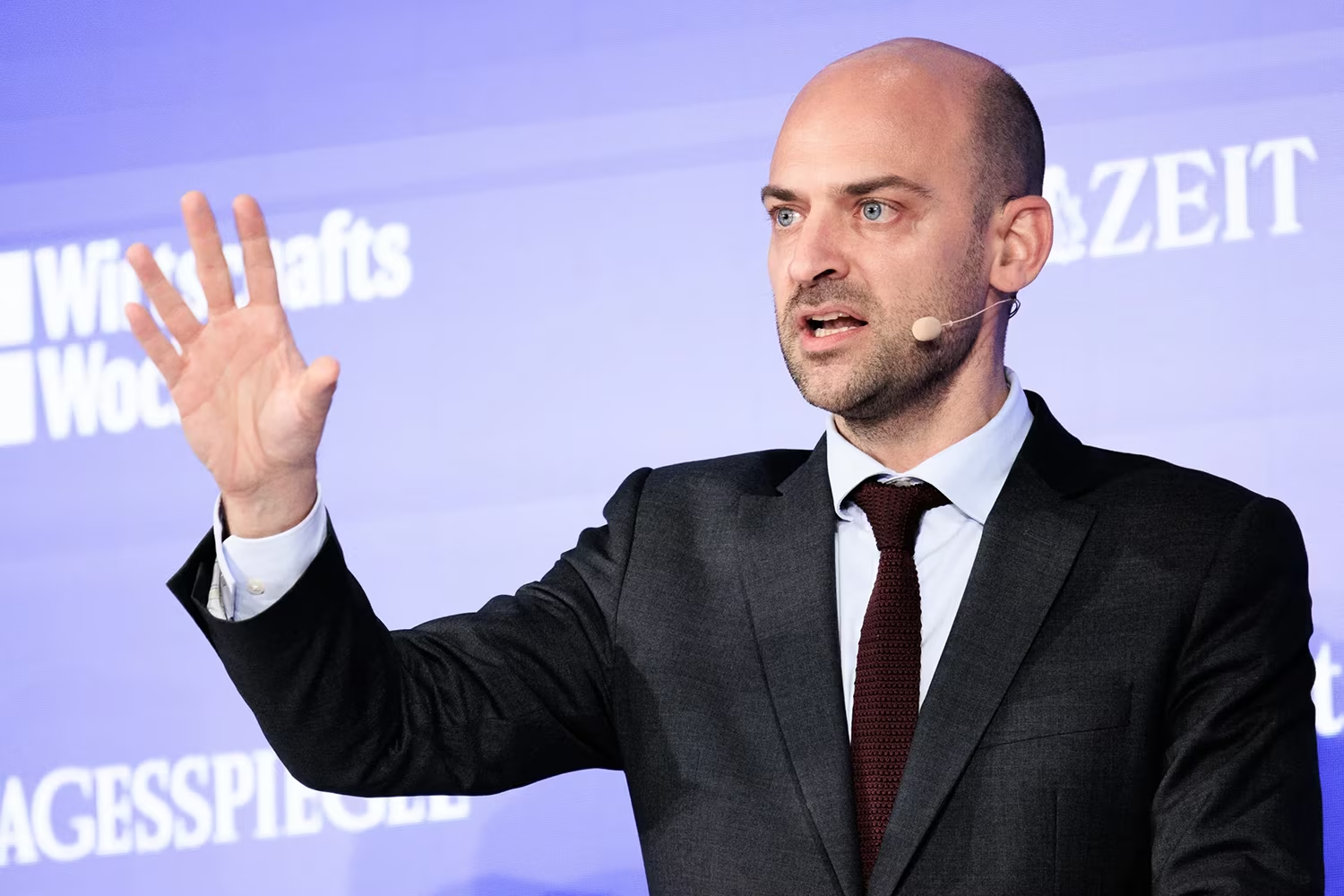
French Foreign Minister Jean-Noël Barrot suggested that, in the longer term, Canada could become a member of the European Union, citing the transatlantic partner as a telling example of the bloc’s growing global appeal.
Speaking at the Europe 2026 conference in Berlin alongside his German counterpart Johann Wadephul, he noted that amid rising geopolitical tensions, the EU is increasingly drawing in countries far beyond its borders.
“Nine countries are formally candidates for EU accession today. Others may join them,” Barrot said. “Iceland—in the coming weeks or months. And perhaps, one day, Canada.”
The reference to Canada was not accompanied by any concrete initiative—it was framed as part of a broader argument that the EU is emerging as a “third superpower” capable of balancing the rivalry between the United States and China.
Earlier on Tuesday, March 17, Finnish President Alexander Stubb, during a joint run with Canadian Prime Minister Mark Carney, suggested he should “think about” the possibility of joining the EU.
The remarks come as European leaders seek to strengthen the bloc’s geopolitical role amid Russia’s war against Ukraine and a U.S.-involved conflict in the Middle East.
Barrot emphasized that Europe possesses a unique set of tools for drawing closer to other countries—its economic weight, democratic model, and regulatory influence. “Many countries around the world are willing to move closer to our union,” he said.
He also pointed to signs of a new phase in relations with the United Kingdom, where closer ties to the single market are once again being discussed, as well as to deepening cooperation with countries such as India and Switzerland.
Talk of Canada potentially joining the EU has become increasingly frequent amid deteriorating relations between Ottawa and Washington under Donald Trump, who early in his second term repeatedly spoke of turning Canada into the “51st state.”
At first, such remarks were воспринимались as a joke—but over time, the reaction in Ottawa grew noticeably more tense, and the laughter largely faded.
A 2025 poll found that 44 percent of Canadians believe the country should join the EU.
Barrot and Stubb have become the most senior officials to publicly entertain such a possibility. A spokesperson for European Commission President Ursula von der Leyen responded positively to the poll’s findings, but ultimately described the idea itself as unrealistic.
Canada, for its part, has already rejected such speculation. Mark Carney said the country has no plans to join the EU. “The short answer is no,” the prime minister said at a NATO summit earlier this year. “That is not our intention. That is not the path we are on.”
Instead, Ottawa is focusing on deepening cooperation without formal membership—in particular through a new strategic partnership with the EU in defence and security, aimed at expanding coordination in trade, supply chains, and security matters.
While Canadian membership in the EU remains unlikely in the near term and no concrete steps are being taken in that direction, the scenario cannot be entirely ruled out amid mounting geopolitical turbulence.