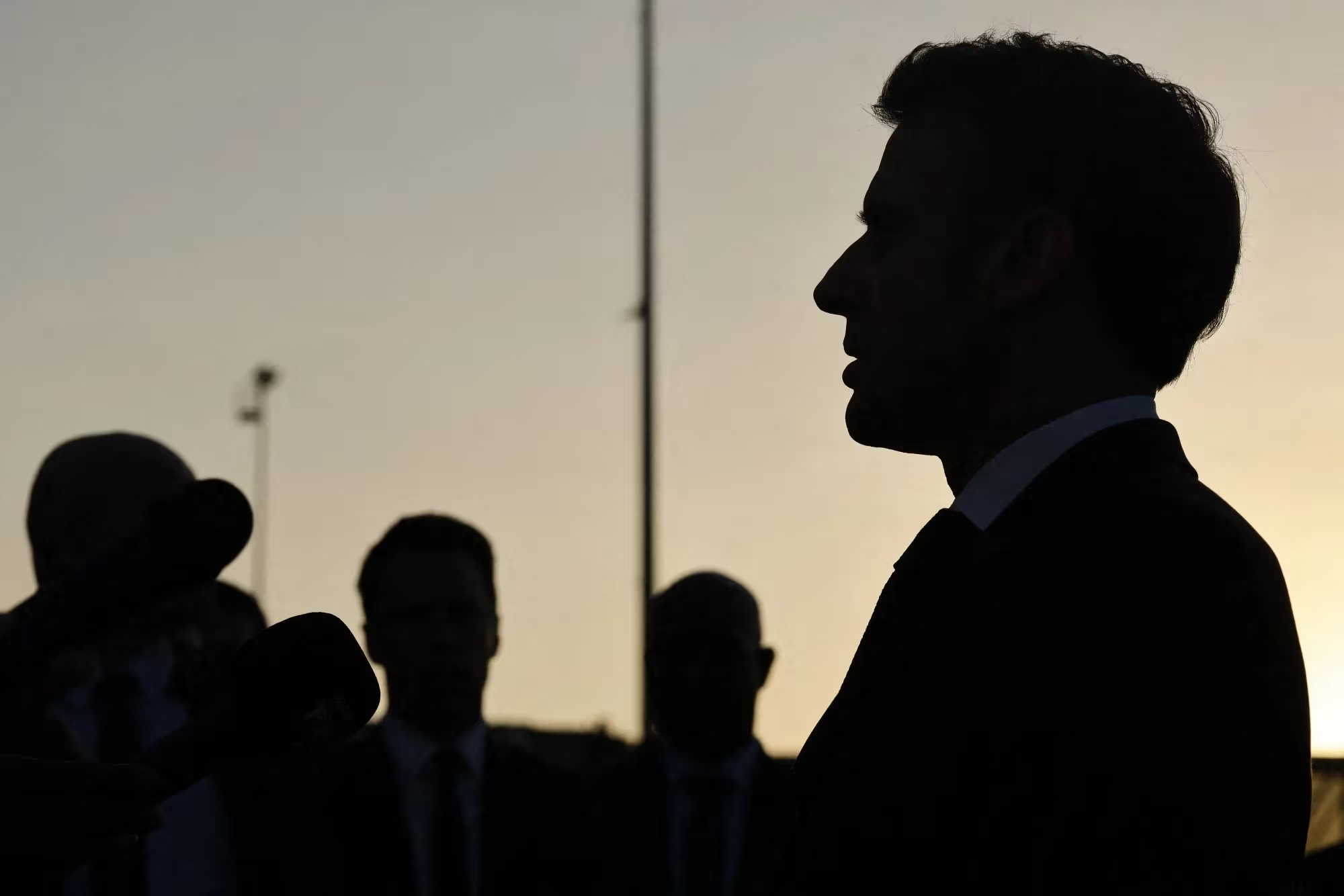
France enters 2026 in a state of prolonged political uncertainty that increasingly looks less like a temporary malfunction and more like a new normal. A fragmented parliament, a succession of government crises, and intensifying rivalry among contenders for the presidency after Emmanuel Macron’s second term form a backdrop in which every decision is hard-fought and the machinery of governance operates at the edge of its capacity. Over the coming year, the country will have to navigate between efforts to preserve governability through compromise, the risk of snap elections, and the possibility of a radical shift in the political balance—with consequences that could affect not only the government, but the stability of the entire institutional framework of the Fifth Republic.
Political instability is likely to become a permanent feature of France’s landscape in 2026. A splintered parliament and personal rivalries among those positioning themselves for the presidential race after Emmanuel Macron in 2027 point to a tense and difficult-to-manage period ahead. By October 2025, France had already cycled through three prime ministers in the space of 12 months, with the third—Sébastien Lecornu—reappointed in an attempt to keep the situation under control. In the best case, the country muddles through on the basis of temporary parliamentary compromises; in the worst, it slides into a full-blown political crisis that could put the very foundations of its institutions and presidential authority to the test.
Three scenarios are coming into view. The first assumes that the centrist minority government led by Lecornu manages to secure the backing of moderate forces in parliament and pass a budget for 2026. To do so, it will have to walk a tightrope: on the one hand, making concessions to the left—he has already pledged to suspend Macron’s pension reform, which raises the retirement age from 62 to 64—while on the other, avoiding the loss of support from the centre-right. Jean-Luc Mélenchon’s hard-left Unsubmissive France and Marine Le Pen’s hard-right Rassemblement National will seize any opportunity to push a vote of no confidence. Together, however, they do not command enough votes in the 577-seat National Assembly, leaving the positions of the Socialists and the Republicans as the decisive factor.
The second scenario assumes Lecornu’s failure, a temporary rollover of the 2025 budget into 2026, and mounting pressure on Macron to dissolve parliament and call early elections. In 2024, a similar move weakened the centrist bloc and produced a marked strengthening of the Rassemblement National. Municipal elections are scheduled in France for March, and, if necessary, parliamentary elections could be held at the same time.
In such a scenario, polls suggest that the anti-immigration, Eurosceptic Rassemblement National would lead the first round with 35%, the four-party left-wing alliance would take 24%, and Macron’s centrists would trail far behind on 14%. In 2024, tactical mobilisation “against the Rassemblement National” helped contain the success of Le Pen’s party; by 2026, however, that unity may fray. If the Rassemblement National, together with its allies, were to secure up to 250 seats, they would claim the right to form a government. The candidate for prime minister would be Marine Le Pen’s 30-year-old protégé, Jordan Bardella. For France, this would usher in a period of heightened uncertainty and preparation for the first populist government in its modern history, with the risk of street protests and civil unrest. Coexistence between such a cabinet and Macron’s presidency—a period of “cohabitation”—would pose a severe test to the constitutional separation of powers.
The third, least likely scenario is tied to a sharp increase in pressure on Macron and the emergence of debate over early presidential elections. Calls for his resignation have already come from Mélenchon and even from some allies of the president himself. Le Pen, who in 2026 will learn whether a court ruling barring her from running remains in force, would also be unlikely to oppose his departure. The more acute France’s internal problems become, the more Macron is likely to concentrate on foreign policy, an arena in which he has traditionally been at his most energetic. His second term does not expire until 2027, and he will do everything possible to avoid leaving the Élysée Palace before then.