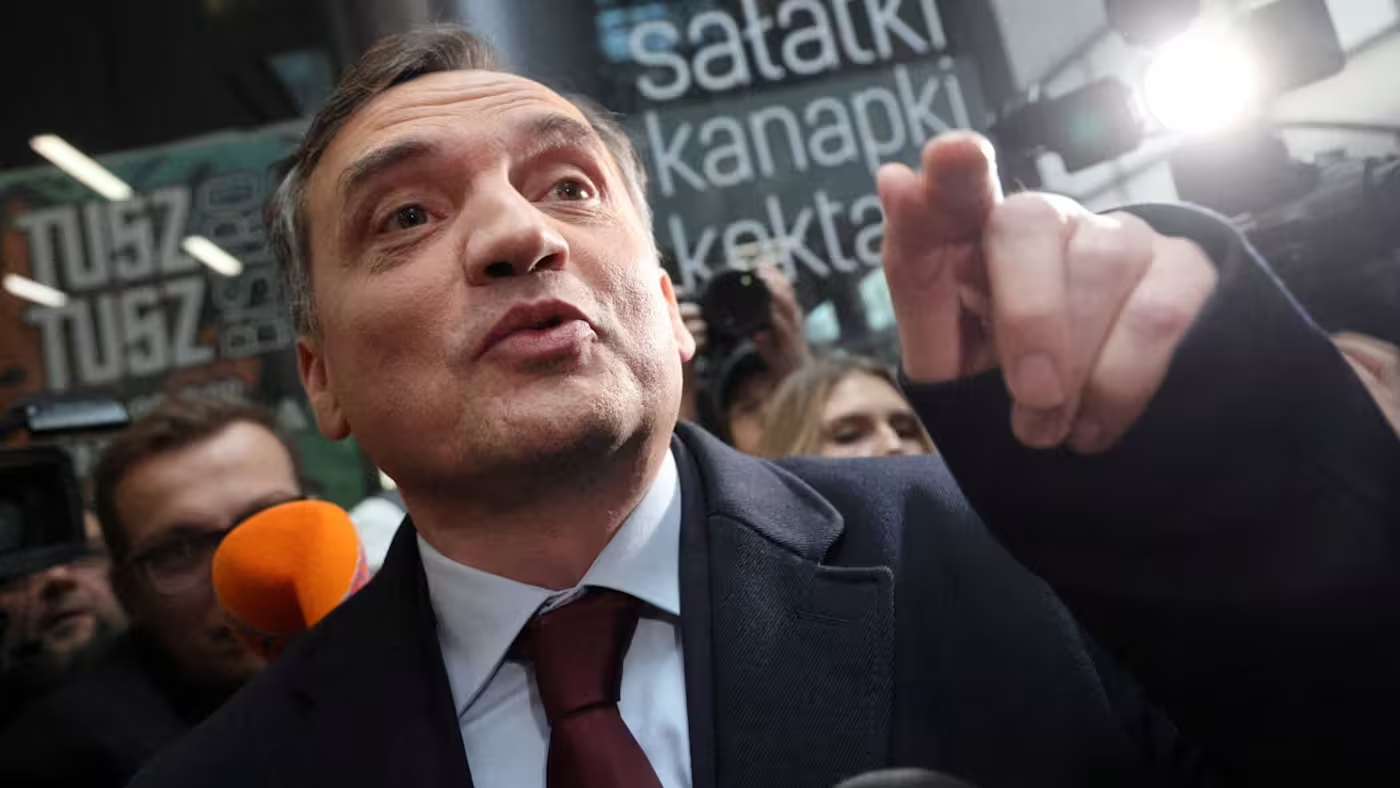
Former Polish justice minister Zbigniew Ziobro has been granted political asylum in Hungary, saying he faces politically motivated prosecution at home over alleged abuse of office. The decision has become a new source of tension in relations between Warsaw and Budapest.
Ziobro was one of the key figures in the previous right-wing government led by the Law and Justice party (PiS), which lost power in 2023 to Donald Tusk’s pro-European coalition. As minister, he oversaw sweeping changes to the judiciary that raised concerns about the erosion of the rule of law and triggered a prolonged confrontation between Poland and Brussels.
Polish prosecutors have brought 26 charges against him, including abuse of power, misuse of public funds, and the alleged leadership of a criminal group. Ziobro rejects all accusations.
“I have become the target of a personal vendetta by Donald Tusk and his circle,” he said on Monday in a post on X, accusing the authorities of running a smear campaign. He said he was resisting Tusk’s “creeping dictatorship” and “methods borrowed from Stalinism” used to crush political opponents.
Hungary’s government, led by Prime Minister Viktor Orban, granted Ziobro asylum just days before Polish prosecutors were expected to seek an international arrest warrant to compel him to stand trial.
Ziobro has repeatedly ignored summonses from investigators and has since remained in Hungary. He has also cited health concerns as one of the reasons for refusing to return to Warsaw.
His lawyer, Bartosz Lewandowski, said on Monday that asylum had been granted because of alleged “violations of rights and freedoms guaranteed under international law” in Poland, according to a statement he posted on X.
During PiS’s time in power, Orban was a close ally of Warsaw and himself clashed with Brussels over concerns about the rule of law in Hungary. But after Russia’s full-scale invasion of Ukraine in 2022-and Budapest’s decision to maintain ties with Moscow-relations between the two countries deteriorated markedly.
Tensions with Hungary intensified further after Tusk returned to power, particularly amid efforts to investigate alleged abuses by former officials. PiS has described these moves as a politically motivated witch hunt.
In November, Poland’s parliament stripped Ziobro of parliamentary immunity, clearing the way for formal charges. If convicted on all counts, he could face up to 25 years in prison, prosecutors have said.
Hungary’s decision was sharply condemned by Tusk’s government. “Next stop—Minsk or Moscow?” Poland’s foreign minister, Radoslaw Sikorski, wrote on X, pointing to Orban’s pro-Russian ties.
In 2024, Budapest had already angered Warsaw by granting asylum to Marcin Romanowski, a former deputy justice minister under Ziobro, who is also accused of misusing public funds. Like Ziobro, he denies any wrongdoing.
Lewandowski, outlining the grounds for the Hungarian authorities’ decision, cited, among other things, the “practice of systematically using law enforcement agencies to suppress political opposition in Poland.”
Ziobro’s judicial reforms, including the replacement of judges, led the European Commission to freeze billions of euros in EU funds earmarked for Poland. After Tusk’s return to power and his pledges to restore the rule of law, Brussels released the funds. Implementation of judicial changes, however, has proved difficult, in part because President Karol Nawrocki, nominated by PiS, has used his veto power to block government initiatives.