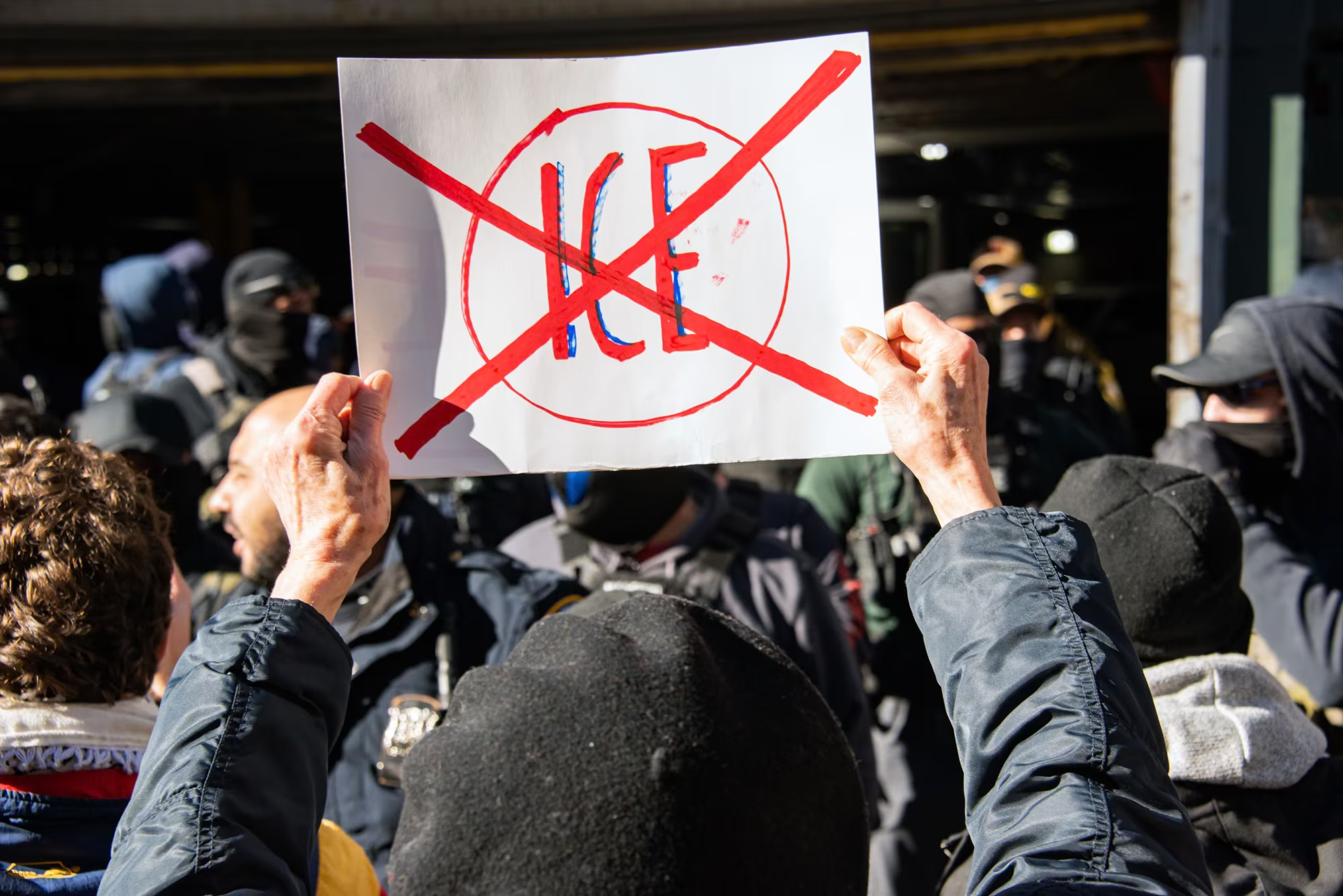
The FBI has launched “criminal investigations and domestic terrorism investigations” in connection with “threats directed at immigration enforcement activities” in at least 23 regions across the United States, according to an internal bureau report.
The two-page FBI document is dated November 14. It notes that some of the investigations are linked to a Donald Trump memorandum on “countering domestic terrorism” issued in September.
The memorandum, known as NSPM-7, was released following the killing of Charlie Kirk and called for the development of a “national strategy” to suppress “violent and terrorist acts” associated with “antifascism.” The document described “anti-Americanism, anti-capitalism, and anti-Christian sentiment” as threats, while citing “riots” in Los Angeles and Portland—in the context of protests against US Immigration and Customs Enforcement (ICE)—as examples of “political violence.”
The FBI report, circulated to other law-enforcement agencies, warns of a rise in “threats directed at government personnel or facilities associated with immigration enforcement.” It references two violent attacks on ICE facilities in Texas and states that “domestic terrorism subjects” covered by NSPM-7 have carried out “reactive violent attacks by exploiting First Amendment-protected events nationwide.”
“Attacks [by domestic terrorists] against ICE continue to be carried out primarily by individuals or small groups,” the document notes. At the same time, it emphasizes that recent incidents point to “an escalation in violence compared with previous attacks, which were largely limited to property damage.”
The report also lists “indicators” pointing to the possible preparation of an attack on ICE. These include the “stockpiling or distribution of firearms,” as well as “online surveillance” of personnel movements and the use of encrypted messaging platforms.
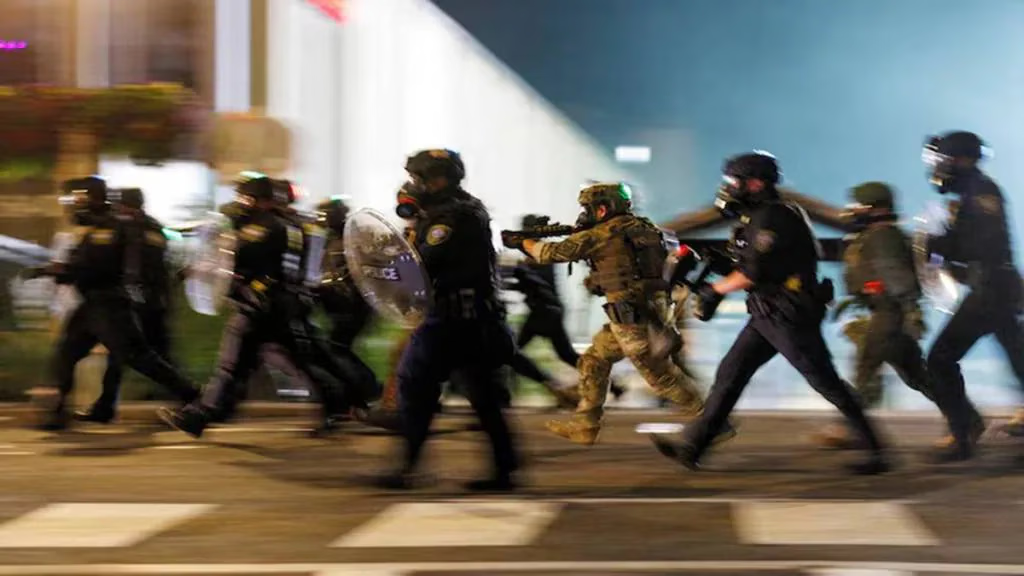
Trump Sends Federal Troops to Portland Under the Pretext of Protecting the ICE Facility
Local Authorities Say the City Is Calm, While Opponents Accuse Him of Abuse of Power and Lack of Legal Grounds
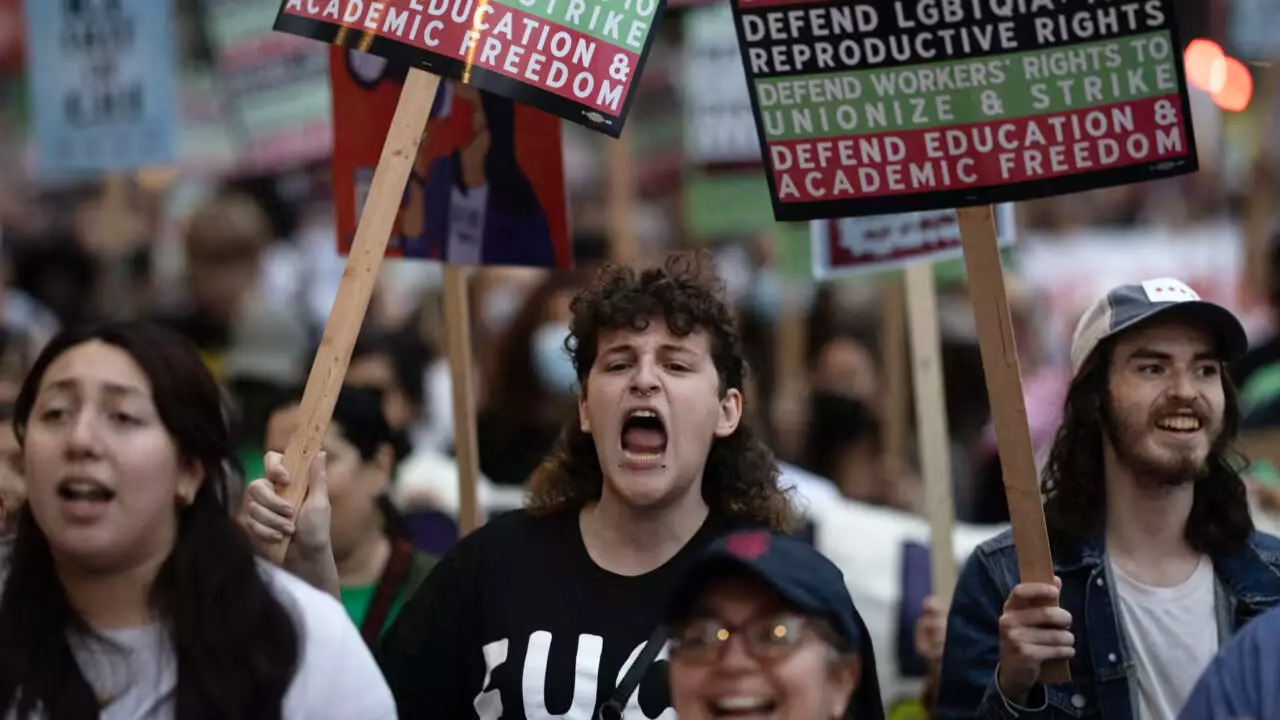
“Operation Midway Blitz”: Trump Administration Launched Immigration Campaign in Chicago
Federal Operation Sparks Protests, Local Criticism and Accusations of Intimidation
The FBI report was subsequently redistributed by another law-enforcement agency and became public through documents obtained via freedom-of-information requests by the nonprofit watchdog group Property of the People, which focuses on government oversight and transparency.
Civil-liberties organizations have previously warned that NSPM-7 could be used to pressure left-wing political activism, participants in protests against ICE, and critics of Donald Trump. Lawyers and rights advocates who reviewed the FBI’s November report said the document only reinforced those concerns.
“The FBI document is saturated with vague and overly broad language—precisely what alarmed us about NSPM-7 from the outset. It effectively invites law enforcement to engage in suspicion and investigations based solely on beliefs and activities protected by the First Amendment,” said Hina Shamsi, director of the ACLU’s National Security Project. According to her, “people who have committed no wrongdoing may find themselves under surveillance or investigation. That stigmatizes them and can unjustifiably draw them into the criminal-justice system.”
The FBI report, labeled as a “public safety awareness” document, asserts that “criminal actors with diverse social and political objectives” are increasingly threatening ICE. It does not, however, disclose specific investigations or the nature of the threats identified.
According to the report, the most common category of cases within investigations of anti-ICE activity is “assault on a federal officer.” Other cases involve domestic terrorism, conspiracy to obstruct or harm personnel, civil disorder, anti-riot statutes, destruction of vehicles, and “explosives-related cases.”
The document cites two specific episodes of violence. In July, a group of individuals allegedly threw fireworks and vandalized vehicles at an ICE detention center in Alvarado, Texas, after which one participant reportedly wounded a local police officer. Some of the defendants later pleaded guilty to terrorism-related charges, while other cases remain pending.
In September, an armed man opened fire on an ICE regional office in Dallas, killing two ICE detainees before taking his own life. No ICE personnel were injured. Several prominent Republicans blamed the shooting on “left-wing forces,” but the gunman’s motives and political views were never clarified, and no evidence was presented linking him to any political or activist organizations.
The FBI report also includes a map marking the bureau’s regional offices where investigations are underway. As of October 31, the FBI reported opening criminal and domestic terrorism cases in connection with “documented threats” to ICE operations in 23 field offices, spanning much of the country—from Washington, Oregon, and California to New Mexico, Kansas, Georgia, Illinois, Florida, New York, and Maine. The total number of investigations is not specified; however, it notes that more than ten “incidents” were recorded in each of the Chicago, Dallas, and Portland, Oregon, regions.
The map separately identifies 27 locations where domestic terrorism investigations are being conducted under NSPM-7. The report does not clarify whether all of these cases are related to threats against ICE. The FBI did not respond to requests seeking clarification on this point. It also notes that some NSPM-7-related cases were initiated before the presidential memorandum was issued but were, in the bureau’s view, consistent with its objectives.
Taken together, the FBI has opened cases in more than 30 states related either to anti-ICE activity or to NSPM-7.
“There may be an increase in threats in these areas in the near term,” the FBI warns, without providing evidence or specific details.
The document also states: “Indicators that individuals may be preparing to carry out an attack against ICE may include conducting surveillance, researching online the arrival and departure times of ICE personnel from facilities or operations, stockpiling or distributing firearms with the intent to carry out an attack, as well as discussing operational plans with other like-minded individuals via encrypted communications applications.”
Civil-liberties advocates described such wording of the “indicators” as alarming.
“It is not illegal in itself to research publicly available information online about the movements of government officials or to use encrypted applications such as Signal or WhatsApp,” Rachel Levinson-Waldman, director of the Brennan Center’s Liberty and National Security Program, wrote in an email. She noted that while the document refers to the use of encrypted channels to discuss “operational planning,” the term is “undefined and ambiguous,” leaving it unclear which kinds of conversations could draw the FBI’s attention.
In recent months, the FBI has already faced criticism for surveilling activists opposed to ICE operations. Documents obtained by Property of the People a month earlier showed that the bureau monitored a closed Signal group chat in which volunteers coordinated a courtwatch initiative and characterized participants observing public immigration court hearings as “anarchist violent extremists.”
The FBI’s November report builds on claims by the Trump administration of a sharp rise in attacks on immigration enforcement officers. The US Department of Homeland Security has repeatedly asserted a “1,000% increase” in assaults on ICE officers—a claim echoed in NSPM-7—yet no evidence has been presented to substantiate it.
A recent Los Angeles Times investigation, based on thousands of pages of court records from cases involving alleged attacks in Southern California, Portland, Chicago, and Washington, DC, found that in most instances the purported assaults did not result in injuries to officers. Law-enforcement materials also revealed cases in which US immigration officers made false or misleading statements about protesters in Los Angeles who were accused of violence. A number of high-profile federal cases alleging assaults on immigration officers ultimately ended in dismissals or acquittals.
The FBI report separately notes that NSPM-7 calls for investigations into “institutional and individual funders, as well as leaders and employees of organizations that are responsible for criminal activity, sponsor it, or otherwise facilitate it.” It is this portion of the memorandum that has generated particularly acute concern about potential pressure on civil society and nonprofit organizations.
The FBI also said it relied on an intelligence bulletin issued in October and likewise obtained by Property of the People, which focused on “domestic violent extremists” threatening ICE. A footnote to that bulletin emphasized: “Advocacy of political or social positions, political activism, the use of sharp rhetoric, or generalized philosophical endorsement of violent tactics does not, by itself, constitute extremism and may be constitutionally protected.”
Ryan Shapiro, executive director of Property of the People, said the FBI’s November report appears particularly alarming when read alongside a US Justice Department memorandum dated December 4 addressing the implementation of NSPM-7.
The document, addressed to federal prosecutors, states that “criminal activity rising to the level of domestic terrorism” includes “doxxing law-enforcement officers, mass unrest and destruction, violent attempts to halt immigration enforcement, and attacks on government officials.” Among the potential terrorist ideologies it cites are “opposition to immigration enforcement” and “extreme views in favor of mass migration and open borders.”
The attorney general called for a broad range of prosecutions, including “picketing or marching with the intent to obstruct the administration of justice” and “obstructing or disrupting order on federal property.” Federal law-enforcement agencies were also instructed to forward materials related to “Antifa” to the FBI.
Trump has repeatedly described “antifa” as a terrorist organization, despite the absence of any formal structure bearing that name; the term is often used by conservatives to denote a broad spectrum of anti-fascist, left-wing, and liberal activity.
“At its core, the war on antifa is a war on dissent, a war on free speech,” Shapiro said. In his view, the FBI and attorney general memoranda, combined with Trump’s sustained attacks on protesters and opponents, “strongly indicate that one of NSPM-7’s key functions is to use it as a tool to label anti-ICE activism as a whole as an anarchist violent extremist threat.”
From the documents available, Shapiro added, it appears that “the ultimate aim of NSPM-7 is to turn criticism of the Trump regime into a form of extremism and terrorism.”
Representatives of ICE and the Department of Homeland Security did not respond to journalists’ inquiries.
White House spokesperson Abigail Jackson said in an email that NSPM-7 “is aimed at investigating, disrupting, dismantling, and prosecuting individuals and organizations engaged in organized political violence and domestic terrorism—in particular complex and well-organized campaigns that require a new law-enforcement strategy.”
She said that “left-wing organizations” are fueling “violent unrest,” organizing “attacks on law-enforcement officers,” and committing other crimes. “The Trump administration will see the investigation of this large-scale network of incitement to violence in American communities through to the end, and the president’s executive actions to counter left-wing violence will put a stop to any unlawful activity.”
A Justice Department spokesperson declined to comment on the specific provisions of the attorney general’s memorandum, saying only: “There is no place for political violence in this country, and the Department of Justice will investigate, identify, and eradicate any efforts by individuals or violent extremist groups to carry out or encourage such acts.”
Responding to questions about cases involving alleged assaults on federal agents that ended in acquittals or dismissals, a spokesperson said: “The Department of Justice will continue to pursue the most serious charges possible against anyone who endangers federal agents… We never make charging decisions based on the views of self-proclaimed ‘experts.’”
Mike German, a former FBI agent who is now a civil-liberties advocate, described NSPM-7 as “a frightening document that equates political opposition to government policy with terrorism.” He also noted that after September 11 the FBI was granted sweeping authority to initiate terrorism investigations with minimal evidentiary thresholds and weak oversight.
“A single allegation is sufficient to justify opening a preliminary investigation, and agents are allowed to generate such allegations themselves. As a result, the sheer number of investigations says little beyond the fact that the FBI is interpreting NSPM-7’s mandate as a signal to open a broad range of cases,” he said.
According to German, FBI alerts of this kind, couched in vague language, offer limited practical value to other law-enforcement agencies: “They provide almost no specificity about what officers should actually be looking for or how to distinguish a protester from someone who poses a genuine threat of violence. What they do increase is the overall level of anxiety within law enforcement.”