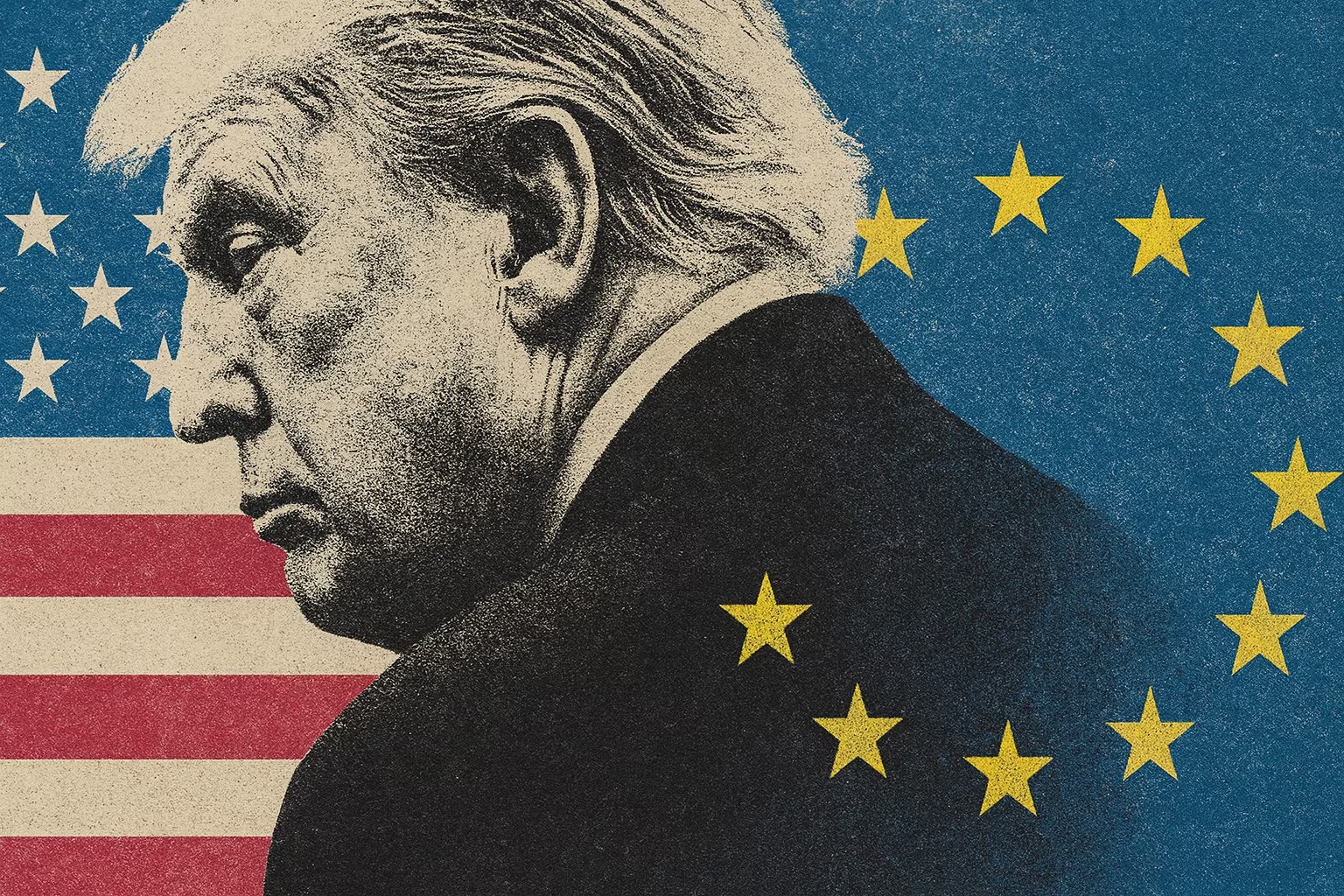
Criticism of Europe from the US president almost automatically provokes indignation and resentment in European capitals. Yet a far more productive response would be a candid, self-critical conversation about Europe’s own strengths and weaknesses—and about the interests it shares with Washington.
America and Europe have for some time been speaking on different wavelengths. For Europe, this is particularly risky. The reaction to the new US National Security Strategy and to Donald Trump’s latest remarks about the Old Continent has once again boiled down to reflexive offense and a refusal to accept criticism: how dare he, what an impermissible intrusion. This posture offers no protection and does real harm, because it overlooks two fundamental points.
First, most Americans criticize Europe precisely because they care about it. Those who speak most harshly—be it J.D. Vance or Trump, Elon Musk or Sam Altman—regularly stress this. The US National Security Strategy, so indignantly debated above all by those who have not read it, states explicitly: “Our goal is to help Europe correct its current trajectory. We need a strong Europe to compete successfully and, together with us, to prevent any adversary from achieving dominance in Europe.” Trump himself, in interviews with Politico, has repeatedly said—literally or in substance: “I want to see a strong Europe.”
The transatlantic rift is compounded by a widening gap in political language. Trump tends to say plainly what he thinks, a sharp contrast to the style of many European politicians, who are increasingly wary of voicing their own convictions. People sense how thought is hollowed out by evasive phrasing and turn away—either from politics altogether or toward agitators and provocateurs.
It increasingly appears that difficult American partners mean exactly what they say: they want a strong Europe, a reliable and capable ally. But Europe does not hear this—or chooses not to hear it, preferring to focus solely on the reproaches. Yet criticism is almost always a sign of engagement and interest. Far more troubling would be its absence—that would signal indifference and, with it, a loss of relevance. Personal sympathy for the critics themselves is secondary in this context.
Responding with arrogance clearly does not serve Europe’s interests. Far more sensible, as Kaja Kallas has rightly stressed, is to pursue a dialogue that includes self-criticism, a discussion of strengths and weaknesses, and shared objectives—backed by concrete actions on both sides of the Atlantic.
The second point is even more uncomfortable: a substantial share of the grievances is well founded. Anyone who does not treat politics as the self-satisfied management of the status quo must concede that for decades Europe has contributed too little—and at times nothing at all. Not in terms of sustained growth and prosperity, nor in securing affordable energy. It has failed to deliver deregulation and a meaningful reduction in bureaucracy, lags behind in digitalisation and in the development of innovation based on artificial intelligence. Above all, Europe is failing to devise a responsible and effective migration policy.
A world broadly sympathetic to Europe watched Germany’s new government with high expectations. Trillions in capital were waiting for the first signals to begin investing in Germany and across Europe, on the assumption that the world’s third-largest economy—under a pragmatic chancellor attuned to business and transatlantic ties—would finally steer the continent off its misguided course. The disappointment was therefore all the more painful. With the exception of the interior minister, the digitalisation minister, and the economy minister, the new government in many areas is delivering the exact opposite of what was promised before the election. The chancellor prefers to blame the vice-chancellor; the vice-chancellor blames his own party; together, they most readily shift responsibility onto the Americans and their president.
Instead of a European reboot, what is on display is a prolonged stagnation and decline. Germany remains a prisoner of the trauma of National Socialism and proceeds from the belief that by staying a pleasant middle ground and avoiding any aspiration to excellence, it will be liked by everyone. France is paying the price for its colonial past in Africa and finds itself—up to and including a president driven by political opportunism—caught in the grip of Islamist and antisemitic networks.
In the United Kingdom, the prime minister is pursuing a similar course of cultural and economic self-abasement. Spain is governed by socialist fantasists who appear to take genuine pleasure in weakening the country, while their rhetoric about a “genocide in Gaza” largely mobilises bored and affluent daughters of the upper middle class.
Sources of hope lie in Finland and Denmark, in the Baltic states and Poland, and—unexpectedly—in Italy. There, the threats posed by Russia, China, and Iran are assessed with greater sobriety, and—most importantly—a healthy drive to be better and more successful than others endures. The starting conditions are far weaker, but the ambition to excel is present.
What Europe needs today is less wounded pride and more patriotism grounded in results. An obvious example would be unity and resolve in defending Ukraine—not merely talk of European sovereignty, but its practical demonstration, even amid friendly disagreements with the United States. Over time, this could well lead to an unexpected shift in Washington’s policy toward Russia. Combined with economic growth driven by real and far-reaching reforms, this would mark a beginning. After that, Europe would have to confront a central task—a radical overhaul of a migration policy rooted in cultural self-denial and allowing in excessive numbers of newcomers who seek a different kind of society, embrace different values, and show little respect for the rule of law.
If all this ends in failure, American criticism will be vindicated by history itself. The explanations for why European renewal is supposedly impossible or unnecessary are nothing more than symptoms of weak leadership. The converse is also true: where there is political will, there is always a way.
This path begins in Europe—with a spirit of renewal that can, without misunderstanding, be called “Europe First” (what else?)—and leads to America. Europe needs America. America needs Europe. And perhaps it took the deep crisis in the transatlantic relationship for both sides to see this with full clarity. Paradoxically, it is precisely now that a genuine opportunity for a revival of a transatlantic community of shared interests is emerging. Precisely because the situation is deadlocked. And precisely because pressure is mounting on both sides of the Atlantic to act differently.
A trade war between Europe and America only strengthens their shared adversaries. The sensible alternative would be to move in the opposite direction—a kind of new deal in relations between the EU and the United States. Tariff-free trade as a stimulus for growth in the world’s largest and third-largest economies—and as the foundation of a shared policy of interests and, inevitably, a joint security policy for the free world.
It is precisely this historic opportunity that Friedrich Merz could now explore and lock in through negotiations with Donald Trump.
As Winston Churchill once put it: “Never let a good crisis go to waste.”