
Donald Trump’s claims on Greenland are becoming increasingly insistent. If European governments once underestimated such remarks, they now, notes Politico, are taking the rhetoric of the US president seriously and, in what officials describe as “desperation,” have begun developing counter-scenarios. The outlet spoke with officials, diplomats, experts, and NATO representatives to determine what tools Europe might use to deter Trump and what options would remain if he were to move ahead with a bid to seize Greenland. As a former Danish lawmaker conceded, “everyone is in shock and has only a vague idea of what instruments we actually have at our disposal.” “But we need answers to these questions immediately,” he added.
Searching for Compromise
Trump insists that Greenland is of critical importance to US security, while accusing Denmark of failing to respond adequately to the growing military presence of China and Russia in the Arctic. According to Politico, the fastest way out of the crisis could be an agreement that Trump could present as a personal victory, while Denmark and Greenland would be able to save face. As a possible mechanism for such a deal, a former senior alliance official points to NATO mediation between Greenland, Denmark, and the United States.
At the same time, NATO allies are discussing options for new initiatives aimed at Trump and designed to strengthen Greenland’s security—despite the widespread view that threats to the island from Russian and Chinese vessels are often overstated. Three alliance diplomats argue that NATO should consider higher defense spending in the Arctic, an expansion of military exercises in the region, and the possible deployment of forces to protect Greenland.
Two additional Politico sources note that the alliance should be prepared to launch a dedicated mission to deploy troops to the region under the name “Arctic Sentry,” modeled on the “Eastern Sentry” and “Baltic Sentry” operations. As one interlocutor put it, “everything that can be done” to strengthen NATO’s presence in the region “should be done to the fullest extent.”
More Money
Politico reduces this scenario to a simple formula: “flood Greenland with money.” As the outlet notes, Trump’s signal is that, should an agreement with the United States be signed, the island would be “literally awash in American cash.” The European Union and Denmark, for their part, are trying to convince Greenlanders that they can offer more attractive terms.
As early as September, after Trump began advancing claims on Greenland, the European Commission presented a plan calling for more than a doubling of spending on the island—to €530 million over seven years, starting in 2028. These funds are intended to complement financing that Denmark already provides to Greenland under its arrangement with the self-governing territory. At present, Danish and European support is focused primarily on social welfare, healthcare, education, and the “green” transition. However, Politico writes, the new plans envisage a shift in emphasis toward developing Greenland’s capacity to extract mineral resources independently.
“We have a very, very large number of people living below the poverty line, Greenland’s infrastructure is lagging behind, and our resources are largely extracted without any meaningful benefit to Greenland itself—the profits go mainly to Danish companies,” says Kuno Fencker, an opposition member of Greenland’s parliament who supports the island’s independence.
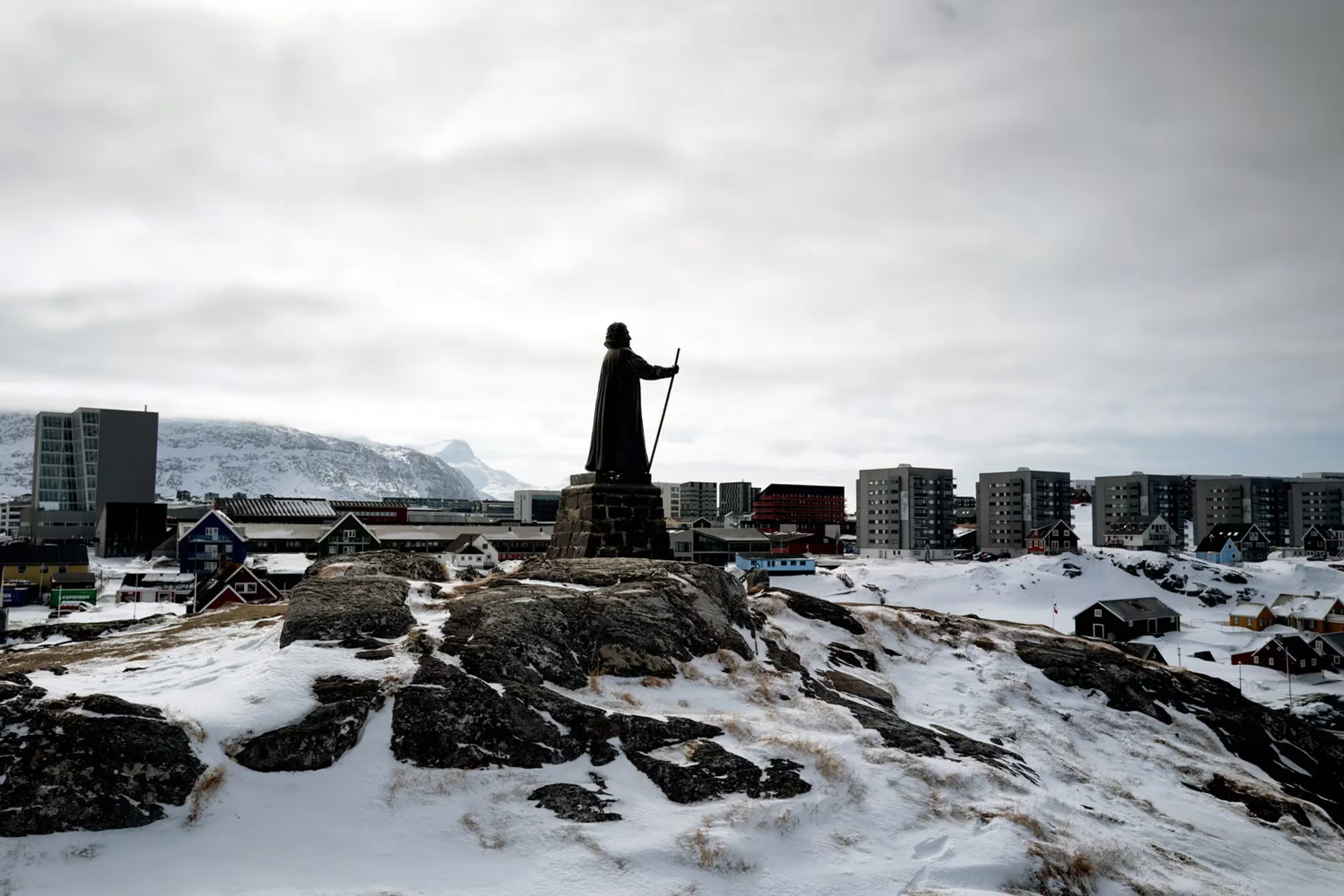
View of Nuuk. May 3, 2025.
According to Politico, a sufficiently convincing offer from Denmark and the European Union could prevent Greenland from falling under US control.
An Economic “Counterattack”
This scenario examines the use of a mechanism that the European Union discussed as a response to Trump’s trade tariffs. It refers to the Anti-Coercion Instrument—an instrument that Bloomberg described as a “tool to counter coercion.” France proposed revisiting its potential use in March 2025. The mechanism allows the European Union, in cases of trade discrimination, to deploy a broad range of retaliatory measures, including restrictions on trade and services, as well as steps affecting certain intellectual-property rights, foreign direct investment, and access to public procurement.
Ultimately, the instrument was never put into effect—in July, Politico notes, it was “shelved” after the parties reached a temporary agreement. At the same time, the United States continues to impose tariffs on EU goods, and in that context Brussels may once again consider returning to the mechanism.
However, Politico stresses that Trump would still need to be convinced of the European Union’s seriousness, given that last time tough rhetoric failed to produce any tangible consequences.
A Military Response
If the United States were to move ahead with a forcible seizure of Greenland, European countries would have an extremely limited set of tools to prevent it, the outlet notes.
Danish military expert Thomas Crosby emphasizes that Europe is not considering the option of “launching a preemptive strike against the Americans before they assert claims to Greenland.” The nature of the response to an initial US move, he says, would depend on the specific circumstances. If it involved a “very small” group of Americans, there could be an attempt to arrest them, as such actions would fall under criminal law. However, if the United States were to go all in, the situation would take on an entirely different scale, Politico writes.
From a legal standpoint, Denmark could find itself obliged to respond to an invasion with military force. Under a standing order dating back to 1952, in the event of an attack on Danish territory the armed forces are required to “engage immediately, without waiting for or requesting orders.”
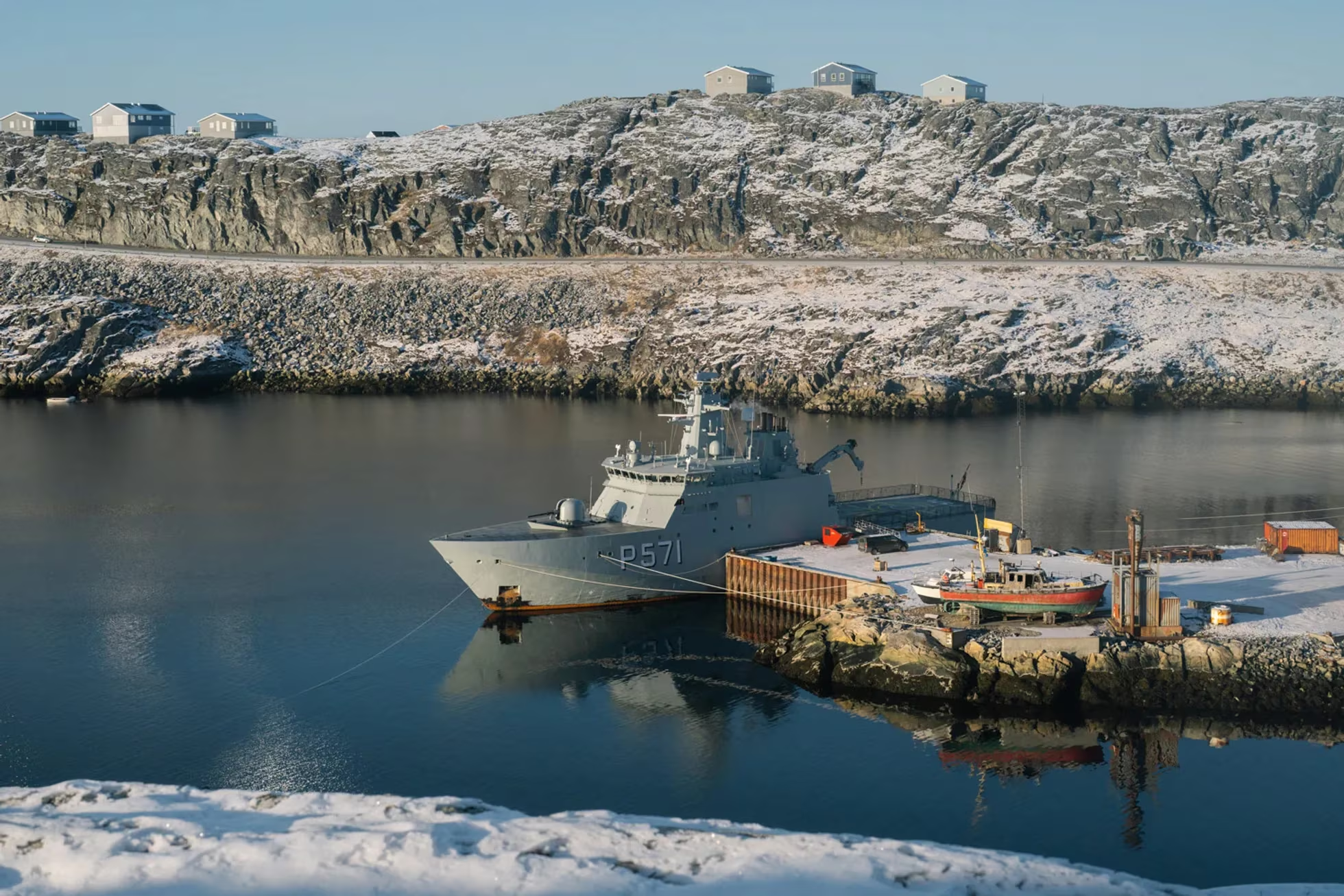
The Danish patrol vessel HDMS Ejnar Mikkelsen in Nuuk. November 3, 2025.
Other European states, an EU diplomat says, should consider the possibility of deploying their own troops to Greenland—at Denmark’s request—to raise the potential cost of a US military operation. Such contingents would be unlikely to stop an American invasion, but could serve a deterrent function, Politico writes. In that configuration, Crosby notes, US forces might face a choice—“either use force or withdraw.” At the same time, he cautions that such a strategy would entail a “high price,” given the risk of human casualties.