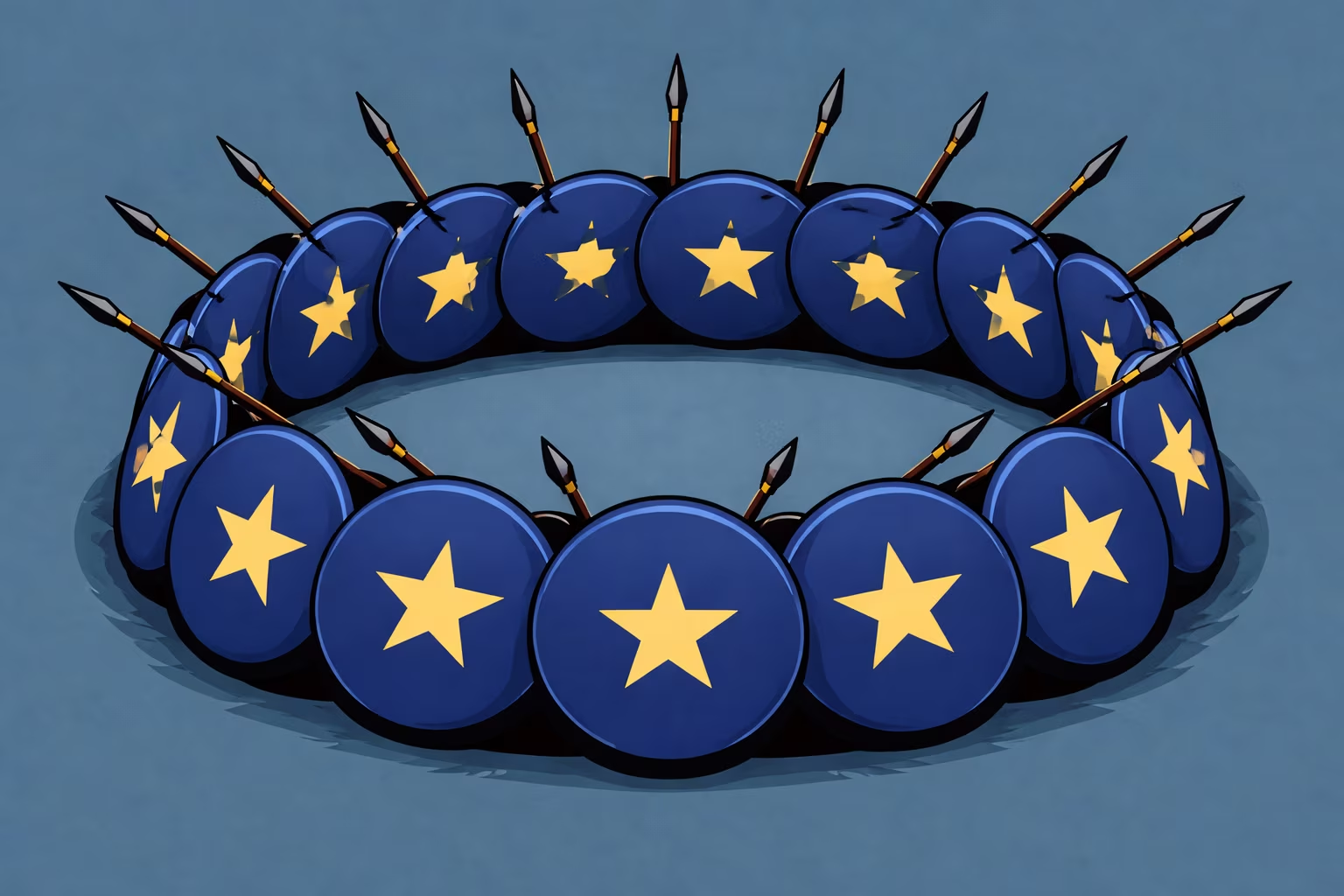
Political theory has long held a simple thesis:to forge a collective identity, you need an enemy. The presence of an adversary compels a society to pull together. For Britain, that enemy was Hitler; for the United States—the Soviet Union. When the Soviet foe disappeared, America’s internal cohesion unraveled with it.
The European Union acquired external enemies only in the past decade. First came the champions of Brexit, then Vladimir Putin; China loomed in the background; and now, at last, the ideal antagonist has arrived—Donald Trump. Few Europeans have done more to unite Europe than he has.
The long absence of enemies weakened Europe. There was no sense that the common project required fighting for. When I recently studied the history of the European Economic Community’s creation in 1957, what struck me was how little resistance there was. A centuries-old idea of a united Europe—previously unrealized—was suddenly formalized by the decision of a handful of leaders of countries that had only just fought one another in a devastating war. They scarcely consulted voters—and almost everyone simply went along. The United States backed the EEC’s creation; Britain did not join, but barely objected; the Soviet Union was more preoccupied with NATO; and the parliaments of the six founding states ratified the agreement by an overwhelming majority.
A technocratic economic bloc without enemies did not stir strong feelings. No one was ready to die for the blue-and-gold flag, and only a handful of Ryder Cup diehards waved it in sports arenas. In films and TV series, the hero battling geopolitical villains was almost always an American—not a European.
“Brexit” became the EU’s first plausible existential threat. Many feared a chain reaction of exits. In 2018, Italy’s ultra-right leader Matteo Salvini, shortly before entering government, likened the EU to the “Titanic, ready to sink.” In response to that threat, support for the union rose to its highest level since 1983—according to a Eurobarometer poll in spring 2018. Brexit, in effect, buried continental movements advocating withdrawal from the EU.
Then Putin took the place of Europe’s main enemy, which also helped to strengthen unity. By autumn 2024, even before Trump’s election, 74% of Eurobarometer respondents said they felt like EU citizens—the highest figure in more than twenty years.
But Trump proved an even more convenient adversary. If TV writers were casting the perfect villain, he would look exactly like this:an usurper in the home of a dependable protector, a man who monopolizes attention even among those who give politics five minutes a week. He threatened to do real damage—as in January’s “Greenland moment.” And he embodied the inverse of the values Europe proclaims—peace and democracy. He also comes with an entire gallery of supporting antagonists:American tech oligarchs whose products have seeped into Europe’s consciousness like nothing before.
I have never before seen Europeans feel so intensely European. Last week I attended an elite gathering in emphatically Atlanticist Netherlands, where the prevailing view was that the United States is lost and Europe must learn to defend itself. One participant, Jaap de Hoop Scheffer, NATO’s secretary-general from 2004 to 2009, argued that Europe cannot defend itself alone and that the United States still backs NATO, but he added:“I fear being abandoned, but I have already passed through the mourning stage.”
Then I watched the prime ministers of Denmark and Greenland speak at Paris’s Sciences Po, where students—and even some journalists—gave them a standing ovation. Europe, at last, had begun to hit a nerve. If the continent is truly starting to decolonize from its American patron, that is both frightening and exhilarating.
These feelings are not confined to elites. The latest Eurobazooka poll, conducted among 7,498 Europeans for the French magazine Le Grand Continent, is striking. A majority backed sending European troops to defend Greenland. Fifty-one percent called Trump an enemy of Europe, and only 8% a friend. Just 3% of German Christian Democrats—traditionally the most committed Atlanticists—considered him a democrat. And, unusually for a foreign-policy topic, awareness of the “Greenland moment” was close to universal.
The poll found only one political group in Europe with no internal consensus about Trump—the far right. Some of its supporters sympathize with him; others do not. He is splitting the far-right flank much as migration once split Europe’s left. I have always doubted that Europe exists as anything more than an unfinished single market. Perhaps that is beginning to change.