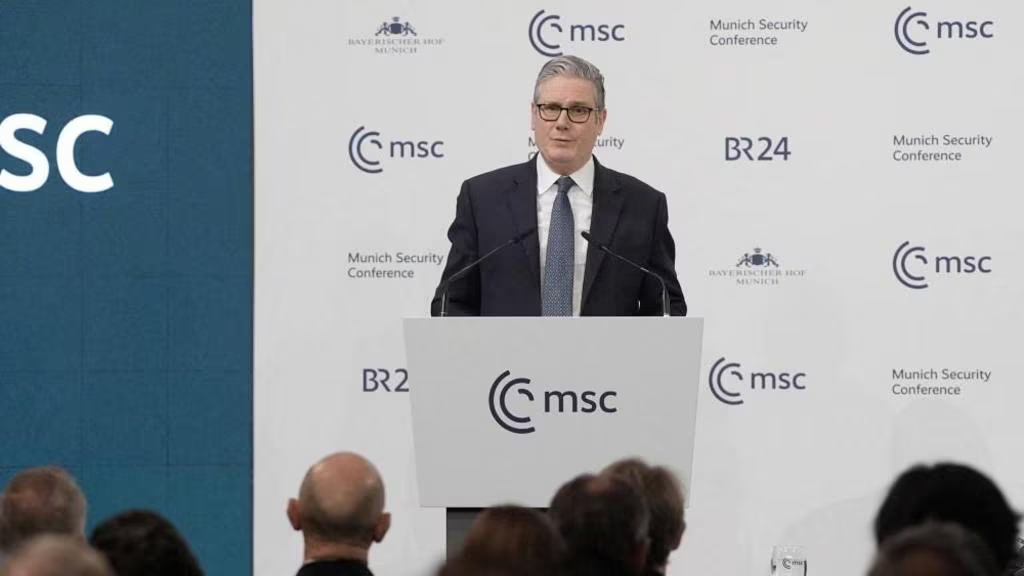
In European capitals, officials are increasingly making it clear that an end to the war in Ukraine is not seen as an unconditional reduction of risks for the continent. UK Prime Minister Keir Starmer argues that a peace agreement could not weaken but accelerate Russia’s rearmament. Speaking at the Munich Security Conference, he said that Moscow is already expanding its military capabilities and rebuilding its armed forces and industrial base, despite the ongoing fighting. Starmer cited NATO assessments suggesting that by the end of the decade Russia could be ready to use force against the alliance.
According to him, even the achievement of peace in Ukraine would not reduce the threat to Europe; on the contrary—risks could increase. In this situation, the British prime minister stressed, allies must deliver a “full-fledged response” to the emerging danger.
A similar position had earlier been voiced by the chairman of the Munich Security Conference, Wolfgang Ischinger. He reiterated that halting the war in Ukraine does not serve Europe’s interests. In an interview with Tagesspiegel, Ischinger noted that a ceasefire could lead to a heightened threat on NATO’s eastern flank. “The Russian threat to us, to Germany, would also increase if any future ceasefire were not accompanied by meaningful constraints on military deployments in Russia’s western military districts,” he said.
According to Ischinger, immediately after a ceasefire “Putin would be able to calmly continue his rearmament program, and the threat situation for NATO countries on the eastern flank would deteriorate.” For this reason, he described the way the war in Ukraine ends as “a decisive question of fate for Germany and Europe.”