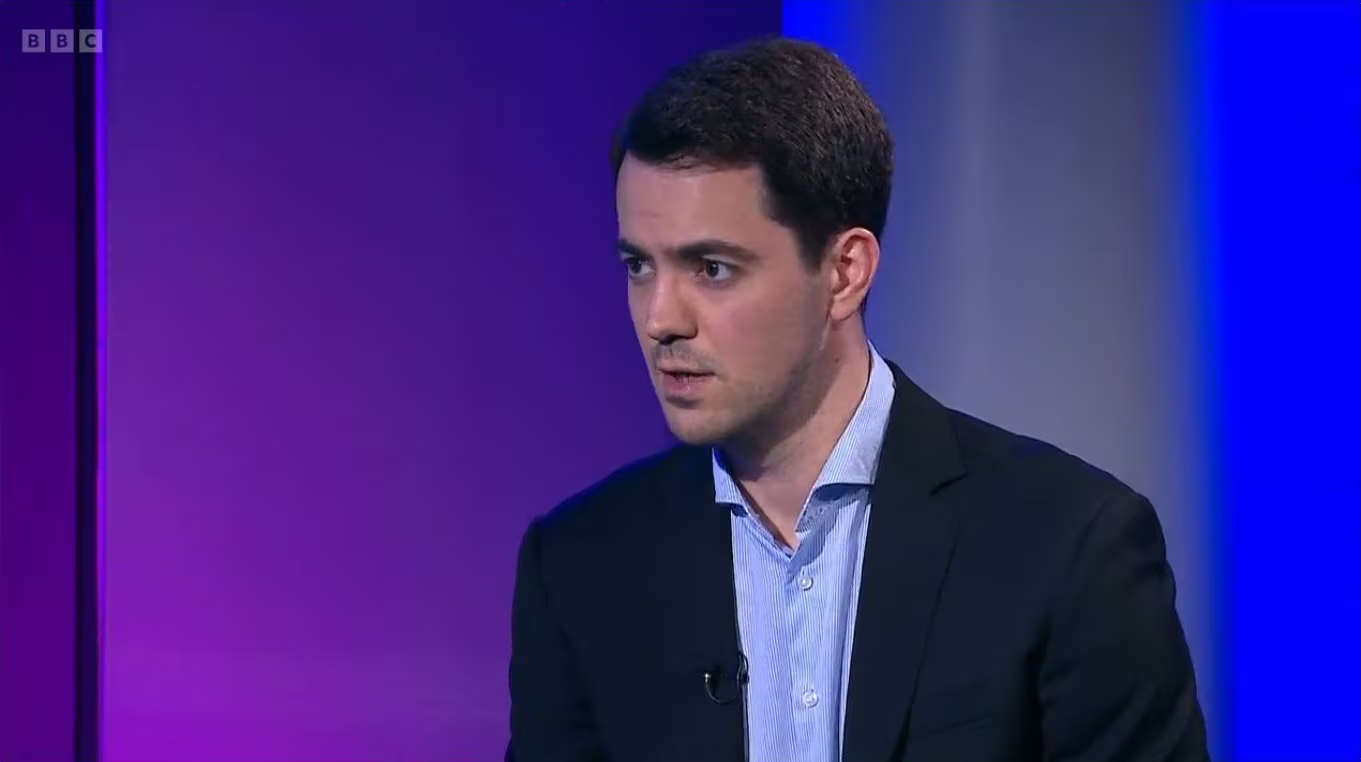
European countries are ignoring troubling trends within Ukraine—so argues Alexander Rodnyansky, a former economic adviser to Volodymyr Zelensky and the son of producer Alexander Rodnyansky, in an op-ed for The Wall Street Journal.
He notes that, in informal conversations, European politicians are increasingly acknowledging that support for Kyiv is driven less by solidarity than by a desire to “buy time for themselves,” rooted in fears of a possible Russian attack and a view of Ukraine as a buffer. In public, however, Europe continues to speak “as though it is engaged first and foremost in a noble democratic mission.”
“This lie is becoming dangerous. It encourages European governments to judge Ukraine solely by its willingness and ability to keep fighting, while excluding any criticism of the quality of the Ukrainian state. As long as the front holds, almost everything else becomes easier to rationalize: forced mobilization, executive overreach, the suspension of accountability, persistent corruption, incompetence, and political dysfunction in Kyiv. The moral rhetoric remains untouched, while the harder questions are deferred,” Rodnyansky writes.
In his view, ignoring these warning signs may leave Europe with what he calls “a source of instability” on its borders.
“Europe should be more concerned about this. A country can remain militarily viable while deteriorating politically. That is one of the classic dangers of long wars of attrition. They tend to centralize power, normalize coercion, and create powerful incentives to postpone scrutiny and oversight in the name of necessity. The problem does not disappear simply because it is uncomfortable for Western politicians to acknowledge it,” he argues
Rodnyansky suggests that Europe’s strategy may rest on the assumption that the distortions accumulating now can be corrected later.
“But that is a gamble, not a strategy. If the current trend continues, Europe may not get the inspiring postwar democracy it imagines. Instead, it may inherit on its border a heavily armed, deeply traumatized, politically fragile country—a country that is anti-Russian but not liberal, lacking effective governance and resistant to integration. Ultimately, the risk is that a protracted war and indulgent external support will produce a state whose pathologies are themselves dangerous,” Rodnyansky writes, urging Western countries to rethink their approach to Ukraine’s internal dynamics.