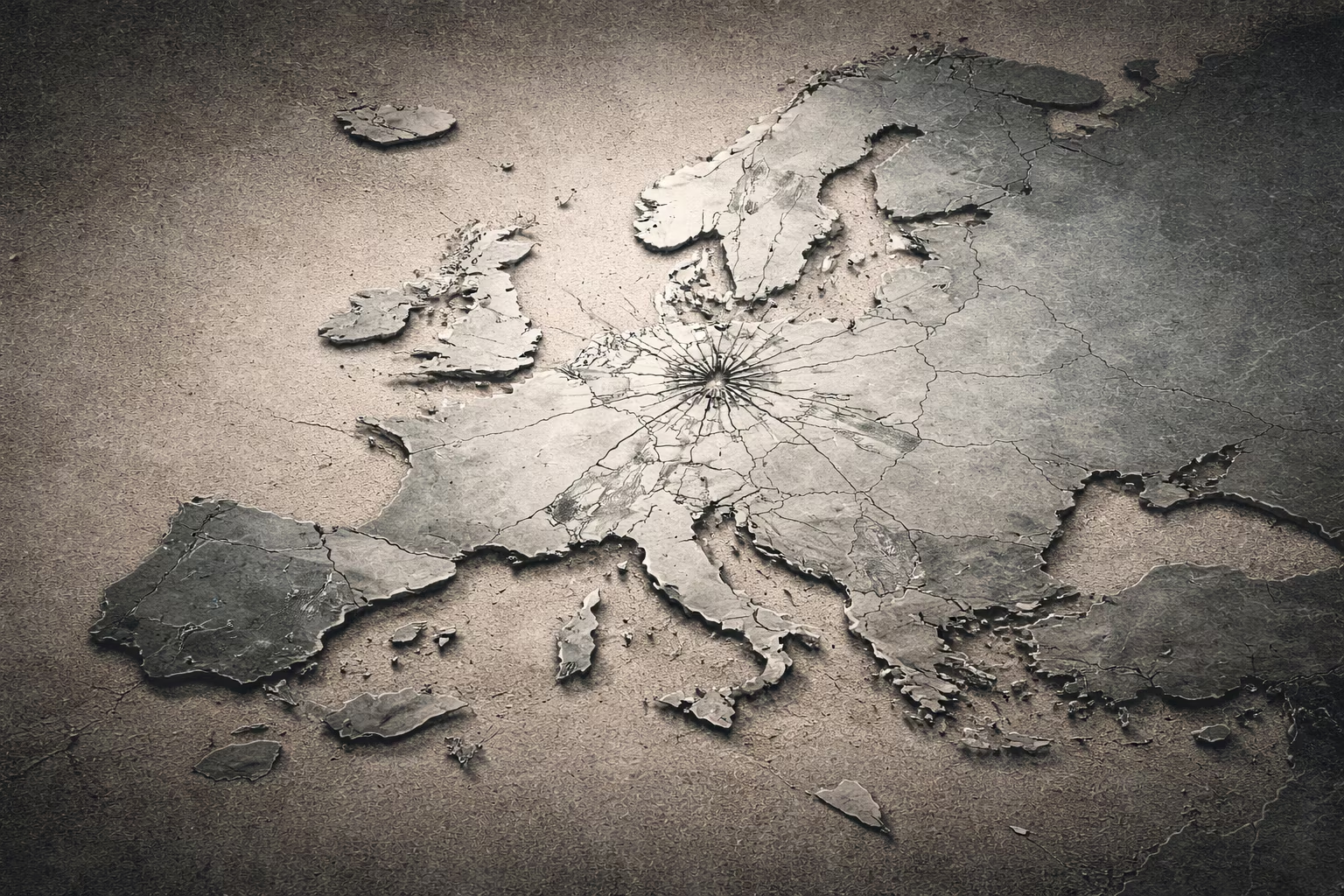
External pressure on Ukraine from Russia is intensifying, China is eroding the EU’s industrial base, and the United States—by effectively threatening the annexation of a NATO ally’s territory—is undermining the multilateral rules on which the European Union long relied. Those norms look increasingly outdated in a world that is becoming less cooperative and far more transactional.
There is nothing to suggest that this process will slow. On the contrary, over the coming year the gradual erosion of Europe’s familiar reference points is likely to be compounded by weak political leadership within the bloc itself—above all in the so-called E3 countries: Germany, France, and the United Kingdom. In the longer term, Europe’s key existential risks will stem from the transatlantic relationship. For European leaders, keeping the United States committed to supporting the war in Ukraine was the central task of 2025. The best possible outcome for 2026 would be the continuation of the ad hoc diplomacy and transactional approach that defined the past 12 months. Yet if new threats emerge in these relations—especially around Greenland—maintaining this fragile balance may prove impossible.
The year is beginning with no sign that Russia is ready to make concessions on the terms of a ceasefire or to accept the 20-point plan put forward by the United States, the EU, and Ukraine. Russian President Vladimir Putin is operating on the assumption that Ukraine’s military position will deteriorate, forcing President Volodymyr Zelensky to agree to territorial concessions. It is possible that, with European backing, Zelensky will continue to resist US pressure on territorial issues and will step up strikes on Russian energy infrastructure and exports, while simultaneously holding positions along the front line. It is clear that, in response, the intensity of Russian air attacks on Ukrainian cities and energy facilities would also increase.
Even so, rising military spending in Europe, purchases of US weapons, financial support for Kyiv, and sanctions on Russia—including measures targeting sources of energy revenue—could help preserve last year’s status quo. But this is, perhaps, the best of the plausible scenarios.
Meanwhile, European leaders will have to publicly ignore Washington’s support for far-right parties—explicitly recorded in the new US national security strategy—while simultaneously doing everything behind the scenes to contain an anti-establishment backlash at the ballot box. In this context, the upcoming elections in Hungary will serve as an indicator of whether the MAGA movement is capable of tipping the scales in favor of its ideological allies in Europe. Eurosceptic Prime Minister Viktor Orban, for the first time in 15 years, faces a real risk of defeat.
Orban himself is campaigning with the aim of mobilizing the electorate, suggesting that he and his inner circle are seriously contemplating the possibility of losing. His challenger, Peter Magyar—who shares Orban’s conservative-nationalist roots but is untainted by corruption—poses a credible threat. Structural pressures are mounting as well—economic stagnation and rising prices. Traditional tools—cash handouts, smear campaigns, and the stoking of war-related fears—have so far failed to deliver results for Orban. However, a direct military echo of the war in Ukraine affecting Hungary could once again activate voter anxieties and alter the political dynamic.
All of this is compounded by the weakness of the E3 countries. The erosion of Europe’s political center has been underway for decades, but France, Germany, and the United Kingdom entered 2026 with fragile and unpopular governments, squeezed between populists on both the right and the left and a US administration that is, in effect, interested in their weakening. Although no general elections are scheduled in any of these countries, all three risk sliding into paralysis—at best—or destabilization—at worst. At least one leader—the British prime minister, Keir Starmer—may fall victim to an internal party revolt.
The key political event of the year in the United Kingdom will be the local elections in May. Under the current configuration, the Labour Party risks a humiliating third-place finish in the Welsh parliament, an inability to unseat the Scottish National Party in Scotland, and the loss of seats to the Greens and Reform UK in local elections in England. Labour MPs are already bracing for a formal leadership challenge to Starmer, and his chances of surviving it appear slim.
France, meanwhile, entered 2026 for the second year in a row without an approved budget. For President Emmanuel Macron, the good news is that the minority government of his prime minister, Sebastien Lecornu, is likely to secure agreement on a budget with a modest reduction in the deficit by late February or March. Moreover, with just 16 months remaining until the presidential election and municipal elections scheduled for March, the opposition’s appetite for an early dissolution of parliament has visibly diminished. Beyond that, however, Macron has little reason for optimism—the fragmented National Assembly will sustain an atmosphere of protracted crisis through the 2027 elections.
In Germany, by contrast, the economy is likely to post a weak recovery, but this will do little to resolve its structural problems. The government of Chancellor Friedrich Merz, hamstrung by ideological divisions, will struggle to push through far-reaching reforms. And with support for the far-right Alternative for Germany expected to rise in five upcoming state elections, pressure on Berlin’s leadership is set only to intensify.
In 2026, a historical truth long forgotten in calmer times will reassert itself—freedom, stability, prosperity, and peace in Europe have always been fragile. The holiday from history provided by Pax Americana and an exceptional level of cooperation and integration after the Second World War has formally come to an end. Going forward, Europe’s place in the new world order will be shaped by its response to escalating hybrid aggression from Russia, its influence on diplomatic efforts surrounding the war in Ukraine, and its ability to strengthen its own competitiveness—while simultaneously containing the rise of the far right and addressing the existential economic and security threats posed by Russia, China, and the United States.