Amid political turbulence emanating from the White House, European Union lawmakers on Thursday, March 26, sought to secure at least a degree of predictability—wherever it still seemed possible.
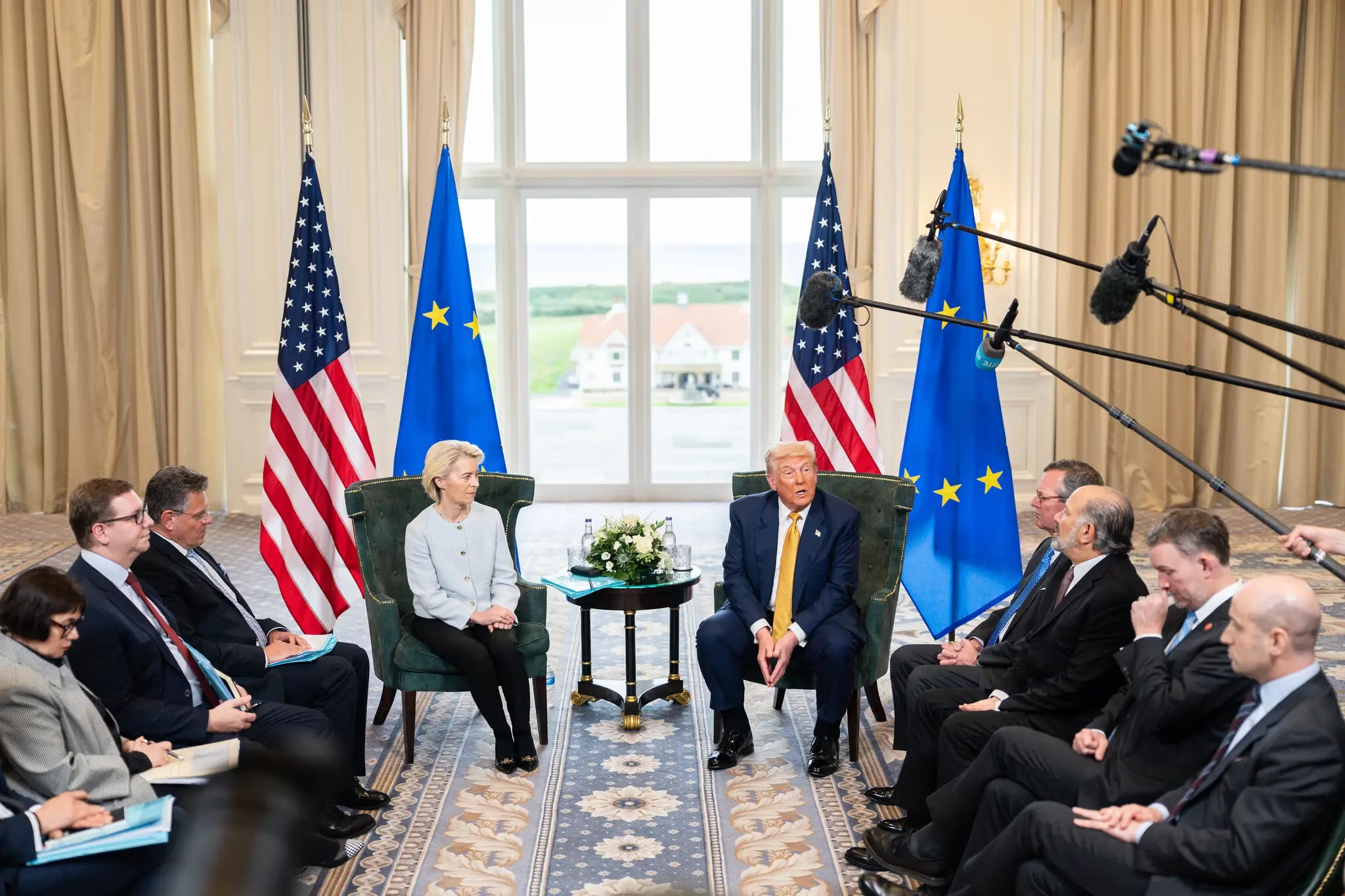
The European Parliament approved key provisions of the trade agreement reached between the United States and the European Union last year at Donald Trump’s golf resort in Turnberry, Scotland. The decision followed protracted negotiations and came against a backdrop of mounting doubts among European policymakers about the reliability of the United States as a partner.
The ratification process on the European side proved unusually drawn out even by the bloc’s own standards. Progress on the agreement was repeatedly stalled. It was first frozen after Mr. Trump threatened to take control of Greenland—an autonomous territory of Denmark, an EU member. Discussions were later suspended again when the U.S. Supreme Court ruled Trump’s across-the-board tariffs unconstitutional, leaving uncertainty over how the administration would respond.
In the end, the European Parliament agreed to eliminate tariffs on American industrial goods—including components, equipment, and raw materials—as well as on certain agricultural products. These measures formed the core of the agreement reached with the Trump administration a year earlier. Yet concerns persist: officials in Brussels acknowledge that Washington may retreat from its commitments and maintain tariffs on most EU exports at around 15%.
Bernd Lange, chair of the European Parliament’s relevant committee, said additional conditions had been incorporated into the approved version: the agreement is to be automatically reviewed if the Trump administration breaches its commitments and imposes new tariffs on the European Union. In effect, lawmakers sought to embed safeguards against a potential unilateral withdrawal by the United States.
The next stage involves negotiations with the participation of member states and EU executive bodies, after which the agreement must be approved by the ambassadors of all 27 member countries. These steps are expected to proceed without major obstacles—the principal hurdle was widely seen as the vote in the European Parliament. “We are close to the finish line,” said Jacob Funk Kirkegaard, a senior fellow at the Brussels-based think tank Bruegel. At the same time, he suggested that provisions designed as “insurance against Trump” will most likely be removed, as Washington is unlikely to accept them. In his view, their inclusion is largely political in nature: “This is realpolitik and a process in which much happens behind the scenes.”
The decision by the European Parliament is expected to be received positively in the White House. The U.S. ambassador to the EU, Andrew Puzder, said in a television interview that failing to adopt the agreement this week would have been “economic malpractice.” EU officials have likewise stressed the need to see the process through. “An agreement is an agreement,” said Valdis Dombrovskis, the European Commissioner for the economy, on Thursday morning ahead of the vote. “Our reputation depends on whether we honor our commitments.”