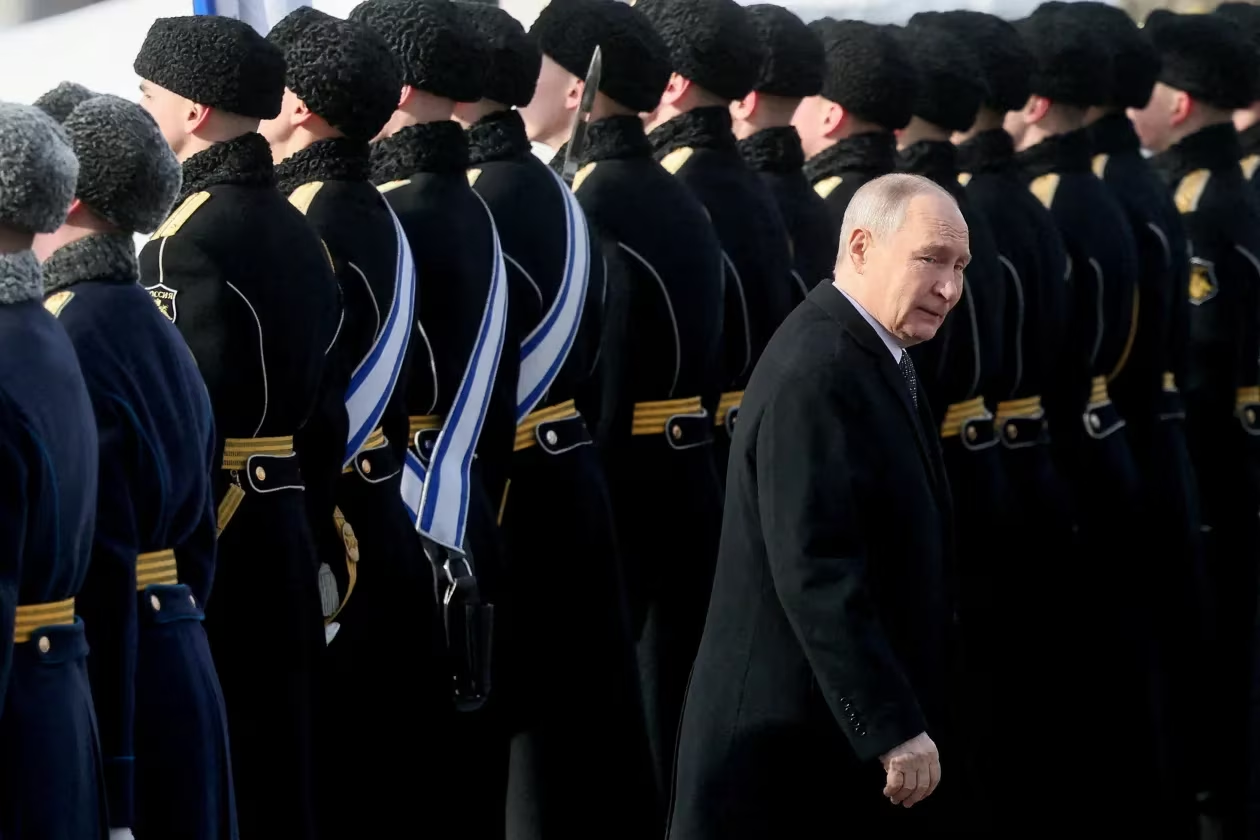
European capitals are speaking ever more insistently about the need for direct dialogue with Vladimir Putin—and almost nobody involved in the discussion expects quick results. According to the Financial Times and Politico, the EU is discussing appointing a special envoy for contacts with Moscow, while foreign ministers plan to return to the issue at a meeting in Cyprus. Names reportedly under consideration include former German Chancellor Angela Merkel, former Italian Prime Minister Mario Draghi, and Finnish President Alexander Stubb.
But many analysts believe the real purpose of these initiatives lies less in negotiations themselves than in Europe’s attempt to demonstrate its own geopolitical agency after Washington effectively put its peace process on hold.
Below is why few expect rapid progress, what narrow window for diplomacy may nevertheless be opening, and what remains the main obstacle.
The logic of “showing that the war cannot be resolved without Europe” helps explain why Vladimir Zelensky has not objected to the idea of dialogue itself. The Ukrainian president regularly stresses that Europe must participate in any negotiations, expecting the EU to maintain positions coordinated with Kyiv.
Experts nevertheless remain skeptical about the prospects for such talks. If Donald Trump’s administration failed to find a formula capable of narrowing the gap between Moscow and Kyiv, European mediators are unlikely to be in a stronger position—especially amid the sharp rise in mutual hostility.
European leaders continue calling for tougher sanctions and expanded support for Ukraine. Moscow, meanwhile, accuses European countries of assisting strikes on Russian territory, supplying components for Ukrainian drones, and providing airspace for their operations. Russian officials and propagandists are increasingly threatening strikes against military-industrial facilities inside EU states.
As a result, the most widespread assumption remains that any negotiations would quickly reach a dead end. European representatives would restate Kyiv’s already familiar position, Moscow would once again repeat its previous demands—including the withdrawal of Ukrainian forces from Donbas—and both sides would then accuse each other of lacking seriousness.
Even so, some analysts believe changes in the global political landscape are creating a limited opening for a more serious conversation.
Twenty to twenty-five years ago, relations between Europe and Russia were built primarily around trade and economic integration. In the early 2000s, politicians actively discussed the idea of a “Europe from Lisbon to Kamchatka,” while Moscow and several major European capitals often held similar positions on international issues—as during the Iraq War in 2003. Supporters of this interpretation argue that the United States viewed such rapprochement as a threat to its interests and turned Ukraine’s geopolitical orientation into a tool for breaking apart Russian-European relations. Critics counter that the rupture was driven primarily by NATO expansion and Russia’s own actions—not by an American grand design.
Whatever the interpretation, the war in Ukraine led to a dramatic rupture between Moscow and the EU. Europe reduced its dependence on Russian energy, deepened military coordination with the United States, and effectively integrated itself into the American security system.
Trump’s return to the White House in 2025 altered many of the previous assumptions. On one hand, Washington signaled that it was no longer interested in prolonging the war and favored ending it as quickly as possible. On the other, Trump sharply escalated his rhetoric toward the EU, demanding higher military spending, changes in domestic policy, and greater alignment with American interests. In Europe, this fueled fears of ending up simultaneously at odds with both Russia and the United States.
Against this backdrop, a growing idea has taken hold within parts of the European elite that prolonging the war supposedly gives Europe time to prepare for a possible future conflict with Russia. Critics of this approach argue that extending the war itself increases the risk of direct confrontation.
The main practical argument in favor of de-escalation became the conflict around Iran and the Strait of Hormuz. Rising energy prices intensified pressure on the European economy, which was already struggling with declining competitiveness and rising defense costs, and fueled support for gradually restoring relations with Moscow in the interest of stabilizing supplies. At the same time, earlier moral and political constraints have begun to erode. Europeans increasingly question how consistently Russia can remain isolated while maintaining relations with Saudi Arabia, Turkey, or Syria’s new authorities—especially when the United States itself demonstrates a willingness to act outside established norms of international law.
Within Russia itself, pressures are also accumulating that could potentially push the Kremlin toward searching for an exit. The war is becoming increasingly positional in nature, the economy faces mounting strain from Ukraine’s long-range strikes, and further escalation—a new mobilization, attacks on Europe, or the use of nuclear weapons—would carry significant risks for the Russian leadership itself.
If negotiations do begin, Moscow would likely seek to bring the EU into the framework of the so-called “Anchorage understandings”—the compromise outlines reportedly agreed by Putin and Trump in Alaska in August 2025, involving sanctions relief, recognition of Russian control over occupied territories, and pressure on Kyiv regarding territorial concessions. As a softer alternative, Europe could propose freezing the war along the current front line while offering Ukraine certain security guarantees, though the willingness of all sides to accept such a scenario remains highly uncertain.
And this is where the central obstacle emerges—the mutual perception of Russia and Europe as long-term adversaries. Within the EU, the belief is widespread that Russia poses an existential threat to European security. In Russian political circles, by contrast, there is a deeply rooted view that any strong and unified Europe has historically been hostile toward Moscow.
As long as these underlying assumptions remain intact, discussions about a special envoy and new dialogue formats are likely to remain an exercise in political positioning rather than a genuine road to peace.