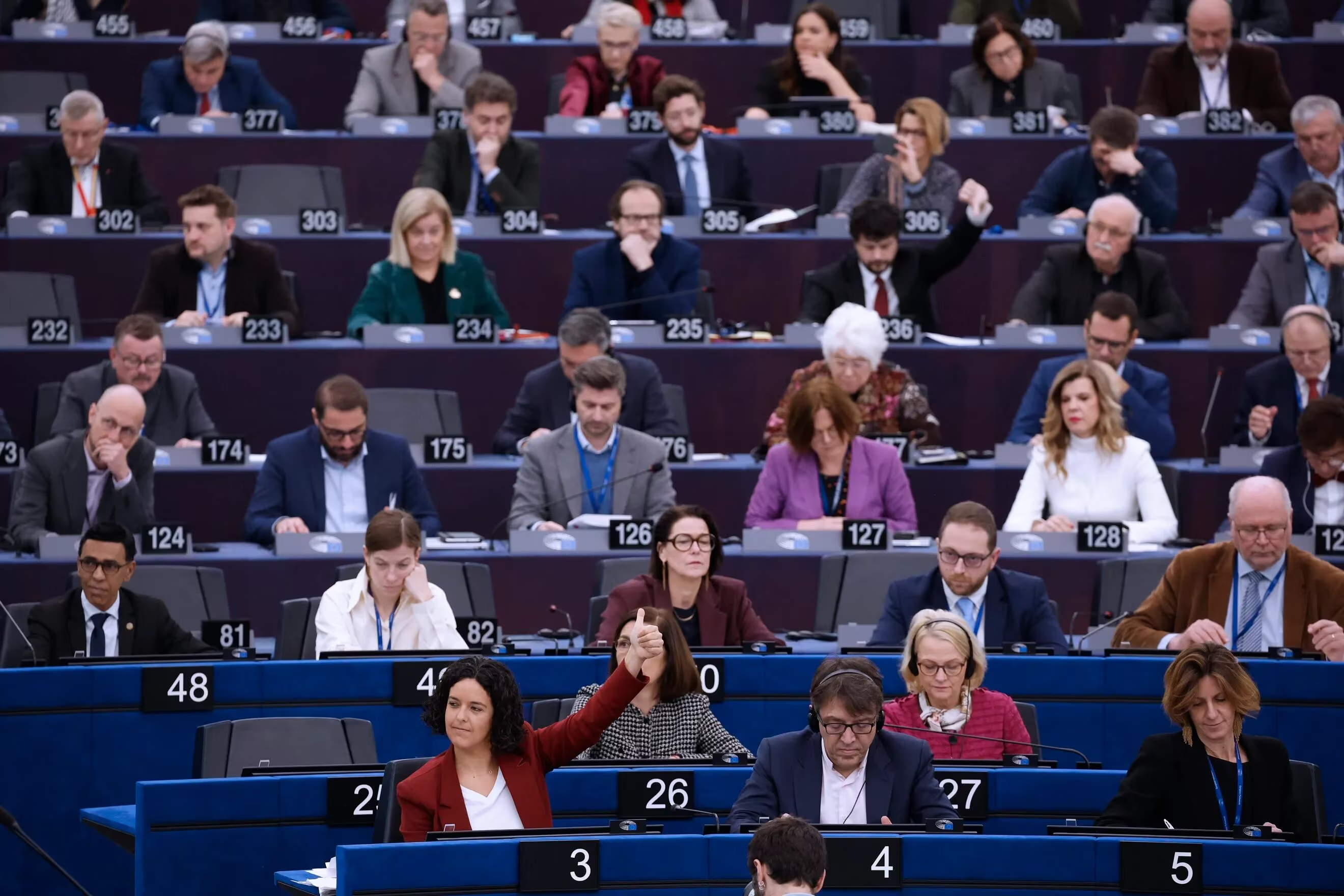
The European Parliament’s decision to refer the EU’s trade agreement with MERCOSUR to the Court of Justice of the European Union was the product of a razor-thin vote and internal political rifts—not a reassessment of the deal’s underlying logic. With 334 votes in favor, 324 against, and 11 abstentions, ratification of the agreement—more than 25 years in the making—has effectively been frozen for at least 18–24 months, pending a judicial opinion on its compatibility with EU treaties.
The European Commission was well aware in advance that support for the agreement was weakening and, in recent weeks, sought to reverse the trend through coordinated pressure on lawmakers. These efforts—ranging from intra-party leverage to direct calls from heads of government and European commissioners—failed to deliver. The outcome proved particularly painful for Commission President Ursula von der Leyen, who had framed the deal as a cornerstone of strengthening the EU’s external trade amid strained relations with the United States.
The decisive factor was not pan-European trade considerations but the domestic politics of individual countries. The margin tipped due to shifts among Romanian Socialists and parts of the center-right, most notably Hungarian lawmakers. In Romania, Hungary, Spain, France, and Poland, pressure from far-right and right-wing populist forces—actively mobilizing farmers’ protests—has rendered support for the agreement politically toxic at the national level.
Formally, the centrist coalition—the European People’s Party, the Social Democrats, and the Renew liberals—backed the deal. In practice, national delegations within all three groups had long opposed MERCOSUR. As one European Commission official acknowledged, the outcome was expected, but the closeness of the vote merely underscored the depth of the split.
A particular surprise was the behavior of ten Romanian Social Democrats who, instead of the anticipated abstention, backed the court referral in response to pressure from the far right at home. A similar radicalization, sources say, has in recent weeks affected Greek Socialists as well—against the backdrop of farmers’ protests. Within the EPP, uncertainty persisted until the final moment: Hungarian lawmakers wavered between abstention and supporting a freeze, factoring in upcoming elections and the rhetoric of Viktor Orban, who accused them of serving “Brussels” against farmers’ interests.
Spanish EPP lawmakers ultimately did not support sending the agreement to court, despite a tougher anti-MERCOSUR tone during the national campaign. However, the following day the leadership of Spain’s Popular Party and EPP leader Manfred Weber publicly opposed the idea of temporarily applying the agreement by bypassing the European Parliament—placing the EU’s largest political force on a trajectory toward open internal conflict.
The infighting also reached Renew Europe, where French and Irish lawmakers were sharply criticized for voting against the group line. Taken together, the MERCOSUR vote demonstrated that national electoral logic has decisively prevailed over a pan-European trade strategy—leaving behind not only a frozen agreement, but also deep fractures within the European Parliament’s key political groups.