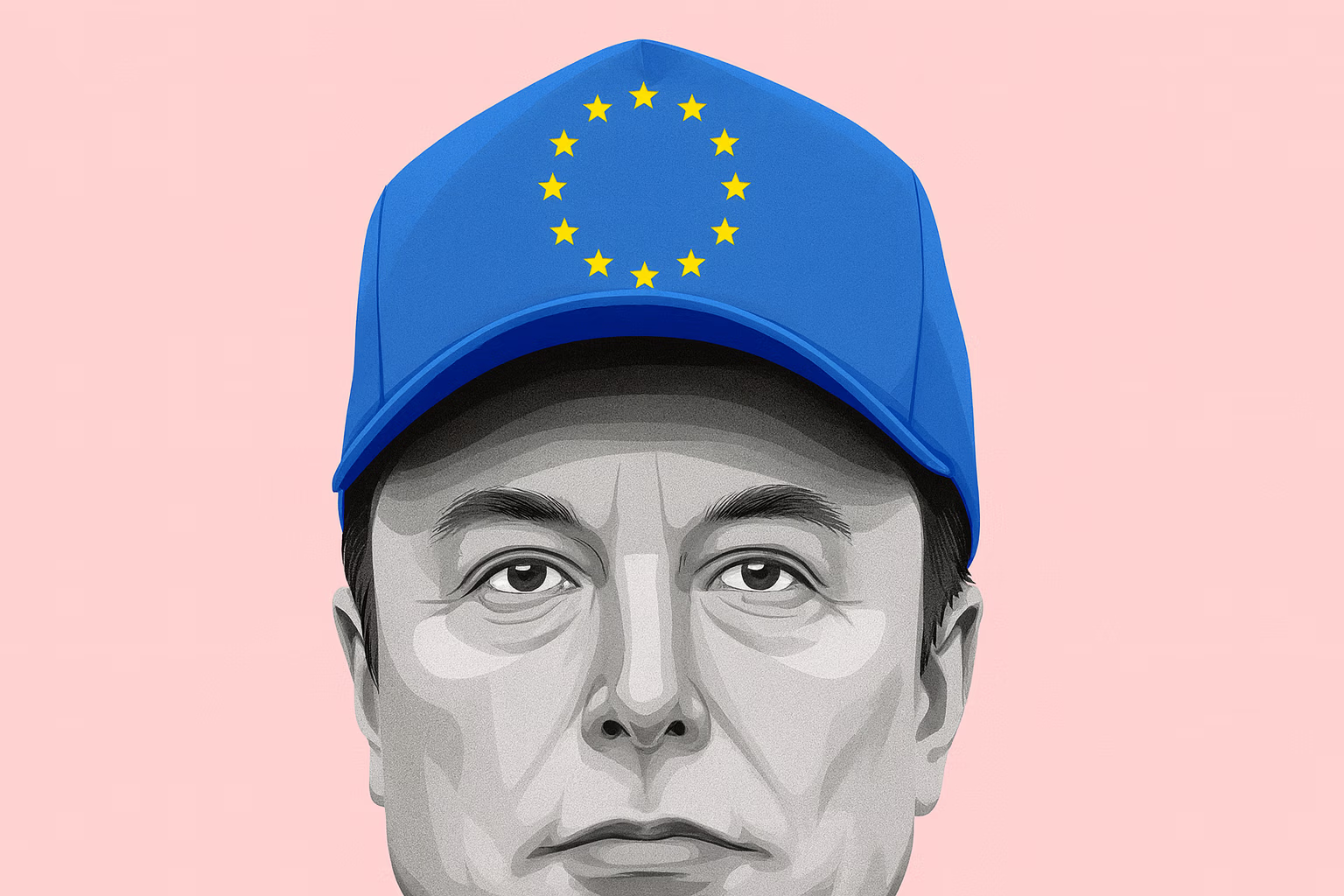
The European Commission on Friday fined Elon Musk’s X platform €120 million—the first penalty imposed under the EU’s new continent-wide content-moderation law. The move is almost certain to deepen tensions between Brussels and Washington over digital regulation and has already drawn criticism from U.S. Vice President JD Vance, who called it an attempt to punish the company for its “refusal to censor.” Although the sum is modest compared with earlier EU actions against tech giants, Washington has repeatedly pressed Brussels to soften its rules during trade negotiations.
Following its audit, X was found to have violated transparency obligations that apply to the largest online platforms under the Digital Services Act. The Commission said the current design of the blue checkmark is “misleading,” because the symbol no longer signals account verification and has instead become a paid feature.
The Commission also said X’s advertising library lacks sufficient transparency, and the company fails to provide researchers with the required access to public data as mandated by the law. The fine concludes only one strand of an investigation launched nearly two years ago—the first under the DSA. Other parts of the inquiry, including X’s efforts to curb illegal content and information manipulation, remain ongoing.
Henna Virkkunen, the European Commission’s Executive Vice-President for Technological Sovereignty, compared the decision on X with a parallel ruling on TikTok issued the same day. The review of TikTok’s ad library was closed without a fine after the company agreed to redesign parts of its interface. “We’re not here to hand out the highest fines but to ensure compliance with digital legislation. If you follow the rules—there will be no penalty,” Virkkunen told reporters. The DSA allows fines of up to 6 percent of a company’s global annual turnover. While X’s revenue sits at the lower end of the multibillion-dollar range, Musk’s other companies generate substantially higher income.
According to Virkkunen, the penalty was deemed “proportionate” and calculated with regard to “the nature of the violations, their relevance to EU users, and their duration.” Asked to clarify the methodology, a senior Commission official reiterated the emphasis on proportionality and said the figure cannot be “reduced to a simple economic formula.” Meanwhile, pressure on Brussels is mounting—from EU leaders, members of the European Parliament, and rights groups—urging the Commission to demonstrate that it is safeguarding citizens in the digital sphere.
U.S. officials routinely accuse the DSA of enabling censorship and threaten trade retaliation in response. On Thursday evening, Vance again insisted the EU should not “attack American companies.” “Rumor has it the Commission is preparing to fine X hundreds of millions of dollars for refusing to censor. The EU should uphold free speech, not go after American firms over frivolities,” he wrote on X. “Much appreciated,” Musk replied. Asked about Vance’s comments, Virkkunen noted: “The DSA has nothing to do with censorship; this decision concerns X’s transparency.”
X did not provide a comment. TikTok spokesperson Paolo Ganino said: “We take our obligations under EU law seriously and reiterate the importance of fair competition. We expect DSA standards to be applied to all platforms equally and consistently.”