The era of nuclear-arms control is coming to an end this week—the last legally binding mechanism limiting the number of deployed nuclear weapons held by Russia and the United States is set to expire.
The New START treaty, which set a ceiling on the number of operational missiles and warheads in the world’s two largest nuclear arsenals, expires on Thursday. With the prospects for new negotiations close to zero, this could open a period of renewed atomic confrontation among the great powers.
“I genuinely believe we are on the threshold of a new arms race,” said James Acton, co-director of the Nuclear Policy Program at the Carnegie Endowment for International Peace. “I do not think another treaty limiting arsenal sizes will emerge in my lifetime.”
The treaty’s expiration draws a line under more than half a century of attempts by Moscow and Washington—amid persistent distrust and with uneven success—to restrain the growth of their own arsenals. That path began under Richard Nixon and Leonid Brezhnev in 1972 and continued through the negotiations between Ronald Reagan and Mikhail Gorbachev in 1985 at a villa on the shores of Lake Geneva.
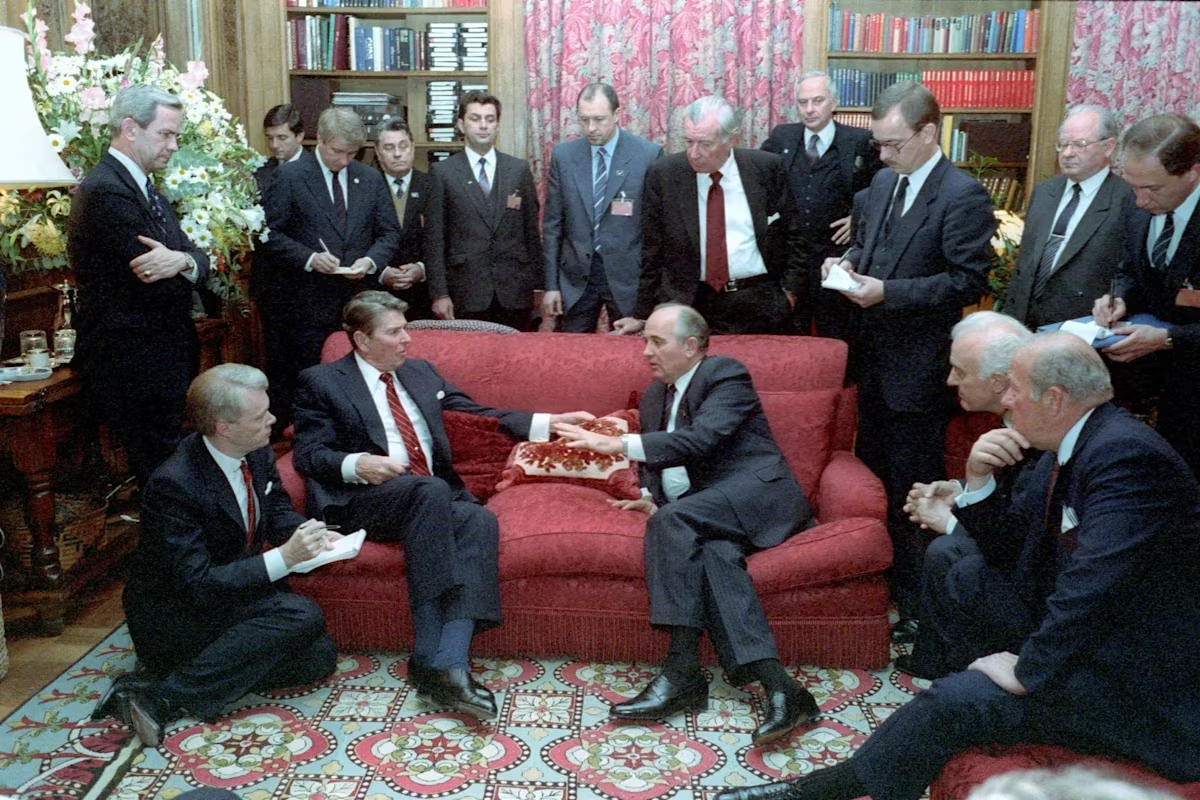
US President Ronald Reagan and CPSU General Secretary Mikhail Gorbachev during a meeting at the Geneva summit. 1985.
Signed in 1991 amid the collapse of the Soviet Union, the START I treaty introduced for the first time substantial limits on US and Russian strategic nuclear forces and established an inspections regime that became a benchmark for all subsequent arms control in the post-Cold War era.
After a brief hiatus, it was replaced by the New START treaty, signed in 2010 and extended in 2021. It set a cap on deployed nuclear warheads for each side at 1,550—a figure more than sufficient for mutual annihilation and for inflicting catastrophic damage on large parts of the world.
Russian President Vladimir Putin has suggested that both sides could voluntarily continue to observe the existing limits after the treaty expires. Donald Trump, who called the proposal “a good idea,” has yet to give an official response but has indicated that he would prefer “a new agreement that will be much better”—one involving not only Russia but also China.
“President Trump has repeatedly spoken about the need to respond to the threat that nuclear weapons pose to the world and has made clear that he would like to preserve limits on nuclear arms and bring China into arms control negotiations,” a White House spokesperson said.
Discussions around the treaty, signed in 2010 during the ill-fated attempt at a “reset” in relations with Russia under then US President Barack Obama, stalled after Vladimir Putin ordered a full-scale invasion of Ukraine in 2022. A year later, Putin suspended Russia’s participation in the treaty and signaled that Moscow could return to nuclear testing.
Last year, Donald Trump ordered the Pentagon to resume nuclear tests “on an equal footing” with Russia and China. It remained unclear, however, whether he was referring to explosive nuclear tests or to trials of nuclear delivery systems.
“It is impossible to have a treaty that is better than the overall state of relations. The absence of a treaty therefore reflects what is happening more broadly between the United States and Russia,” said Pavel Podvig, director of the Russian Nuclear Forces Project.
Trump, known for his unpredictable style, could still at the last moment announce his willingness to accept Putin’s proposal and voluntarily observe the treaty’s limits for another year.
Rose Gottemoeller, who served as the US chief negotiator on the treaty in her role as undersecretary of state for arms control, described accepting such a proposal as “the obvious step.”
She said the United States risked finding itself in a more vulnerable position if the two countries entered a race to increase the number of warheads deployed on missiles and bombers. “The Russians are able to ramp up the number of warheads faster than we are,” she stressed.
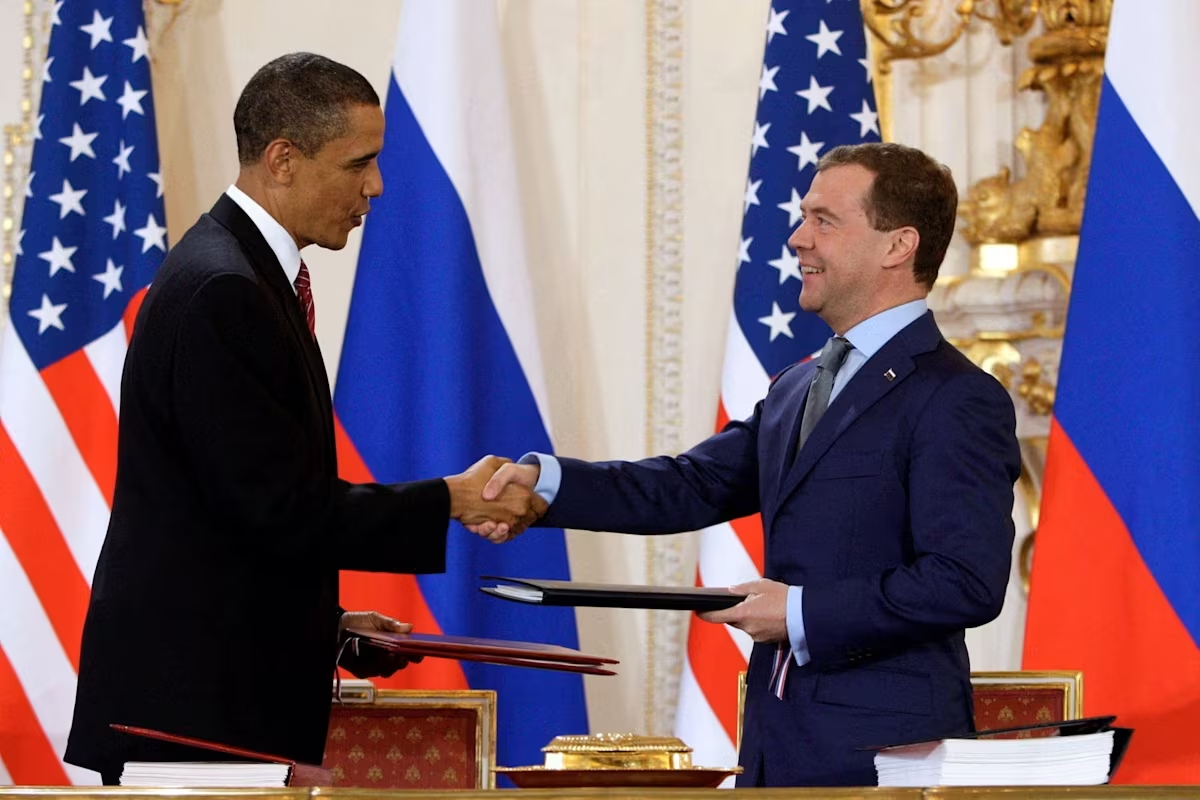
US President Barack Obama and Russian President Dmitry Medvedev sign a landmark treaty providing for significant reductions in nuclear weapons. Prague, 2010.
Dmitry Medvedev, a former Russian president who took part in negotiations with the Barack Obama administration on the New START treaty, said in late January that tensions over Ukraine and fundamental disagreements with Washington on arms control made a new agreement unlikely.
“It is obvious that there have been insufficient positive signals from the United States,” he said. “It is better to have no [new agreement] at all than to conclude a document that merely masks mutual distrust and fuels arms races in other countries.”
Even while complying with the treaty’s terms, Russia continued serial production of new nuclear weapons and warheads, while the United States focused on modernizing its existing stockpiles.
New START—key dates
December 2009
The 1991 Strategic Arms Reduction Treaty expires
April 2010
The United States and Russia sign the New START treaty
February 2011
The treaty enters into force
February 2018
The United States and Russia complete the reductions предусмотренные treaty
February 2021
The two countries agree to extend the treaty for five years
February 2023
Russia announces the suspension of its participation in the treaty
February 2026
New START expires at midnight on February 4
Vasily Kashin, a professor at the Higher School of Economics in Moscow, noted that the Kremlin has little interest in expanding its arsenal as long as strategic parity with the United States is maintained.
“We are satisfied with the current state of affairs, and our security is already assured. Why launch an arms race and spend additional resources on it? There is no need for this, because we already have an advantage,” Kashin said.
New START also provided for an extensive system of verification and notifications designed to reduce the risk of misunderstandings that could rapidly escalate into a nuclear crisis.
“The real value of arms control treaties reveals itself in their implementation—in inspections, data exchanges, and notifications, which numbered in the thousands,” said Samuel Charap, a senior political scientist at the RAND Corporation.
The inspection regime was suspended during the Covid-19 pandemic and later fully halted after Putin suspended Russia’s participation in the treaty in 2023. According to Pavel Podvig, Putin’s proposal to extend the limits for another year would mean little if Moscow does not agree to resume verification procedures.
“The value of New START lay not so much in the ceilings themselves as in the entire system of inspections, data exchanges, and notifications. If it were possible to agree on higher limits while preserving this transparency mechanism, that would be a reasonable compromise,” Podvig stressed. “It requires a fairly high level of cooperation, trust, and mutual respect. And that, in itself, matters for the system as a whole.”
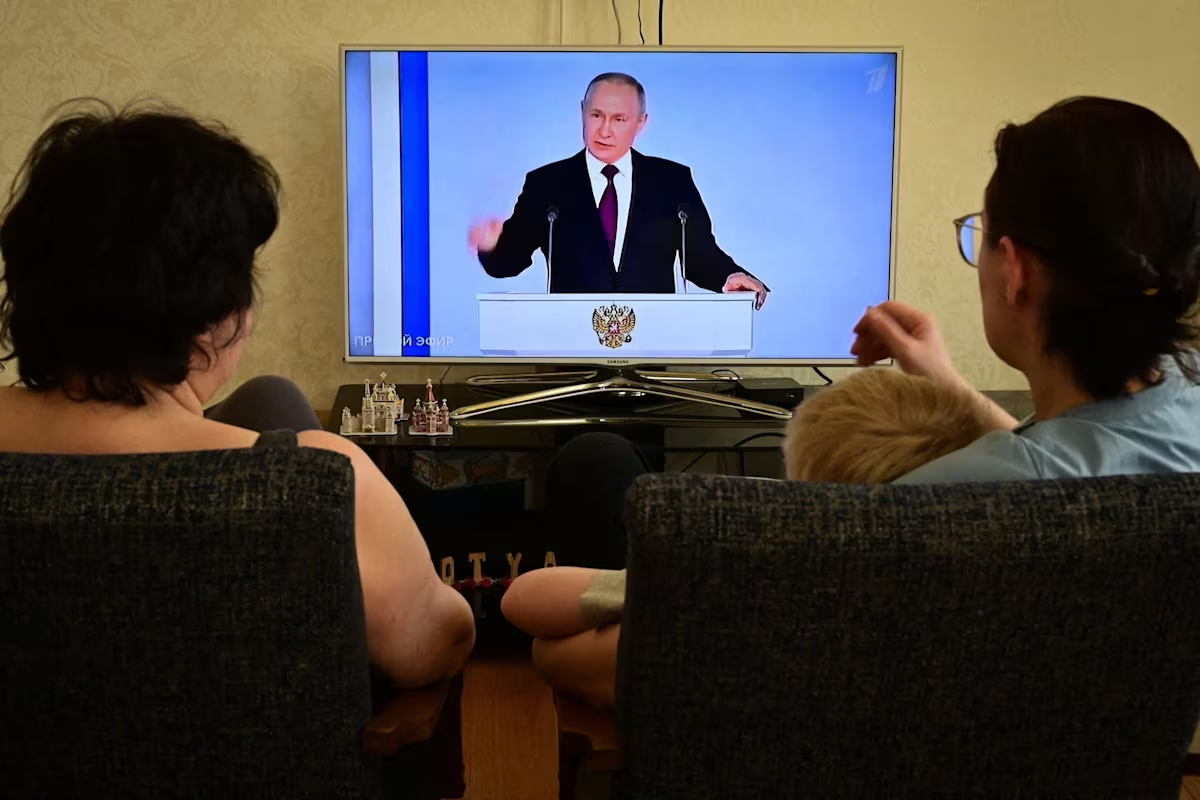
Russian President Vladimir Putin said that Russia and the United States could voluntarily continue to observe the existing limits after the treaty expires.
“The expiration of New START is not really about New START itself. It is about a broader pattern of distrust and a loss of interest in arms control more generally,” said Matt Korda, deputy director of the Nuclear Information Project at the Federation of American Scientists.
In parallel, Donald Trump is pushing a missile-defense project known as the “Golden Dome,” which Dmitry Medvedev has described as “highly provocative.” According to him, the initiative “flatly contradicts the assertion of an inseparable link between strategic offensive and defensive weapons” enshrined in the preamble to the New START treaty.
China’s rapid expansion of its own nuclear capabilities has significantly complicated discussions on arms control. Donald Trump has repeatedly said that he would like to bring Beijing into a nuclear-arms agreement alongside Moscow.
The United States and Russia still account for 86% of the world’s stockpile of these devastating weapons, even as China’s arsenal has doubled in recent years.
“There is a fairly widespread belief in the United States that we need to build up in response to China,” James Acton noted. “Strategic Command has concluded that it needs the ability to target Russian and Chinese nuclear forces simultaneously,” he said, referring to the US combatant command responsible for the country’s nuclear arsenal.
For its part, Beijing is unlikely to contemplate arms control until it reaches parity with the United States.
“China’s nuclear weapons are Trump’s problem, not ours,” said Vasily Kashin. “Talk that the United States must be stronger than Russia and China combined is precisely what could set off a new arms race.”