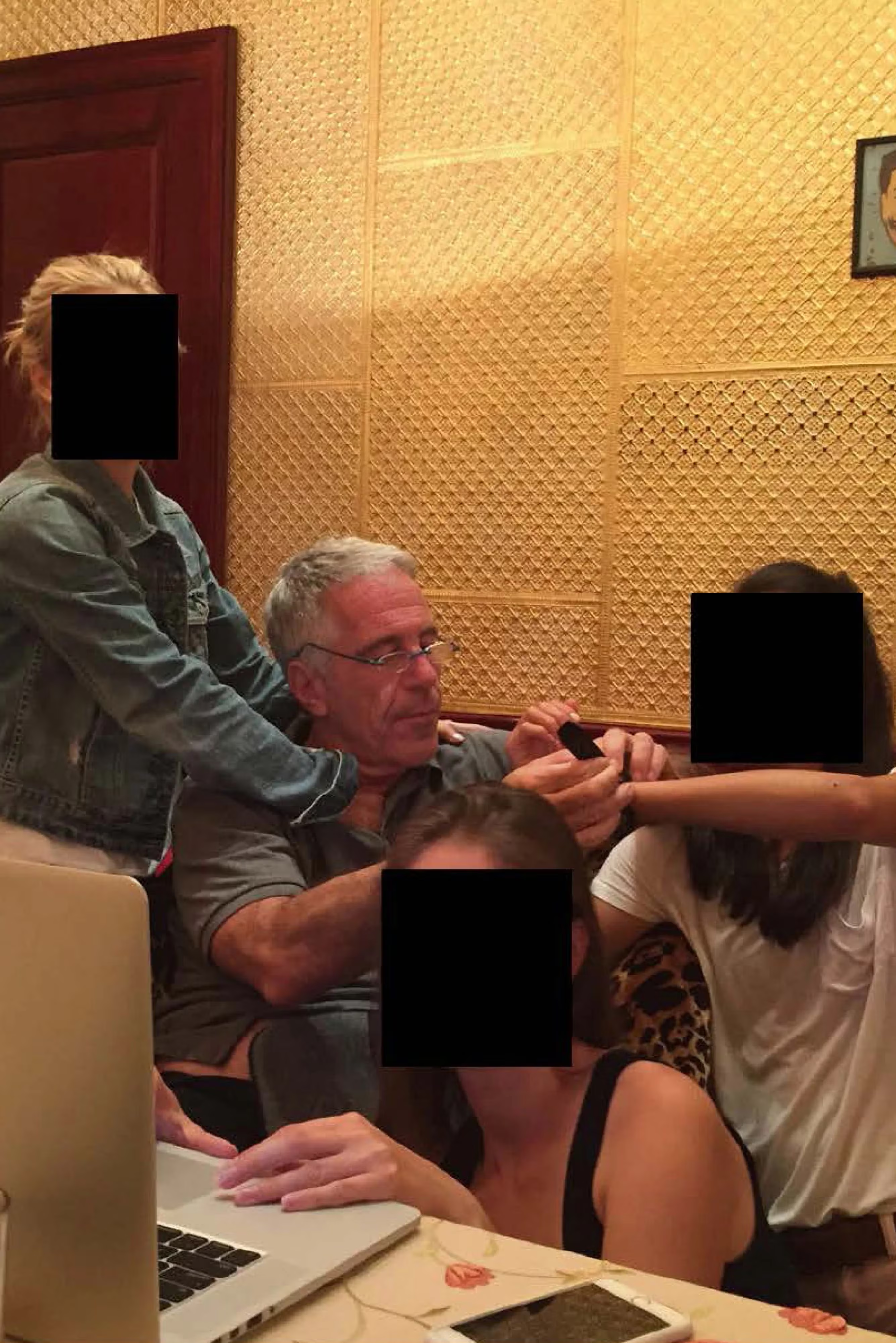
A week has passed since the U.S. Department of Justice published nearly three million pages from the archive of Jeffrey Epstein, a billionaire and convicted sex offender. In the so-called “Epstein files,” journalists found the names of numerous public figures, inevitably triggering reputational damage. Yet the greatest harm was not to them, but to the victims themselves: the personal data of dozens of survivors ended up posted in the open.
On January 30, the U.S. Department of Justice released roughly three million pages, 180,000 photographs, and 2,000 video recordings from Jeffrey Epstein’s personal archive—an affluent financier who, investigators say, built an extensive system for locating and recruiting young girls from different countries for himself and part of his influential circle.
The volume of published material is vast. A full review will take months—and possibly years—so investigations and revelations based on Epstein’s archive will likely continue to emerge for a long time. At the outset, journalists focused on the most obvious task: searching for the names of well-known people with whom Epstein maintained ties.
Among those named in the documents are the world’s richest man, Elon Musk; Norway’s crown princess, Mette-Marit; U.S. Commerce Secretary Howard Lutnick; Prince Andrew—the brother of the King of the United Kingdom—and other public figures. If you look at who has already faced tangible consequences from the archive’s release, the picture is as follows.
Peter Mandelson, one of Britain’s most influential politicians, has left the Labour Party and come under police scrutiny after documents surfaced containing letters suggesting that Epstein paid him money in exchange for confidential information. Mandelson had previously lost his post as the United Kingdom’s ambassador to the United States because of his ties to Epstein. Prime Minister Keir Starmer publicly apologised for having recommended Mandelson for the diplomatic role in 2025, despite facts already known at the time. Starmer said Mandelson lied during the appointment process about how close he had been to Epstein.
Miroslav Lajcak, a former Slovak foreign minister and diplomat, stepped down as national-security adviser to Slovakia’s leader after the release of a 2018 correspondence with Epstein in which women were discussed. Lajcak described the messages as “a display of stupid male ego”. Norway’s former prime minister Thorbjorn Jagland became the subject of an anti-corruption investigation after the archive yielded indications that Epstein had paid for his holidays and for trips taken by members of his family. The correspondence also suggested that the financier sought to use Jagland to establish contacts with Vladimir Putin and his circle.
Norway’s Crown Princess Mette-Marit has twice issued public apologies for a friendly correspondence with Epstein, calling the relationship “a real disgrace” and separately asking forgiveness “for the situation I put the royal family in, especially the king and the queen”. Prince Andrew left the Royal Lodge residence in Windsor soon after previously unknown letters and photographs involving him were found in the archive. His move to Sandringham—the King’s private estate—had been known since the autumn, when Andrew was stripped of his titles; but the release of the archive appears to have accelerated the process.
Brad Karp stepped down as chairman of the board at Paul Weiss, one of America’s largest law firms, after his years-long contacts with Epstein became public. In 2016, among other things, he asked the financier to help secure a role for his son in a film being prepared by director Woody Allen.
Epstein interacted with dozens of prominent people, yet so far the tangible consequences of releasing his archive have reached only a few. For his victims, the situation has been fundamentally different—the fallout has touched dozens of women and, in many cases, has been far more devastating.
Donald Trump signed the law mandating the release of the “Epstein files” on November 19, 2025. The document gave the Justice Department 30 days to make the materials public, but the agency missed the deadline, citing the need to review and redact the files to protect victims’ personal data. Despite the nearly six-week delay, the published documents still contained the names and photographs of many women who had been victimised by Epstein.
The Wall Street Journal reported that it found the names of at least 43 victims in the archive, roughly half of whom entered Epstein’s orbit as minors. Lawyers later уточнили, that almost 100 victims were affected by the disclosure of personal data. In some cases the leaks went beyond names—the documents still contained home addresses, phone numbers, and банковские реквизиты. This information has already begun circulating on social media, above all on X, and has been used to track down and intimidate women.
The New York Times and the AP news agency also found десятки photographs of young women in the archive, in which their faces and nude bodies were clearly visible.
Against that backdrop, it looked especially absurd that in other documents the Justice Department had redacted far less sensitive information. In an exchange between Epstein and Steve Bannon, a former Trump adviser, a photograph of Donald Trump was published with his face covered by a black square—later it was removed. In a note from an employee of a Paris modelling agency, who told Epstein about a “new Brazilian—sexy and sweet, 19 years old”, the sender’s name was censored. The department similarly withheld the name of the author of a message thanking the financier for the evening, adding: “Your little one was slightly naughty.”
“At first I thought it was negligence, then incompetence, and now I think it was done deliberately,” said one of Epstein’s victims, Danielle Bensky, a former ballerina, commenting on the Justice Department’s actions.
“Most of the information disclosed [about me] came from notes taken by FBI agents while preparing for testimony. I co-operated with the U.S. government when it asked me for help, and now it has let me and other victims down, showing a profound disregard for the safety, protection, and welfare of victims of crimes like these,” said Anoushka de Georgiou, another Epstein victim who testified at the trial of his girlfriend and accomplice, Ghislaine Maxwell.
Initially, the Justice Department sought to play down the scale of the problem, claiming that redaction errors affected only 0.01% of the documents released and that each one would be corrected once a victim or her lawyer provided notice. But attorneys Brad Edwards and Brittany Henderson said that in early December they had already submitted a list of 350 names that were supposed to be mandatorily withheld before publication. No such steps were taken, and now, the lawyers argue, the Justice Department is effectively shifting responsibility onto the victims themselves—expecting them to sift through millions of files, find every mention of their own names, and submit removal requests with precise links.
The lawyers went to court seeking a temporary shutdown of the government website hosting the archive until the documents could be properly redacted. The judge refused, citing the Justice Department’s assurances that the mistakes would be fixed quickly. “Yes, errors were made, but we are dealing with such a volume of documents that if you stacked them, they would be as tall as two Eiffel Towers,” said Deputy Attorney General Todd Blanche. “Whenever a victim or her lawyer contacted us, we responded immediately, reviewed the issue, and took the [documents] down.”
Edwards and Henderson agreed to give the department additional time, but a few days later said that the data of some victims still remained publicly accessible. Commenting on the situation on February 4, Henderson stressed that Epstein victims’ personal information had been in the public domain for five days; in that time it had been “downloaded, copied, and saved, making the damage irreversible”. In her words, “every additional hour these records remain on the internet increases the threat to women who never sought publicity and had a legal right to protection”.
“It creates the sense that if you come forward, you will not be protected. I’m sure there are people who have survived sexual violence who see this and think: ‘Fine, the [documents] are being published, but nothing happens. What will happen to me if I report a crime?’”, Kim Villanueva told the BBC. Villanueva heads the U.S. advocacy group National Organization for Women, which lobbied Congress for the release of the Epstein files.